

Vacuum handling
A test course for suction pads
Energy-efficient vacuum handling. The Institute of Machine Tools and Production Engineering at TU Braunschweig develops gripping technology and process strategies for increased energy efficiency in vacuum handling.
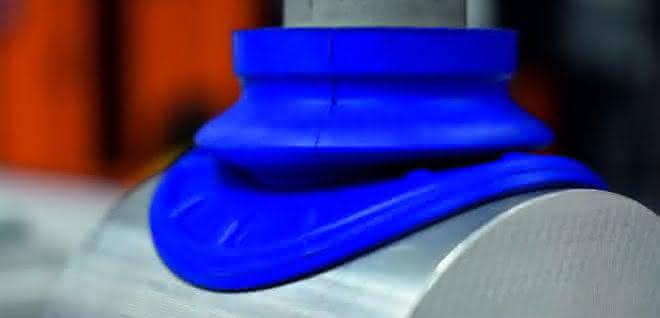
Vacuum handling is used extensively for automated parts handling in manufacturing and production systems, particularly in the automotive sector and for packaging tasks. Experience shows that around 20 percent of industrially generated compressed air - which is proven to be responsible for at least ten percent of total industrial electrical energy consumption in the European Union - is used to generate vacuum for robot-assisted handling tasks in production. For large-scale industrial handling applications, compressed air-based vacuum generation is typically realized by ejectors due to their fast and wear-free operation and direct integration into gripping systems. In view of the typical efficiency of air compression and pneumatic vacuum generation, only a fraction of the electrical energy originally invested can ultimately be used for the vacuum-based handling process, meaning that even a small amount of energy saved on the process side can lead to a significant reduction in the amount of electrical energy required. The aim of the IWF in the BMWi-funded BiVaS research project is to achieve a significant increase in the energy efficiency of vacuum handling processes by means of intelligent operating strategies.
The ability of industrial suction pads to adapt to complex surfaces and to provide both the sealing required to generate the suction force and the force transmission due to external loads has hardly been investigated to date. The lack of detailed knowledge about the mechanical processes involved in the evacuation of suction pads and external loads is usually taken into account with safety factors that are used in system and process design. However, the use of safety factors greatly oversizes both the vacuum generation system and the gripper system.
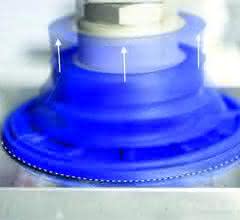
Comparability through automated test procedure
In order to eliminate the need for oversizing, an automated test procedure was developed at the IWF that makes the performance of any suction pads visible using defined test objects and load cases. The test objects differ not only in their geometry - convex and concave primitive geometries such as cylinders, pyramids or rounded edges were parameterized and manufactured in different forms. The material and surface roughness are also varied in order to maximize the information content of the test trials. In this "gripper course", a fully automated robot-supported process, the test cycles are triggered centrally by a programmable logic controller (PLC). A 6D force-torque load cell records the relevant loads on the suction cup and, in addition to these measured values, also stores the applied pressure difference as well as the compressed air and vacuum volume flow. Thanks to full automation, a large number of different suction cups and load cases can be tested with the necessary statistical validation in a short time and with little manual effort. Long-term tests are also planned for future investigations in order to determine whether newly manufactured suction pads are subject to initial conditioning and from which number of cycles reproducible behavior can no longer be determined.
Using the results for process planning
With knowledge of the capabilities and limitations of the characterized suction pads, new design methods can be developed for gripping system and process planning. This begins with the positioning of the individual suction pads on the workpiece to be handled. Whereas previously the requirements were adequate mass distribution and gripping surfaces that were as flat as possible, it is now possible to prove, based on reliable test results, that a curved surface may offer a more advantageous force transmission for the specific application than a flat surface. Taking this idea even further, these findings can also be transferred to component design in the sense of Design for Handling (DfH) and specific elements can be incorporated into the component to enable more efficient handling. The trajectory planning for the robot movement can also be expanded with new boundary conditions using the findings from the gripper course. For example, the process planner can significantly reduce conservative safety factors by optimizing the trajectory according to the maximum permissible loads for the application-specific combinations of suction gripper and component surface geometry.
F.Gabriel/as

Briefly explained: The MHI e.V.
The Wissenschaftliche Gesellschaft für Montage, Handhabung und Industrierobotik e.V. (MHI e.V.) is a network of renowned university professors - institute directors and chair holders - from German-speaking countries. The members conduct both fundamental and application-oriented research on a wide range of current topics in the fields of assembly, handling and industrial robotics. Further information on the society, its members and activities: www.wgmhi.de.

Briefly explained: The IWF
The Institute for Machine Tools and Production Engineering (IWF) at the Technische Universität Braunschweig is jointly headed by Prof. Dr.-Ing. Klaus Dröder and Prof. Dr.-Ing. Klaus Dröder focuses on technological and automation-related issues along current and future manufacturing process chains. The focus is on the implementation of future manufacturing strategies that enable the flexible production of functionalized products in terms of quantities and variants with maximum efficiency. The research areas range from assembly and production automation to the machining and processing of metallic materials, wood and composite materials and new production technologies for the integrated production of material-hybrid functional structures. Novel tool concepts and technologies are also considered.


You might also be interested in
ebm-papst is growing again thanks to AI and data centers
ebm-papst returned to a growth trajectory in fiscal year 2025/26. Air Technology, data center applications, and artificial intelligence are driving revenue and investment.
 read more...
SPE on the Verge of a Market Breakthrough
Single Pair Ethernet (SPE) has moved beyond the conceptual phase and is increasingly being implemented in industrial settings. The focus here is not only on higher data rates and simplified cabling, but above all on the issue of system integration...
read more...More than 900 exhibitors already registered
Around six months before the start of the trade fair, more than 900 companies have registered for SPS 2026 in Nuremberg. The trade fair focuses on industrial AI, cyber security and digital transformation.
read more...Virtual PLCs in practice: How vPLCs make production systems more flexible and scalable
The increasing networking of IT and OT is fundamentally changing industrial automation. The IT/OT Integration Summit shows how modern technologies can make production environments more efficient, flexible and future-proof. The event will focus on...
read more...Sales growth in a turbulent market environment
Thanks to innovations and a focus on strategic industrial markets, Sick was able to moderately increase its sales in the 2025 financial year. In a turbulent market environment, the company was able to maintain its position and gain market share with...
read more...Siemens presents new AI agent
Siemens is launching 'Eigen Engineering Agent', an AI for automation technology. The solution is integrated into the TIA Portal, has been tested with over 100 companies and is designed to significantly accelerate engineering processes.
read more...Schaeffler keeps sales almost stable
Schaeffler generated revenue of EUR 23.5 billion in 2025 and increased EBIT before special items to EUR 936 million. At 266 million euros, free cash flow was significantly above the prior year and forecast. Net income remained negative due to high...
read more...Advancing artificial intelligence together
Helukabel is stepping up its activities in the field of artificial intelligence and is now a member of the IPAI. The innovation and collaboration platform for companies, research facilities, institutions and administration has set itself the goal of...
read more...New impetus for ifm sales
Two new positions were filled at ifm at the start of 2026: Markus Wolf becomes Managing Director Sales Germany, Sven Quant takes over the position of Central Managing Director in the Process Sensors division within the ifm Group.
read more...