
Gripkit technology
Smart handling solution for the robot
With the Gripkit technology, Weiss Robotics offers a universal platform with which smart gripper modules can be seamlessly integrated into robot applications.
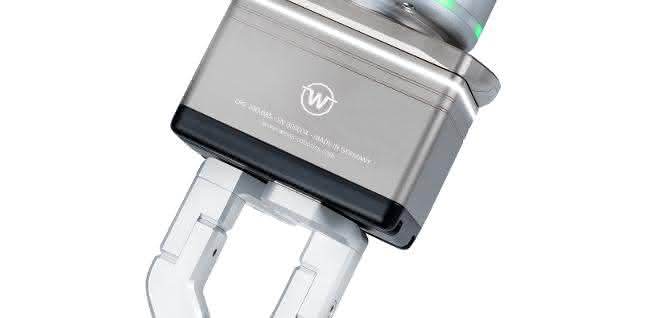
Users can implement pick-and-place applications in no time at all with the Gripkit technology from Weiss Robotics. It is a ready-made plug-in solution for industrial robots and cobots from leading manufacturers that relieves the user of the otherwise complex integration of the gripper module into the robot controller, thus saving time and money.
In addition to the smart gripper module, the user is provided with all components for system-side integration. The highlight is the Gripkit plug-in, which is specially tailored to the robot controller and guarantees fast configuration and commissioning. Thanks to the mounting accessories and fastening material supplied, mechanical integration is also child's play.
Gripkit is available as a sensitive servo-electric, safe collaborative or powerful pneumatic version with both parallel and centric gripping and covers a gripping range of ten 500 Newton with its available sizes. The collaborative Gripkit CR, based on the CRG gripping modules, was specially developed for human-robot interaction and is available in two sizes. With a 30 Newton and 50 millimeter stroke and a 200 Newton and 85 millimeter stroke, it is a real all-rounder for collaborative applications. The functionality and design of the gripping modules are geared towards safety. For example, the CRG series is the first gripper on the market to feature the patented Permagrip technology from Weiss Robotics. This is a clever mechanism for maintaining gripping force that does not snap shut when workpieces are removed manually and can therefore be used safely in direct interaction with humans. Another plus point is the safe gripping force control, which achieves category 3, PLd. This means that the grippers meet all normative requirements for use in fully collaborative operation. The rounded edges of the gripping modules and the integrated glare-free illuminated ring not only minimize the risk of injury, but also make collaboration with the user considerably easier. The illuminated ring provides the worker with a clearly visible indication of the current status of the system so that he can better assess the system. As a result, cooperation between humans and robots is particularly smooth and risk-free.
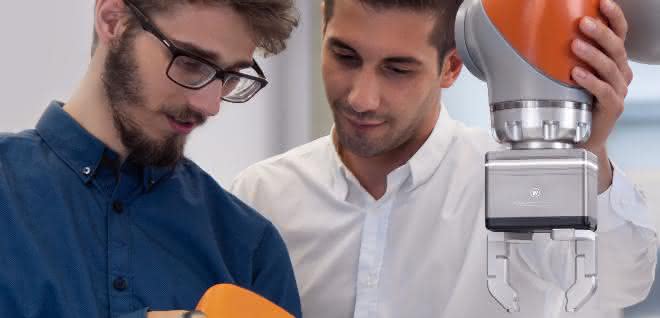
The Gripkit CR can be used in numerous areas: in addition to purely collaborative applications and the reliable handling of components in Industry 4.0 processes with many variants, the smart gripper can also be found in smart factory applications.
For easy handling of different objects, all Gripkit series support freely parameterizable grippers, which can be flexibly parameterized directly on the robot controller and easily implemented without time-consuming and cost-intensive retooling. Batch handling with several grippers is also no problem with Gripkit: several different gripper modules can be integrated per robot arm. Combinations of different gripper modules are also possible.
The Gripkit technology from Weiss Robotics is available in two different versions, the Gripkit IO and the Gripkit ProO. The IO version is suitable as a flexible basic solution for almost all available robots and cobots. The gripping module is configured separately via a PC or laptop. The robot controller is only responsible for opening and closing the gripping module and querying whether a gripped part has been gripped correctly. The Pro version enables configuration from the robot panel, so that no additional device is required for setup. The innovative teach mode enables new gripped parts to be taught in at the touch of a button without having to know the exact dimensions beforehand. This means that the pick-and-place application can be set up in just a few minutes.
Gripkit Pro also significantly extends the functional scope of the user gripping solution. Data on the gripping process and device status can be retrieved directly from the gripping module and used in the robot program. Process data such as the current gripping position is also available and can be used directly for quality assurance, for example. In addition, maintenance and diagnostic information can be retrieved from the gripping module, helping to identify problems more quickly and avoid unnecessary system downtimes. The ability to change parameters during operation means that your robot system remains as flexible as possible.
Both versions are equipped with the integrated gripping part detection and monitoring known from Weiss Robotics. This ensures reliable handling throughout the entire process, even in demanding applications. pb


You might also be interested in
Hamburg Regional Court issues preliminary injunction against Elite Robots Germany
In the copyright dispute between Teradyne Robotics and Elite Robots Germany, the Hamburg Regional Court has issued an interim injunction. The distribution of the software and products concerned is prohibited, and there is also a comprehensive...
 read more...
Schunk founds tech spin-off for humanoid robot hands
Schunk is bundling its activities in humanoid robotics by founding its own spin-off at the beginning of January. The aim of the new company is to develop modular humanoid robot hands for industrial applications.
read more...Partnership for humanoid robotics
Schaeffler and Neura Robotics jointly develop humanoids
Schaeffler and Neura Robotics will work together in the future to develop and supply key components for humanoid robots. The systems will also be integrated into Schaeffler's global production network.
read more...Yaskawa at the Automatica 2025
AI meets robotics
At this year's Automatica, everything at Yaskawa revolves around AI-based robotics solutions for the smart factory and beyond. As a trade fair highlight, the manufacturer is presenting its new Motoman Next product concept.
read more...Kassow Robots at the Automatica
7-axle vehicle in action
At Automatica, Kassow Robots will be presenting a wide range of industrial applications for production and logistics tasks that provide new impetus for efficiency and flexibility in industrial automation.
read more...Robotics and automation in six exhibition halls
From June 24 to 27, 2025, Automatica, the trade fair for intelligent automation and robotics, will bring industry and research together in six exhibition halls. Preparations are in full swing.
read more...Interview with Jörg Rommelfanger
Robotics in 25 years
The annual IFR report shows that the number of industrial robots is steadily increasing worldwide. They have already played an important role in ABB's portfolio for decades. In an interview with INDUSTRIAL Production, Jörg Rommelfanger, Head of...
read more...Reliable end effector for cobots
Collaborative robots are now widely used for a wide range of handling tasks. SMC offers three versions of the RMH pneumatic gripper for this purpose; it is compatible with cobots from a total of twelve companies.
read more...7-axis cobots with controller in robot base
With the Edge Edition, Kassow Robots has launched the world's first 7-axis cobots with a controller integrated into the robot base.
read more...