
Automatic drum aeration unit
Semi-automated drum change minimizes the risk of accidents
Tünkers-Nickel has efficiently semi-automated the drum change. The lifting and moving of the follower plate is fully automatic with an electrically controlled lifting drive and an automatic drum ventilation unit, eliminating the need for operator intervention during the lifting process.
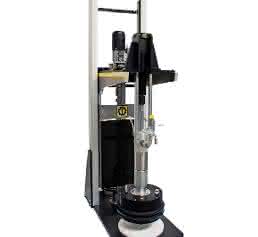
Surprisingly, in the many highly automated dosing systems used in large-scale production, one process is still largely manual: the drum change process. This is particularly critical, as there is still a clear risk to the operator during the process, even when all procedural regulations are observed.
Even for trained specialists, changing drums is often a critical process. This is because with an empty material drum, the follower plate, which has a diameter of up to 550 millimeters, is located directly at the bottom of the drum and is under negative pressure. The manual release of this negative pressure by supplying compressed air is often abrupt. Even during the entire subsequent lifting process, abrupt movements are always possible under unfavorable conditions.
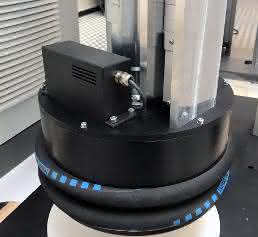
This risk of accidents and the considerable amount of time involved were ultimately decisive factors in Tünkers-Nickel Dosiersysteme now efficiently semi-automating this drum change.
In contrast to conventional drum systems, the lifting and moving of the follower plate is no longer carried out with compressed air cylinders, but fully automatically with an electrically controlled lifting drive and an automatic drum ventilation unit. This means that, as a rule, operator intervention is no longer necessary during the lifting process. This means that the subsequent plate can be lifted more reliably and with less risk for the operator. Another advantage is that the time required for changing the drum can be significantly reduced. The operator only has to remove the free-standing drum and replace it with a new one. as


You might also be interested in
Cooling and temperature control units
Hygienic packaging sells safely
In few industries are the requirements for hygiene in the production process as strict as in the food sector - the health of consumers has top priority. This results in enormous challenges for all machines and components involved, especially in...
 read more...
Simple tool change in seconds
With the CMS, Schunk is launching a user-friendly, manual change system for quick component replacement. In addition to its simple and convenient operation, the CMS also stands out with its extensive range of optional modules and complementary end...
read more...Customized machining solutions
Custom-fit solutions for hydraulic valve housings from Mapal
The production of valve housings is the supreme discipline in the world of fluid technology. As a technology partner, Mapal provides support and designs the optimum machining strategy in dialog with the customer.
read more...LEF and LEY series with additional size
Solutions often need to be developed for tight spaces or compact machine designs. To meet such requirements even better, SMC has now added size 16 to its LEY series electric cylinders and LEF series electric spindle drives.
read more...The same locking system around the globe
Orca Industriemontagen builds machines and systems worldwide and now only needs a single locking system to effectively protect all construction sites. The eCliq electronic locking system from Assa Abloy secures the containers during transportation...
read more...Plug-and-produce with smart subsystem
The mechanical engineering company KMS Automation standardizes pressing and joining applications with the Smart Function Kit from Bosch Rexroth. The mechatronic subsystem simplifies machine design, increases process quality and shortens...
read more...Designing transport systems for high flexibility
Factories need flexibility to further increase productivity and introduce new products. Manufacturers must continuously adapt in order to increase productivity and production output.
read more...Twelve new variants for professional users
Kärcher is revamping its range of super-class cold water high-pressure cleaners with twelve new products. With the HD 9/20-4 S, HD 10/21-4 S, HD 10/25-4 S and HD 13/18-4 S, there are four different product classes, each available in three different...
read more...Norelem supports VDI Racing Camp
Mastering the challenges of e-mobility
Promoting young talent has been a priority at Norelem for many years: the company supports young talents with components and the necessary know-how and provides schools with illustrative material.
read more...