
Gripping systems
Grippers for sensitive components
When handling sensitive components, conventional handling systems quickly reach their limits, as even minimal force is enough to damage highly sensitive materials or contaminate them with residue. These components can be gripped gently and residue-free with the aid of adhesion forces.
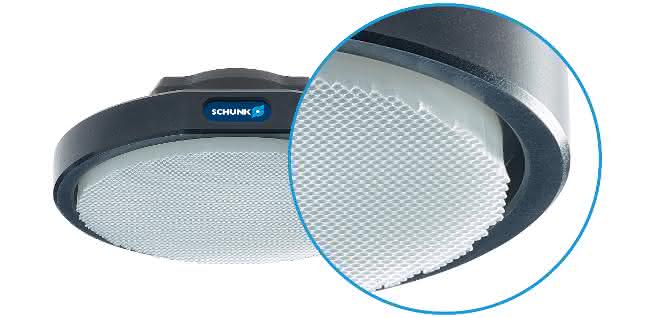
Nature has shown us how it's done and doesn't need glue or suction power: geckos can use adhesion to race over vertical and smooth surfaces and even hold their entire body weight with just one foot. Their secret: millions of tiny hairs on their feet bind to the molecules of the polished surface as they run. Van der Waals forces, weak electrodynamic interactions, ensure that the geckos adhere to pretty much any surface.
Schunk utilizes this functional principle from nature for its new gripper technology Adheso. Plastic pads made of special polymers imitate the fine hair structure of geckos on the adhesive grippers. When gripping, the hairs of the pad press against the surface of the workpiece. This increases the contact surface and the Van der Waals forces take effect. The workpiece can thus be gripped and held without the application of external energy. This offers two decisive advantages for users: Firstly, the effort required for installation and commissioning is minimal, and secondly, operating the holding gripper saves energy costs, as neither compressed air nor vacuum or electricity are required. The adapter plates with integrated bayonet lock developed by Schunk also enable the pads to be changed quickly.
Another advantage of the technology is that components can be gripped very gently and completely residue-free thanks to the adhesion forces. As the new gripping technology works without the application of mechanical force, it handles sensitive workpieces such as delicate battery components, glass vials or plastic films very gently. In contrast to alternative gripping technologies, it leaves no marks on the workpiece. The gripper is also removed from the workpiece without leaving any residue. Philipp Matyssek from Adheso Product Sales at Schunk explains: "Compared to other adhesive grippers, with Adheso there is not just one way of removing the workpiece from the gripper, but four. Depending on how and where users want to place their workpiece, they can choose between a rotating, tilting or pushing movement, as well as pushing off." Alternatively, the machine can also be equipped with an active stripper.
Possible applications from fiber optics to car doors
The special surface architecture adheres to a wide variety of materials and objects and can therefore be used in many different ways. Feather-light glass fibers, the smallest SMD components or micromechanical parts can be handled just as easily as significantly heavier automotive or mechanical engineering components. This is because the pads are easily scalable and are always individually tailored to the desired application. "The only important thing is that the workpieces are as smooth as possible," explains Matyssek. "Because the rougher the surface structure, the lower the gripping force." Adheso is also well suited for one-sided accessibility, for example when separating paper or other flexible workpieces from a magazine. The technology also delivers good results in micro-handling with reproducible positioning accuracies of <0.01 mm.
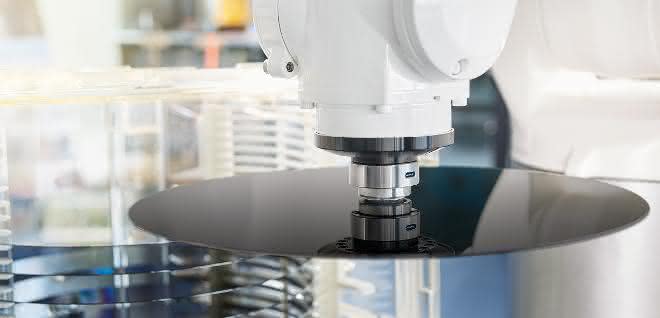
The gripping technology is particularly suitable in clean environments such as in a vacuum or in clean rooms, as dust and dirt affect the gripping force over a longer period of time. However, the full gripping force can be restored using simple cleaning methods, so that dirtier environments only have an impact on the maintenance interval. The grippers can therefore also be used in conventional industrial environments. As they have no moving parts, no particle emissions are generated during gripping. Adheso is particularly suitable for laboratory automation, the medical and pharmaceutical industries and the electrical industry, as the grippers also have to work cleanly in these hygienically sensitive environments. Containers, syringes or other medical objects made of plastic and glass are also difficult to handle with other technologies due to their often very smooth surfaces. "In the electronics industry, residue-free gripping is particularly crucial for wafers," says Matyssek. "This is because they have to be absolutely clean in order to be able to apply structures in the order of micro- or even nanometers to the silicon." When handling circuit boards, gripping with intermolecular forces offers the advantage that a single adhesive gripper can handle a very wide range of different circuit boards. The technology is also suitable for gripping air-permeable surfaces, such as perforated electronic circuit boards, where conventional gripper technologies reach their limits.
Individually adapted to the application
Each standard gripper with Adheso gripper technology is individually configured and adapted to the customer's requirements. Thanks to different material characteristics and individual size adjustment, the adhesive structure can be variably tailored to the workpiece and its surface. Various influencing factors play a role in the design of the adhesive gripper: weight, material and surface of the workpiece, but also the ambient conditions and the gripping process itself. Schunk application specialists therefore support users with the configuration and offer the opportunity to test the gripping process at Schunk in the CoLab, the new application center. This gives users the certainty that the gripping process will work for their workpieces. "The size of the pad is very easily scalable to customer specifications, from a few hundred micrometers to several meters, and can be brought into any geometric shape that it should grip. This means that Adheso technology can be used for almost any component," says Matyssek.


You might also be interested in
Predictive maintenance in retrofit
Predictive maintenance pays off. This is because early detection of impending failures means that systems can be serviced in a targeted manner before production downtime occurs. But how complex is it to integrate such a maintenance concept into an...
 read more...
Maintenance instead of replacement
The circular economy starts with the machinery
Sustainability in industry starts with machines, says our guest author from Deguma: How maintenance, modernization and the 5R strategy save resources, energy and CO₂.
read more...3D printing for unplanned requirements
The material fails and the machine suddenly stops? Then you need to take the right measures to be able to resume production quickly. Material failure in the form of faulty components or material wear in the frame are a risk for any production.
read more...High demands in terms of safety, application and robustness
Demanding work in the electrical trade and energy supply as well as smooth processes in production require innovative and customized measurement technology that scores points for safety, ease of use and resilience.
read more...Car meets e-bike: riding with lubrication-free polymer bearings
Studies show that the proportion of pedestrian and bicycle traffic is increasing in urban areas. With the JetBike, JetBike GmbH from Braunschweig presents a mixture of e-bike and car and relies on lubrication-free polymer bearings from Igus.
read more...Hydraulic hub for more efficient servicing
Bosch Rexroth presents a digital toolbox for service and maintenance. With a comprehensive range of digital services, the Hydraulic Hub simplifies and accelerates the service and maintenance of hydraulic products and increases machine availability.
read more...Arnold Umformtechnik expands after-sales...
Faster help with VR glasses
Arnold Umformtechnik is expanding the after-sales service for its machines to include digital remote services. The focus is on data security, simple operation and clear processes.
read more...147,000 euros per hour: high costs for German companies due to unplanned downtime
According to the "Value of Reliability" study, 67% of industrial companies in Germany experience unplanned downtime at least once a month. This costs the German economy 147,000 euros per hour. Nevertheless, reactive maintenance concepts are not...
read more...Maintenance starts with a maintenance planner
Legal requirements stipulate that machines and systems must be serviced regularly. The maintenance work serves to ensure occupational safety and economic efficiency.
read more...