
Nest and tub handling
Secure grip in the cleanroom
Machine manufacturer Bausch+Ströbel has developed a production system in which the filling and closing of ampoules, syringes and vials is automated. The gripper solution for this robot-based handling in the automated aseptic filling process for pharmaceuticals comes from the Zimmer Group.
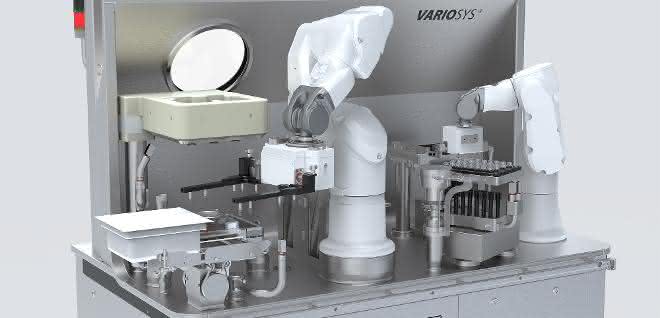
The trend towards individualization and personalization can also be observed in the pharmaceutical industry. The industry is looking for alternatives to mass-produced products and filling and packaging solutions are also becoming faster and more flexible. Small batches, quick product changes and individualized solutions: More automation, less user intervention and higher availability are required. And, of course, the technology of the future should be able to adapt independently to changing requirements.
In view of increasingly limited space in production, high labour costs, a shortage of skilled personnel and, above all, the safety of the operators and the entire process, the machine manufacturer Bausch+Ströbel has picked up on the trend towards more automation and individualization with the flexible VarioSys production system: This modular and aseptic production system fully automates the filling and closing of ampoules, syringes and vials, flexibly and for small filling quantities. VarioSys combines a standardized clean room isolator with an interchangeable machine module.
Filling and packaging processes are the specialty of Bausch+Ströbel Maschinenfabrik Ilshofen (B+S). Liquid and powdered pharmaceuticals, syringes, vials, cartridges and ampoules are processed worldwide on B+S systems - from object cleaning and sterilization to labelling and syringe assembly. In addition to the development, design and construction of systems specially tailored to customer requirements, Bausch+Ströbel offers a wide range of services.
A new machine module (DDM 9105) with new functionalities was recently added to the B+S VarioSys system. It now allows fully automatic opening of tubs and enables RTU ("ready to use") vials in the nest (packaging unit) to be opened, denested, filled and stored fully automatically. The cover film of the tubs is removed using a thermal process, for which they are transported into the corresponding positions by a cleanroom robot or gripper. After opening, a second gripper removes the RTU vials from the nest and transfers them to the next module for further processing in bulk. If the RTU objects are processed further in the nest, the tub is placed on a conveyor belt for transfer after opening.
Zimmer gripper for nest handling
For the nest and tub handling of this special application, B+S decided to work with the Zimmer Group. In addition to the interaction with the robot, a major challenge for the gripper specialist from Rheinau in Baden was that the grippers are used in a clean room system. This ruled out the use of pneumatic grippers from the outset - simply for reasons of space due to the cables and exhaust air. A purely mechatronic gripper solution was therefore chosen relatively quickly.
Due to the aforementioned cleanroom issues, the grippers had to pay particular attention to the specifications for technical cleanliness, as they can come into direct contact with syringes and vials or with the nest. Commercially available grippers are not immune to particle transfer and unwelcome particle entrainment. Contact abrasion on the gripper itself can also generate annoying foreign bodies. They therefore pose a particular challenge for designers of cleanliness-sensitive systems. One of the first design measures taken by B+S was therefore to choose easily removable and sealed enclosures or sheaths with a closed surface for the grippers to prevent particles from entering the process.
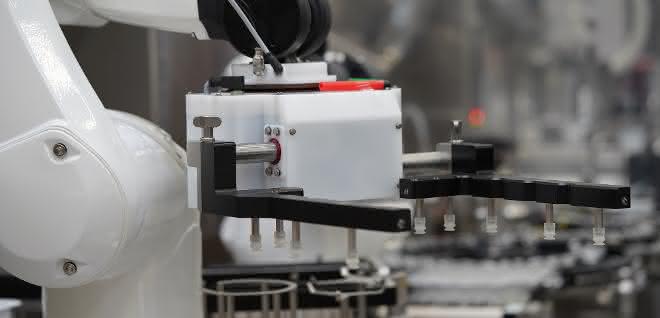
The flexibility of the grippers was also of crucial importance to B+S, as the system itself is also very adaptable and modular and the packaging sizes can vary at any time. The GEH6180IL and GEH6040IL were therefore selected from the Zimmer Group's portfolio as the two most suitable grippers for the respective task: In addition to a large stroke, both electric grippers have a servo drive with integrated controller. The brushless drive technology guarantees individual force adjustment as well as position and speed control. The safety of the system should also not be a negligible aspect, as fragile glass and plastic are usually handled. The grippers also have a mechanical self-locking mechanism that prevents a vial from falling even in the event of a power failure.
The fact that the Zimmer Group was also able to respond to necessary modifications (a side connection using a built-in connector on the GEH6180IL) was very convenient for B+S. The fact that the grippers only have a single cable outlet was also a great advantage given the very limited space available in the cleanroom. The equipment with IO-Link also made it easier to read out specific data, such as temperature measurement, position or the number of cycles.
High process reliability thanks to fully automatic handling
Until a few years ago, the opening and closing of tubs was handled manually. In the past, an operator was employed specifically for the cleanroom, who carried out the nest and tub handling using two gloved hands in the module. Today, this production step can be handled with the help of the two robots and their grippers with 100% in-process control (IPC) at full machine output (up to 60 tubs per hour). In addition to cost savings due to lower personnel costs, full automation has now made it possible to increase process reliability in particular. as


You might also be interested in
Helu makes its first trade fair appearance under a new brand name
Helu Kabel will be presenting itself as Helu for the first time at Hannover Messe 2026, showcasing system solutions, Heluchain cables and new industrial luminaires.
 read more...
Strategic realignment with brand relaunch
In future, Helukabel will trade as Helu
The Helukabel Group is parting with part of its name: in future, the company will only operate under the Helu brand. With this step, the specialist for electrical connection technology is underlining its strategic development from a classic cable...
read more...Modular plant construction for corrugated board
Insight into the production of corrugators at BHS Corrugated: Automated, modular and equipped with Helukabel components.
read more...Best quality for the steel
Conditions in the steel industry are harsh and inhospitable. The machines used must be able to withstand the demanding environmental conditions in order to deliver the best quality at all times.
read more...If the standard cable is not sufficient
Lapp offers cables for countless applications - but not for all of them. From time to time, the developers have to modify a standard cable or develop a special cable.
read more...Slight decline in sales, strong investments
The Lapp Group has not been spared from the weakening global economy. However, the company only recorded a slight loss in the past 2024 financial year.
read more...Electrical connection technology
Cables and wires for industrial automation
Heukabel offers system solutions for cable routing from a single source. The subsidiary EKD Systems specializes in tailor-made cable drag chains made of steel, stainless steel and plastic, which are used in moving machines and systems as well as in...
read more...Lapp relies on Ultramid from BASF
Mobile charging of electric vehicles
The automotive industry is currently undergoing the biggest transformation in its history. The boom in battery electric vehicles in particular is presenting the industry with major challenges. Lapp, as a supplier of cables and connection...
read more...Cable handling application
At this year's Motek, ArtiMinds Robotics is showcasing a robot-based automation solution for the sensor-assisted assembly of flexible cables in connector housings.
read more...