
Rotary modules
A swivel over swivel units
Pneumatic swivel units convert the linear movement of the pistons into a rotational movement. The handling units rotate slightly more than 180 degrees to provide degrees of freedom for installation and assembly. Friedemann Wagner has further developed this rotary axis in various stages.
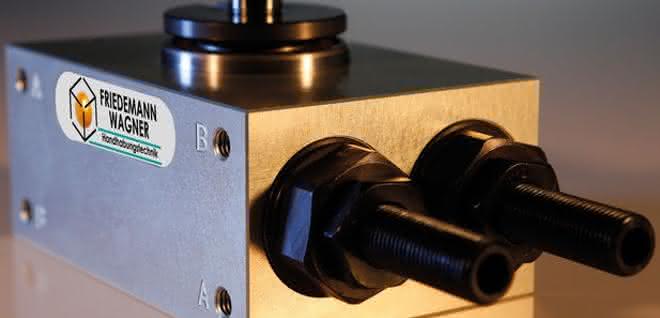
The She-N module is representative of a widely used, simple design principle: the angle of rotation is influenced by a stop directly on the rack (turning in/out). As with most manufacturers, the rotating output to the application is simply designed as a shaft. This design is low and cost-effective, but physics plays a role in a few places:
For a rotary movement, there must be play in the drive - so with this approach, the gearbox determines the repeat accuracy of the end position. As the stops act directly on the rack, the gearing is directly and constantly exposed to the impulse load. Both together influence each other in terms of technical data and durability.
With higher loads, there is a corresponding need for space for shock absorbers on the opposite side. Alternatively, the dampers can be found in the interior of rotary actuators. Alternatively, if the rotation limit is determined solely by the damper, the reproducibility of the end positions depends on a moving system and its properties (damper characteristics, effective stroke, ageing, temperature).
With internal stops, the final angular degrees before the end position are only approached with the force of a drive piston (in the direction of the stop screw). Despite a double-loaded unit, only around half of the nominal torque is available in the end position in systems with internal stops. Finally, due to the cost-effective positioning of the stop screws in the pressure chamber, adjusting or changing them is time-consuming - depressurization is required.
The result was a revised version of the She-A design with an external stop. The above disadvantages are compensated for by external stops, which the customer can reach from the outside for adjustment. With an external stop, the mechanical impulse load is shifted away from the gearbox and the repeat accuracy is improved. In addition, an external stop also provides the full torque in the end positions.
In the latest series of Wagner swivel units, the mounting of the stop screws is an integral part of the housing, which is milled from high-strength aluminum. Two pivoted stop blocks, together with the stop screws, provide a swivel range that can be fully adjusted from the outside with a ring-shaped stop. The fine thread of the stop screw and subsequent countering enable precise adjustment for high repeat accuracy. The external stop provides full torque in the end positions, relieves the drive and decouples the accuracy from the gearbox, which has a positive effect on service life and precision. Thanks to the patented stop system (the inductive initiator is located in the hollow stop screw), all stop masses now point in one direction.
The special sensor, especially its position directly at the end position, enables shock absorber failure to be detected and can protect against consequential damage and downtime. The usual "output shaft" is designed ex works as a stop surface. It is used for direct mounting of the superstructure using a grid dimension and centering system. At the same time, it provides space for air and signal feed-throughs and enables structure and simple installation. as


You might also be interested in
Housing and inserts for plenty of power
Lapp presented the expansion of its Epic Power series at SPS 2023: four new M23 circular connector inserts and three new M23 housings. The special feature: all housings can be combined with any of the four inserts.
 read more...
News and product updates from Smartgas
Portable gas analyzers for outdoor use
Smartgas is starting the second half of the year with a series of updates to existing products and a number of new products. Portable analyzers expand the range of applications, while new accessories such as protective housings and heating modules...
read more...Everything accurate in switch cabinet construction
To ensure smooth work processes, tools for processing enclosures and housings must function flawlessly and reliably. Häwa rounds off its punching range with the Multi-Press 500.
read more...Shafts and conversion parts
The Rodriguez range includes ball bushings including matching housings, shaft brackets, crossbars and supports.
read more...Cooling and temperature control units
Hygienic packaging sells safely
In few industries are the requirements for hygiene in the production process as strict as in the food sector - the health of consumers has top priority. This results in enormous challenges for all machines and components involved, especially in...
read more...Simple tool change in seconds
With the CMS, Schunk is launching a user-friendly, manual change system for quick component replacement. In addition to its simple and convenient operation, the CMS also stands out with its extensive range of optional modules and complementary end...
read more...Motion controller for small drives
Medium power range covered
Faulhaber has another housing-less and compact motion controller in its range, which is particularly suitable for integration in device construction and medical technology applications.
read more...Welding solutions in the name of resource efficiency
At the Welding & Cutting trade fair in Essen (September 11-15), Fronius will be focusing on the major drivers in welding technology. Quality requirements are increasing in all industries, but the required welding specialists are scarce. In...
read more...Safe solutions for cable installations
From thick power cables to thin sensor lines, cables and lines must be routed safely through systems and machines. A challenge that should not be underestimated, explains Jörg Sokat, Head of Product Management at Pflitsch.
read more...