
Additive manufacturing
Productivity is at zero
Clamping modules, such as those commonly used in machining production, cannot be used in additive manufacturing, as 3D printing has special requirements. With AMF zero-point clamping technology, the manufacturing process in 3D printing, including the subsequent follow-up processes, can be standardized to a high degree.

Experts attest to the great future potential of 3D printing with metal powder. At the same time, others refer to current production as a manufactory rather than manufacturing to industrial standards. Nevertheless, car manufacturers and their suppliers, for example, as well as a number of other sectors such as medical technology, are already relying with growing success on the production of ready-to-install series parts using 3D printing. For prototypes and small series such as special sports cars in limited quantities, tool-free production is virtually unrivaled. However, establishing the process for larger quantities is only a matter of time.
The fact that mold and tool costs are eliminated is a notable factor. However, a much more far-reaching advantage of additive manufacturing lies in the design approach. The question is less: "What can I produce?" and more: "What functions should the component fulfill?". This means that very complex geometries can be designed using 3D printing and then manufactured economically. It is often even possible to manufacture components or products that were previously impossible to realize using subtractive processes.
Previously unthinkable geometries
Nevertheless, the printed objects are rarely ready for installation after the printing process. The actual additive manufacturing process is usually followed by further processes until the component is finished. This is often followed by cleaning and measuring processes as well as milling, drilling or sawing processes. Sawing in particular plays an important role at the end, as the component has to be separated from the base plate that has accompanied it through all the production steps. The entire process chain is therefore an ideal area of application for a zero-point clamping system. And this is despite the fact that neither molds nor raw parts need to be clamped. Instead, the base plate on which the product is created layer by layer must be clamped.
However, conventional clamping modules, as are common in machining production, cannot be used in additive manufacturing. This is because 3D printing has very special requirements that need to be taken into account when clamping. For example, the 3D printing process involves high temperatures of up to several 100 degrees Celsius. Even the clamping device can reach temperatures of up to 150 degrees Celsius and more. This requires seals and media that can withstand and resist this. The constant temperature fluctuations caused by heating up and cooling down should also not be underestimated. Process reliability and repeat accuracy must not suffer as a result. This is why AMF has developed special clamping modules for these particular challenges.
Clamping modules for special conditions
These zero-point clamping modules specially designed by AMF for additive manufacturing meet the special requirements and accelerate the set-up processes involved. Carefully selected materials and processes are used to ensure that the zero-point clamping modules can withstand the sometimes adverse conditions. Hardened surfaces are just one example, while special seals are another to ensure that the AMF modules are temperature-resistant. When used along the entire process chain, they can bring their advantages to bear to optimum effect. Instead of setting up the base plate with the component anew for each subsequent process, it is "zeroed" only once and the zero point is then simply "taken along" from process to process.
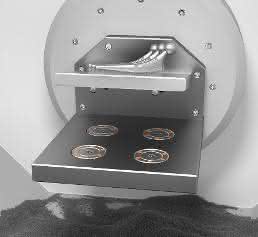
If zero-point clamping technology can already significantly reduce set-up times in the 3D printer, the time saved when switching to subsequent processes can easily be increased by up to 90 percent or more. This is because if the zero point is "taken along" to subsequent machines, there are virtually no more set-up processes. The next work step can be started immediately in a comparable "plug-and-play" manner. Manufacturers who transfer this AMF zero point interface to all subsequent processes in additive manufacturing confirm the enormous reduction in their set-up times across the entire production process.
Pneumatics and hydraulics
The K10.3 and K20.3 built-in clamping modules from AMF for additive manufacturing open pneumatically at an operating pressure from 4.5 bar, which is available in every production hall. They achieve pull-in forces of ten or 17 kilonewtons (K20) and holding forces of 25 or 55 kilonewtons (K20). They are locked by spring force so that the pressure lines can be disconnected at any time. As an option, AMF offers a blow-out system for removing chips and a support control for queries as part of automated processes. Special solutions for additive manufacturing can be developed for the hydraulic modules at the customer's request.
The Fellbach-based company also offers query technology for the clamping modules. This adds an important aspect: with modules equipped in this way, the interface and therefore the entire production process in 3D printing, including the subsequent downstream processes, can be standardized to a high degree. Such a standardized process chain is the basis for placement by robots and thus for fully automated production. Of course, the sensors selected for this must also be suitable for these demanding conditions.
Whether automated or not, once the additively manufactured component has gone through all the processes, it must be separated from the base plate at the end. Kasto has developed a suitable machine for this purpose. The Kastowin amc (additive manufacturing cutting) high-performance automatic band saw is specially designed for this task because the developers have thought the process chain through to the end with this final step (or cut). As the original equipment manufacturer, AMF is Kasto's partner for the clamping technology in this special saw.
The clamping modules of the AMF zero-point clamping system hold the base plate with the finished component for the cutting process in an exact cutting position for a low pressure allowance. Before the sawing process, a rotary unit on the machine swivels the base plate into a head-over position. Once the components have been cut off, they fall gently into a collecting net. After swiveling back, the base plate can be removed from the zero-point clamping modules and prepared for the next additive manufacturing process. as


You might also be interested in
Schunk shows flexible systems for electronics production
Schunk Electronic Solutions will be exhibiting modular, flexible systems for electronics production at Productronica 2025 - from stand-alone depaneling systems to fully integrated inline solutions.
 read more...
Digital and without staff
Kasto promised a world first for its trade fair appearance at the EMO in Hanover. The sawing and storage technology specialist presented a fully automated system for pre-processing.
read more...Digital and without staff
Kasto is promising a world first for its trade fair appearance in Hanover. The sawing and storage technology specialist will be presenting a fully automated system for pre-processing at EMO. The unmanned concept enables 24/7 operation.
read more...Production, machine tools and robots
High-precision welding for perfect sawing
Stihl uses Nimak's portal projection welding systems to manufacture guide rails for chainsaws.
read more...Prevent damage and save energy
CG Drives & Automation presents a new range of Emotron TSA soft starters from 5.5 to 1000 kW (16-960 A and 200-690 V). This includes the new sizes TSA 5 and 6 for high power applications (470-960 A).
read more...Robot tool for more efficient heating systems
Together with the Chair of Production Systems (LPS), Schmöle is developing a new process for manufacturing spiral finned tubes for heat exchangers. In addition to an ergonomic improvement for the employees, the manufacturing process is to become...
read more...MES solutions in mechanical engineering
A medium-sized machine tool manufacturer successfully networked its production facilities with the company software.
read more...Integration of robot-based production cells
Clamping technology for robot processing
The ISW at the University of Stuttgart researches the use of industrial robots for machining tasks and develops automation concepts that support the integration of robot-based production cells in companies.
read more...For use in heavy industry
The KASTObbs block and panel bandsaw from Kasto was specially developed for heavy industry and is used in steelworks and steel trading companies, among others.
read more...