
Gripper
Gripper jaws are technical fingertips
Gripper jaws are the part of a clamping gripper that makes direct stereomechanical contact with the gripped object. However, it is often not just clamping, but a combination of force and shape pairing.
The jaws are interchangeable and can be fitted with special friction linings to increase static friction. This can reduce the gripping force and increase safety. But first, here are some basic rules on how to use grippers correctly. The terms gripper jaw and gripper finger are often used synonymously and are not used consistently.
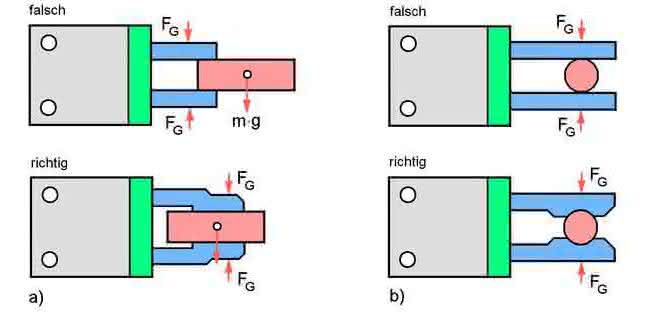
Gripping should be planned so that the center of mass of the gripped object is located between the gripping elements in order to avoid unnecessary tilting moments, especially during acceleration phases of the robot's arm movement. The gripping point should be as close as possible to the gripper housing. This results from the requirement for fingers that are as short as possible. Holding workpieces in pairs is preferable. It is safer and can often be realized with much less gripping force (Fig. 1). This considerably reduces the load on the workpiece.
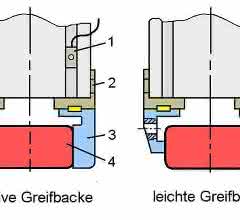
Naturally, gripper jaws should also be low in mass. This helps to improve the dynamics of the handling process and mechanically relieve the gripper. Figure 2 shows an example of this. This is a parallel jaw gripper. Unnecessary accumulations of material have been eliminated. The two gripper jaws should also not be of different weights, because when opening and closing quickly, the gripper mechanism can start to vibrate undesirably due to unequal loads and fail prematurely.
Incidentally, fingers with a wide contact surface have no advantage over jaws with a small contact surface in terms of the frictional force generated during clamping. However, the latter generate greater surface pressure. This can lead to surface damage on the workpiece, such as clamping marks or dents in thin-walled hollow parts. In these cases, the surface pressure should be recalculated.
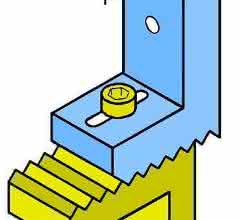
If an additional mechanical interface is provided between the gripper base jaw and the gripper jaw, as shown in Figure 3, it is possible to adjust the gripper to different workpiece widths and also to change to differently shaped gripper jaws.
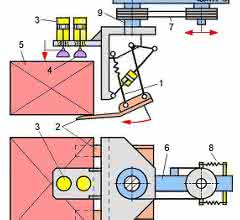
Instead of solid jaws, flat forks can also be used as gripping elements. Figure 4 shows a gripper for cardboard boxes. The object is forked under at the side and pressed on with pressure elements before the planned movement begins. The fork is advanced in a slight arc and is also spring-loaded. The gripper is connected to a rotary axis (manipulator, industrial robot).
Today, gripper jaws with complicated geometries can also be designed on the computer and produced quickly and efficiently from plastic using laser sintering. When using such gripping elements in the food sector or in medicine, the existing hygiene regulations must be observed.
The requirements regarding material, surface coating and design (easy-to-clean design, rounded edges, no open holes, etc.) must be taken into account.
Gripper jaws are also increasingly being equipped with sensors. This allows additional information to be obtained about the gripping process or the gripped object. For example, when separating sheet metal blanks by gripping, a double sheet check can be carried out; this ensures greater process reliability.
Stefan Hesse
Literature: Stefan Hesse, Greifertechnik - Effektoren für Roboter und Automaten. Carl Hanser Verlag, Munich 2011


You might also be interested in
Everything accurate in switch cabinet construction
To ensure smooth work processes, tools for processing enclosures and housings must function flawlessly and reliably. Häwa rounds off its punching range with the Multi-Press 500.
 read more...
Fast connection
In addition to the XTV terminal blocks with side conductor routing, the first terminal blocks with front Push-X connection are now also available from Phoenix Contact.
read more...Automate without control cabinets
Beckhoff wants to revolutionize the market with the MX modular automation system. Andrea Gillhuber spoke to Product Manager Daniel Siegenbrink about the possibilities that the system offers users, what experiences have already been made and where...
read more...Simply assemble cobots
Grip Handhabungstechnik focused primarily on aesthetics when designing its new cobot tables. However, functional and ergonomic aspects also played a major role in creating a perfect working environment for the operation of lightweight robots.
read more...3D printing drone supports fire department in operations
Every day, firefighters risk their lives in unknown environments. With the help of 3D-printed parts, David Häusermann and his team at Empa have spent six months developing and testing a heat-resistant reconnaissance drone. The "fire drone" is...
read more...Wago platform for 3D printing ideas celebrates its birthday
3D printing is in vogue. This is also demonstrated by the digital think tank and 3D printing community Wago Creators. It is celebrating its second birthday this year. Since then, the online community has grown to almost 4,000 users - time for a look...
read more...More efficiency in the control cabinet
clipx Engineer, the engineering software from Phoenix Contact, is the software for control cabinet construction that optimizes data consistency from the circuit diagram to the control cabinet.
read more...Printing and appliqué in one step
Good legibility and permanent marking are of the utmost importance for industrial marking. At the same time, it is considered time-consuming and laborious to assemble the individual markers, especially when many conductors and cables need to be...
read more...Resource-saving plastics processing
Efficient all the way to the cloud
PC-based control, the PC- and Ethercat-based control and drive technology from Beckhoff, offers the potential to make machines and systems for the plastics processing industry work more sustainably.
read more...