
3D snapshot cameras
Container safely in view
When separating goods from the pallet into other containers or onto a conveyor system, every grip should be perfect. If depalletizing is carried out by a robot, it relies on the best possible vision to safely grip individual containers in different directions of rotation and levels.
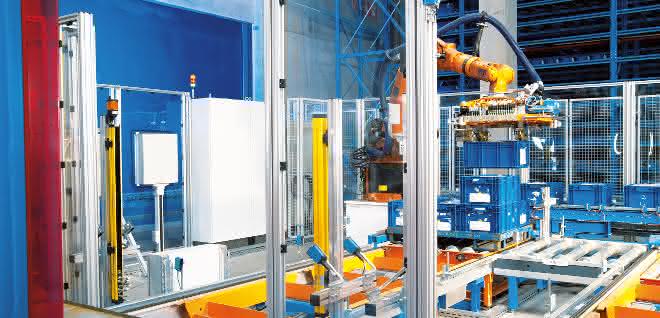
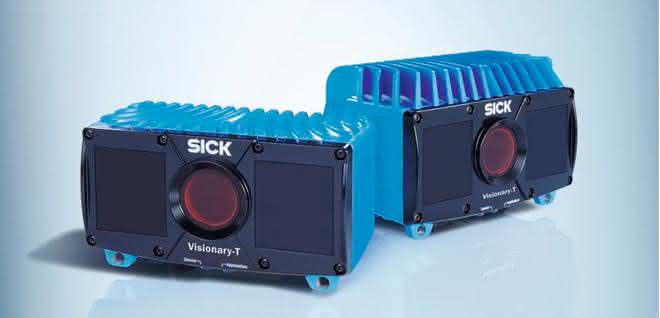
The Visionary-T 3D snapshot sensor from Sick enables robots for goods separation to optically capture the parts. 3D snapshot refers to an image capture process in which cameras not only capture a complete image of their field of view in a single moment, but also determine the distance between the camera and the captured objects. The main advantages of this process include the complete and sharp representation of any object and the high depth resolution of the 3D images, which is particularly beneficial for precise robot guidance. In addition to Sick with the Visionary-T 3D snapshot sensor, the Portuguese vision integrator Neadvance with its specially developed 3D image processing solution for determining the position and orientation of crates and cartons was also involved in the implementation of robot-assisted depalletizing at a Czech car manufacturer.
The overarching task was to connect the car manufacturer's incoming goods department to the high-bay warehouse and production in terms of handling and data technology, thus creating an overall intralogistics solution. Prior to the introduction of the automatic incoming goods system, components such as screws, mirrors or fitting elements were manually removed from the pallet after unloading from the trucks, recorded using data technology and sent on their way to a storage location or directly to vehicle production. This depalletizing and transferring of the delivered components to a conveyor line was to be solved with the help of an articulated robot. To do this, it was necessary to equip the depalletizing robot in such a way that it could independently detect the position of the individual packages on a delivered pallet, even with different loading patterns and packaging units or transport-related changes in position on the pallet, and thus reliably grip them.
Information on shape, alignment and spacing
This challenging task was solved with the Visionary-T 3D snapshot sensor. The streaming camera provides the robot controller with measured values on the shape, orientation and distance of objects on the pallet. The Visionary-T determines the distance and size of objects by measuring 3D time-of-flight (3DToF). To do this, the sensor emits infrared light, which is reflected by the objects in the vicinity. From the phase shift between light and light emission, the sensor calculates the distance to the pallet surface, i.e. to the individual cartons or crates, and displays this in a three-dimensional point cloud. Neadvance's algorithms use the three-dimensional image information to generate depth and intensity information for each individual pixel and thus determine the shape, level and orientation of boxes and cartons. This enables the robot controller to recognize which container can be approached next without collision and can be gripped best, and to calculate the corresponding target coordinates for the automatic path guidance of the robot.
In this application, the 3D snapshot sensor is mounted directly on the articulated robot. As the robot moves over the pallet, the sensor captures images of the pallet surface as it moves. The robust sensor design - durable metal housing, no moving parts inside - ensures a high level of reliability with low maintenance requirements. The high repetition rate of up to 50 images per second also ensures that the metrological precision and reliability of the robot guidance is maintained even during dynamic acceleration and reversing movements of the robot, as well as in the case of reflective surfaces or other difficult conditions. The robot approaches the pallet, picks up the goods safely with its special gripper and places the crate or carton on the conveyor belt. The process starts again from the beginning to pick up the next crate. The dynamics of the robot and the speed of the 3D detection of the pallet surface have considerably accelerated the depalletizing process, significantly increased the throughput in incoming goods and relieved employees of a repetitive task.
Joint engineering for the best performance
Sick's 3D snapshot technology and close collaboration with Neadvance during the engineering process resulted in a future-proof solution for robot-guided goods separation. The precise 3D measurement data and point clouds generated by the sensor made it possible to record loading scenarios more accurately and to further refine the complex gripping processes - even during commissioning and during operation. The new depalletizing solution works so reliably and efficiently that the car manufacturer is planning to use it in other plants as well.
Moritz Vogt, Applications Engineer 3D Compact Systems, and Darko Klinec, Product Manager 3D Compact Systems, Sick


You might also be interested in
Basler acquires 76% of Indian image processor
Basler, supplier of image processing components for computer vision solutions, has acquired 76% of the Indian sales partner Alpha TechSys Automation.
 read more...
Process monitoring and fault detection
Cameras ensure quality during laser melting
Powder bed-based laser melting (PBF-LB/M) opens up new possibilities in additive manufacturing. Modern camera systems provide crucial process data to further increase quality and efficiency.
read more...Vision Sensor is three times faster than its predecessor
The 'CS-62' vision sensor from di-soric is around three times faster than its predecessor, the 'CS-60'. In combination with the 'nVision-i 25.1' software, it enables image processing solutions that were previously reserved for smart cameras.
read more...Thermal imaging cameras for quality control
Automated thermal imaging cameras are often suitable for quality control applications where temperature plays a role. However, while there are various solutions on the market for slow processes, it is challenging to select a camera that reliably...
read more...Easy entry into industrial VGA thermography
Reliable temperature measurement is a prerequisite for the success of many industrial processes. Berlin-based manufacturer Optris presents the Xi 640 infrared camera, a new member of its Compact Line, which enables non-contact temperature...
read more...Powder bed-based laser melting optimized
Aconity3D has set itself the goal of optimizing the stability of the manufacturing method of powder bed-based laser melting and thereby promoting its use in a wide range of industries. By using high-speed industrial cameras from SVS-Vistek, the...
read more...INDUSTRIAL Production Products of the year...
2nd place, category handling, assembly and production logistics: SICK
safeVisionary2 is the first 3D time-of-flight camera with Performance Level c safety certification. It enables safe three-dimensional environmental detection and won 2nd place in the competition for Product of the Year 2024 in the handling, assembly...
read more...Nomination Products of the Year 2024
SICK: Camera systems safeVisionary2
safeVisionary2 is the first 3D time-of-flight camera with Performance Level c safety certification. It enables safe three-dimensional environmental detection and has been nominated in the 2024 Product of the Year competition in the handling,...
read more...AI vision brings additional opportunities
The seamless integration of AI into the consumer sector has helped to improve our quality of life and make interactions with technology more efficient. In industry, AI vision with machine learning opens up new possibilities that are not covered by...
read more...