
Cooperation agreement
Trumpf and Sick develop industrial quantum sensor
The Trumpf subsidiary Q.ANT and the sensor specialist Sick will be working together in future on the development of quantum optical sensors.
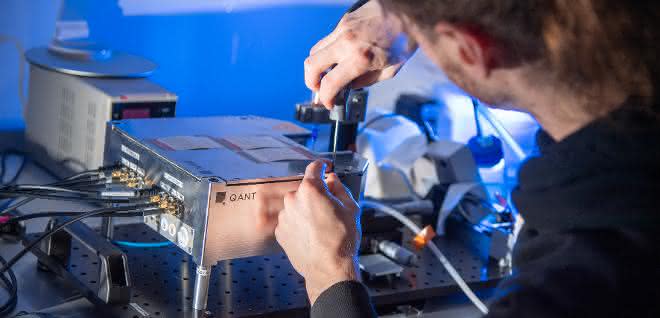
Representatives of the two companies have signed a cooperation agreement to make quantum technology usable for sensors in industrial applications. Quantum sensors enable measurements to be made with a level of accuracy that was not technically possible until now. The signing was preceded by a successfully completed functional test of the world's first quantum optical sensor suitable for series production.
"With its entry into quantum sensor technology, Sick is expanding its global technology leadership in the sensor industry. Quantum sensors are a key technology for the future of industry," says Robert Bauer, CEO of Sick AG. Sick will be responsible for application development and sales of the product. As a specialist in quantum technology, Trumpf subsidiary Q.ANT is responsible for manufacturing the measurement technology and thus the technological core of the sensor.
"Quantum technology is a huge opportunity for German and European industry. This partnership between two high-tech companies is now turning it into a production-ready product for the first time. The quantum sensor enables high-precision measurements and insights that lead to completely new applications in industry," says Peter Leibinger, Chief Technology Officer at Trumpf. The first use of the new quantum sensors is planned for 2021.
High-precision measurements of the smallest particles
Until now, quantum sensors have mainly been used in research. Q.ANT and Sick have now successfully completed functional tests of an application for industry for the first time. "Quantum technology enables, for example, the ultra-fast measurement of the movement and size distribution of particles. With the industrialization of these sensors, not only we but also Germany as a high-tech location are taking a major step towards the commercialization of quantum technology," says Michael Förtsch, CEO of Q.ANT. The quantum sensors use laser light to enable highly efficient measurements that are not possible with conventional methods. "Quantum technology is the next step for sensor technology, as it pushes technical boundaries that were previously firmly anchored. Where previously no good signals could be measured, quantum effects can even make details perceptible in the signal noise. This makes it possible to measure particles that are around two hundred times smaller than a human hair," says Niels Syassen, Senior Vice President R&D at Sick, where he is responsible for the project. The quantum sensors will initially be used to analyze airborne substances.
Growing market volume due to industrialization
Quantum sensors could become part of everyday life in various industries in the future: For example, in civil engineering, it could be possible to map underground structures before construction begins; in the pharmaceutical industry, it could be easier to determine the best composition of tablet powder; in electronics, circuits could be inspected through surfaces and high-precision measurements could be taken in industry. With industrialization, the market for quantum sensor technology is likely to grow steadily. Experts from the German Academy of Science and Engineering Acatech estimate the global market volume of industrial quantum sensors at around 1.1 billion euros by 2023.
Q.ANT is a wholly owned subsidiary of TRUMPF based in Stuttgart. The start-up employs around 15 people and uses new photonic technologies to make quantum technology suitable for everyday use. Trumpf has been using Sick sensor solutions in its manufacturing and logistics processes for many years, so the new cooperation on quantum technology is based on a sound technological partnership.


You might also be interested in
Robotics and autonomous order picking
Locus Robotics acquires Nexera Robotics and expands autonomous warehouse logistics
Locus Robotics takes over Nexera Robotics and may have taken a decisive step towards truly universal warehouse automation. A new gripping technology should now make possible what was previously considered difficult to automate.
 read more...
How bridging steps, stairs and catwalks are changing processes in production and logistics
At Logimat 2026, Munk Günzburger Steigtechnik will be showcasing modular bridging steps, stairs, platform and walkway systems for production, warehousing and logistics. With online configurators, distances can be efficiently shortened, processes...
read more...Highly automated warehouse for...
SSI Schaefer implements highly automated warehouse for CERP in France
SSI Schaefer and CERP are building a highly automated logistics center for pharmaceutical logistics in Wissous with shuttle storage, A-Frame, robotics and WAMAS software.
read more...Start of construction for new production hall
Mayr Antriebstechnik invests in its home base and internationally
Mayr Antriebstechnik strengthens location and international logistics: Construction of a new hall in Mauerstetten - parallel expansion of the plant in Poland as a logistics hub.
read more...Conveyor systems that adapt
Modern conveyor systems must reliably transport different product sizes, shapes and materials. The new modular product system from Kipp offers flexible, modular solutions for this: Adjustable side guides ensure precise alignment and gentle...
read more...Focus on sustainability and AI at the trade fair
With more than 120,000 square meters of exhibition space, LogiMAT 2025 will once again occupy all ten halls of the Stuttgart exhibition grounds. From March 11 to 13, global players, medium-sized companies and start-ups will provide an overview of...
read more...Workstation system for shipping and logistics
With Sintro Packing, Karl is launching a workstation system that is designed to meet the specific requirements of shipping and logistics. It is characterized by modular adaptability and ergonomic efficiency.
read more...Deutsche Messe announces Robotics Award
On the occasion of Hannover Messe 2025, Deutsche Messe is once again presenting the Robotics Award after a break of several years. Prizes will be awarded for robot-supported automation and logistics solutions. Companies and institutions from Germany...
read more...Micro motors as the driving force behind intralogistics
Suitable transport structures in intralogistics are a prerequisite in all industries in order to withstand competitive pressure in the future. The basis for this is comprehensive automation, which would be inconceivable without an armada of powerful...
read more...