
Vacuum systems
Avoid production stops with vacuum solutions
An optimized vacuum system can lead to faster picking and depositing times, fewer production stops or faster switching times. Avac's portfolio includes several vacuum components to achieve these properties.
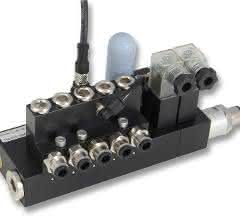
Bottlenecks and problem areas in production are sometimes difficult to identify if you don't know that they are affecting its efficiency. Often these are just small necessary improvements that may seem minimal in themselves, but make a significant difference.
One factor that is easily overlooked is that an optimized vacuum system can lead to faster pick and place times, resulting in a shorter overall cycle time. Safety and flexibility in the vacuum system can also lead to increased uptime, fewer production stops or faster switching times, for example by providing a warning signal for preventive maintenance before a production stop. Avac's portfolio includes several vacuum components to achieve these features.
The booster release ejector offers a fast response time for vacuum build-up as well as a patented seven times more efficient depositing of the workpiece. The transport process is fast and gentle.
The patented and award-winning multi-circuit ejector offers four to eight separate vacuum circuits that do not influence each other. This achieves a high level of system reliability, and a vacuum circuit with several suction cups can also be used for handling many different workpieces. All vacuum circuits are monitored by a common AMS vacuum sensor. The workpieces are deposited simultaneously in all circuits by a common blow-off signal. This system recognizes how many circuits are occupied with vacuum. Each individual vacuum circuit can be equipped with a separate vacuum holding valve. A common signal releases the workpieces from all vacuum circuits simultaneously
With the Autovac MFE ejector (Multi Function Ejector), it is possible to receive a warning signal if something does not correspond to the pre-programmed sequence, for example if a suction plate is worn out. The system recognizes the problem, the user receives a warning signal and can carry out preventive maintenance measures the next time production is stopped. as


You might also be interested in
Predictive maintenance in retrofit
Predictive maintenance pays off. This is because early detection of impending failures means that systems can be serviced in a targeted manner before production downtime occurs. But how complex is it to integrate such a maintenance concept into an...
 read more...
Maintenance instead of replacement
The circular economy starts with the machinery
Sustainability in industry starts with machines, says our guest author from Deguma: How maintenance, modernization and the 5R strategy save resources, energy and CO₂.
read more...3D printing for unplanned requirements
The material fails and the machine suddenly stops? Then you need to take the right measures to be able to resume production quickly. Material failure in the form of faulty components or material wear in the frame are a risk for any production.
read more...High demands in terms of safety, application and robustness
Demanding work in the electrical trade and energy supply as well as smooth processes in production require innovative and customized measurement technology that scores points for safety, ease of use and resilience.
read more...Car meets e-bike: riding with lubrication-free polymer bearings
Studies show that the proportion of pedestrian and bicycle traffic is increasing in urban areas. With the JetBike, JetBike GmbH from Braunschweig presents a mixture of e-bike and car and relies on lubrication-free polymer bearings from Igus.
read more...Hydraulic hub for more efficient servicing
Bosch Rexroth presents a digital toolbox for service and maintenance. With a comprehensive range of digital services, the Hydraulic Hub simplifies and accelerates the service and maintenance of hydraulic products and increases machine availability.
read more...Arnold Umformtechnik expands after-sales...
Faster help with VR glasses
Arnold Umformtechnik is expanding the after-sales service for its machines to include digital remote services. The focus is on data security, simple operation and clear processes.
read more...147,000 euros per hour: high costs for German companies due to unplanned downtime
According to the "Value of Reliability" study, 67% of industrial companies in Germany experience unplanned downtime at least once a month. This costs the German economy 147,000 euros per hour. Nevertheless, reactive maintenance concepts are not...
read more...Maintenance starts with a maintenance planner
Legal requirements stipulate that machines and systems must be serviced regularly. The maintenance work serves to ensure occupational safety and economic efficiency.
read more...