
Assembly technology
Interlinking of machines to form work lines
Combining individual machines into a production line with a continuous workpiece flow is not a new idea.
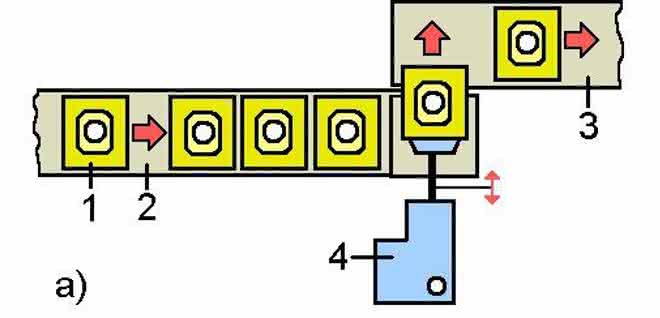
As early as 1923/1924, the British company MORRIS MOTORS developed a cycle line for the mechanical processing of cylinder heads. It was purely mechanically controlled, had a cycle time of four minutes and completed 53 operations. However, the control system proved to be unreliable and still required 21 workers to operate it. However, the general goal of saving on manpower has not changed to this day. But there are new factory concepts under the term Industry 4.0, which can also be used to effectively process a batch size of one. At its core, this involves comprehensive data networking. A workpiece to be manufactured finds its own way through the production plant.
What is behind the conventional term interlinking? It is the connection of automated machines or workstations to form an efficient system structure with a continuous workpiece flow. This is achieved by means of devices for automatic workpiece transfer, but also by connecting the machines via an information and energy flow that enables overall control.
Interlinking type
The interlinking of the machines can be rigid, loose (time asynchronous) and target-coded. In the case of loose interlinking, workpiece stocks are created between the machines. If a machine upstream or downstream fails (short-term malfunction), the part of the production line that is still intact can continue to work for a limited time thanks to the storage. For this reason, loosely linked machines are always more efficient than permanently linked machines. For workpiece storage, a distinction is made between main and secondary storage. The basic structure is shown in Figure 1. The main lock storage must be designed in such a way that workpieces can be connected to workpiece carriers in the event of a gap in the flow.
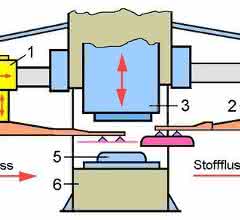
In forming technology, presses are connected to form lines. Continuous conveyors are only used to a limited extent for the workpiece flow. Press-integrated or stand-alone robots are suitable. Figure 2 shows an example. Three-axis robot arms bring blanks into the working zone of the machine, remove the deep-drawn part and then place it in the following machine for trimming.
A prioritized axis of movement is defined to control the machine. In this case, this would be the press ram. Smooth interaction over time requires all overtravel paths and signal delay times to be taken into account. A freedom of movement model is useful here as the basis for a movement regime for all processes.
Multi-machine operation
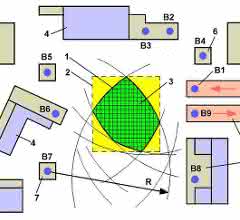
Several operating points of work machines, which are arranged in a circle or line, are approached by an industrial robot as required. This leads to good utilization of the robot. The organizational goal is to achieve a minimum of waiting times for both the machines and the robot. In the case of a robot workstation with a central industrial robot, the question arises as to where it should be positioned. A simple graphical method for determining the location is shown in Figure 3. An arc with the arm reach R of the robot is drawn around each operating position B to be approached. The circular arcs enclose an area. Each grid intersection point within the average set is a potential location. It is only necessary to check whether a collision-free passage of a work cycle is possible. The collision-free locations are selected according to the criteria
- Minimum cycle time
- Load on the industrial robot
- Safety and accessibility
an optimum location is selected. You can generate further variants of the machine installation and thus also find further alternative solutions.
Convertible small parts assembly
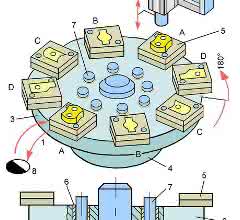
How can a small assembly fixture (Fig. 4) be quickly converted? In the example, the indexing plate of the device is designed for four different assemblies. You can see a station for inserting, checking and removing. Opposite is the automatic assembly station, for example a press. The rotary table always cycles through 180 degrees. Changing over to a different assembly is simple; the top plate is lifted off and replaced in a staggered position.
Stefan Hesse


You might also be interested in
Cooling and temperature control units
Hygienic packaging sells safely
In few industries are the requirements for hygiene in the production process as strict as in the food sector - the health of consumers has top priority. This results in enormous challenges for all machines and components involved, especially in...
 read more...
Simple tool change in seconds
With the CMS, Schunk is launching a user-friendly, manual change system for quick component replacement. In addition to its simple and convenient operation, the CMS also stands out with its extensive range of optional modules and complementary end...
read more...Customized machining solutions
Custom-fit solutions for hydraulic valve housings from Mapal
The production of valve housings is the supreme discipline in the world of fluid technology. As a technology partner, Mapal provides support and designs the optimum machining strategy in dialog with the customer.
read more...LEF and LEY series with additional size
Solutions often need to be developed for tight spaces or compact machine designs. To meet such requirements even better, SMC has now added size 16 to its LEY series electric cylinders and LEF series electric spindle drives.
read more...The same locking system around the globe
Orca Industriemontagen builds machines and systems worldwide and now only needs a single locking system to effectively protect all construction sites. The eCliq electronic locking system from Assa Abloy secures the containers during transportation...
read more...Plug-and-produce with smart subsystem
The mechanical engineering company KMS Automation standardizes pressing and joining applications with the Smart Function Kit from Bosch Rexroth. The mechatronic subsystem simplifies machine design, increases process quality and shortens...
read more...Designing transport systems for high flexibility
Factories need flexibility to further increase productivity and introduce new products. Manufacturers must continuously adapt in order to increase productivity and production output.
read more...Twelve new variants for professional users
Kärcher is revamping its range of super-class cold water high-pressure cleaners with twelve new products. With the HD 9/20-4 S, HD 10/21-4 S, HD 10/25-4 S and HD 13/18-4 S, there are four different product classes, each available in three different...
read more...Norelem supports VDI Racing Camp
Mastering the challenges of e-mobility
Promoting young talent has been a priority at Norelem for many years: the company supports young talents with components and the necessary know-how and provides schools with illustrative material.
read more...