
Handling systems
2,000 lids per hour
For an end customer, Zellwag Pharmatech supplied a rotary transfer machine that simultaneously fills and closes containers. Electric handling systems from Afag are used for pre- and post-screwing. This enables the user to handle up to 2,000 containers per hour.
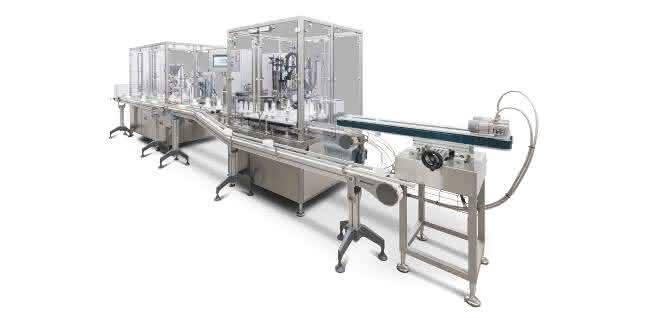
An end customer was looking for a complete solution for its production line that fills and closes containers at the same time. The company finally found what it was looking for at Zellwag Pharmatech in Frauenfeld/Switzerland: The Z-110 P multi-format machine for filling and capping vials, bottles and jars with variable capping systems met the requirements.
"We also needed a cleanroom-compatible screwdriving solution for fast pick-and-place handling," explains Thomas Nüesch, Team Leader Engineering at Zellwag Pharmtech. The machine manufacturer relies on the EPS maxi ZC and EPS mini ZC electric handling systems from Afag. The handling systems developed and produced at the Hardt site in the Black Forest allow objects to be moved and assembled quickly and precisely. They are therefore suitable for applications in assembly automation, the packaging industry, the electrical and automotive industries - and in the pharmaceutical, healthcare and cosmetics industries.
The Frauenfeld-based company has already had very good experience with the systems from Hardt in the past. This made the decision to use handling systems from the Afag product portfolio of handling components an easy one. "As we have been working with the tried-and-tested products for more than a decade, we opted for an EPS maxi ZC at the pre-screwing or crimping station and an EPS mini ZC for post-screwing the lids," continues Nüesch.
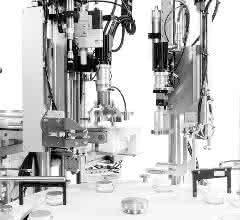
Two powerful specialists
The Z-110 P rotary indexing machine fills and closes between 1,500 and 2,000 containers per hour. To achieve this level of performance, Zellwag Pharmtech has divided the capping process into two stages. Kevin Schwenk, design engineer at Afag, who supervised the project on behalf of the handling experts, explains: "If it takes one second to completely screw a container at one station, for example, it takes one second before the next container can be processed. However, if the screwing work is divided up and the container is processed at two stations for half a second each, a further container is sent to the next processing step every half a second. This allows more containers to be processed in the same amount of time."
When the freshly filled containers reach the pre-screwing or bouncing station, the system clamps them and the EPS maxi ZC begins its cycle. The Z-axis of the handling system consists of an electric PDL40 gantry axis with linear motor, which is suitable for fast and precise applications thanks to its compact design and high performance. A maximum speed of three meters per second with a repeat accuracy of plus/minus 0.05 millimetres is stated in the data sheet for this handling component.
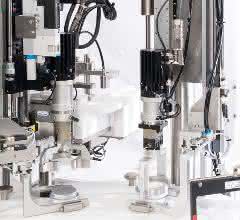
The SE30 electric rotary axis with a gripper is used on the C-axis to position the lid. The lightweight rotation unit has a repeat accuracy of plus/minus 0.0017 degrees thanks to a backlash-free gearbox and positions the caps precisely. The system grips a lid, moves down, places it on the waiting container and screws it tight. The handling system then moves back to its starting position to pick up a new lid while the next container is already being prepared.
Meanwhile, the pre-screwed container moves on to the re-screwing station, where the EPS mini ZC screws the lid on torque. To do this, the container is clamped again. The screwing axis moves out of its starting position with the help of the electric Afag ES20 slide. The C-axis of this somewhat smaller handling system is a SE30 rotation axis, which tightens the previously placed lid using a gripper. The rotation axis has a maximum speed of 280 revolutions per minute for this purpose. The tightly closed container then moves on to the next production step.
Both handling systems are built using components from the Afag modular system and are designed according to customer requirements. "Only one adapter installed in the system is actually a custom-made product, because a special design was required here," explains Schwenk. Only eight weeks passed between Zellwag Pharmtech's first inquiry and the delivery of the two handling systems. Considering the good order situation in the industry and the nature of the handling systems, this is quite remarkable. as


You might also be interested in
Soft grippers for delicate foods
Irregularly shaped, fragile, and varying in size and weight: products such as potatoes, baked goods, and dairy products push mechanical grippers to their limits.
 read more...
Development Collaboration for Humanoid Robotic Hands Launched
Schunk is entering into a new development partnership with Robert Bosch Robotics. Their shared goal is to develop an industrial-grade robotic hand that can be integrated into various humanoid robot systems.
read more...Robot-controlled packaging of rolls
Koch Robotersysteme, a company specializing in the integration of robotic systems, has developed a complete, automated packaging line for packaging rolls based on Tentoma’s RoRo StretchPack packaging machine.
read more...Robotics and autonomous order picking
Locus Robotics acquires Nexera Robotics and expands autonomous warehouse logistics
Locus Robotics takes over Nexera Robotics and may have taken a decisive step towards truly universal warehouse automation. A new gripping technology should now make possible what was previously considered difficult to automate.
read more...Gentle wheel handling
The newly founded Eisenmann Robotics division develops new robotics concepts to increase the level of automation in modern production facilities.
read more...Gripping systems and vacuum generators
Schmalz is presenting new gripping systems and vacuum generators at Automatica. Exoskeletons, which allow employees to move heavy workpieces effortlessly, will also be on display.
read more...Smart universal gripper for power electronics
The power electronics manufacturer Semikron Danfoss uses the EGU 50 mechatronic parallel gripper from Schunk in a robotic cell. It handles different components and feeds them to a measuring line. With its functionalities, it meets all requirements...
read more...Schmalz takes over finger gripper from Soft Robotics
The vacuum specialist Schmalz is expanding its gripper portfolio and acquiring the mGrip product family from the US company Soft Robotics (SRI), including all finger gripper configurations, patents and the associated know-how.
read more...Soldering with special gripper
In order to make the mini wave soldering of large panels stable and reproducible, Eutect developed a special gripper that prevents the panel from bending, among other things.
read more...