

Blechexpo 2019
Gentle movement: Brush systems for sheet metal processing
While Kullen-Koti's brush plate systems are part of the basic equipment of many sheet metal processing machines and systems, the company's satin finishing brushes are used in many disciplines of mechanical surface treatment of sheet metal products. Both types of brushes and both areas of application are the focus of Kullen-Koti's presence at this year's Blechexpo.
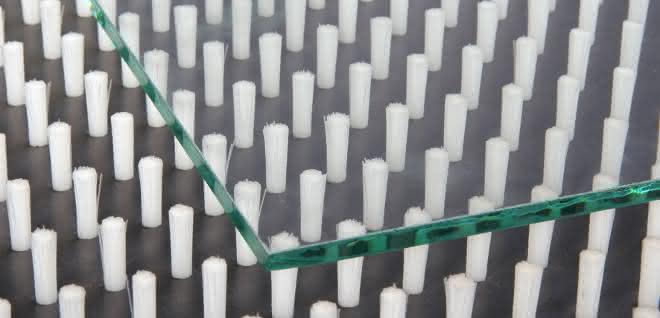
Kullen-Koti will be presenting technical brushes for the gentle handling and targeted surface treatment of metal sheets and strips at this year's Blechexpo in Stuttgart. The focus of the exhibition program will therefore be on the company's various brush plate systems and the group of satin finishing brushes with their process-specific fill materials. Kullen-Koti will be on site with numerous experts who will be available as competent discussion partners for both machine manufacturers in the industry and sheet metal processing suppliers. The manufacturer's portfolio is of interest to both the designers of the plant manufacturers and the manufacturers of semi-finished products and vendor parts made of sheet metal.
Conveying and fixing
The brush plates from Kullen-Koti are important components of the feeding, clamping and fixing systems of modern sheet metal processing plants. Among other things, they are used for the gentle feeding, precise positioning and alignment of thin and thin sheets of steel, stainless steel, copper or aluminum, which are sometimes delicate. Compared to other systems, they offer an enormous weight advantage, which enables high travel speeds and low drive power for the systems. In many cases, the brush plates can therefore contribute to the realization of energy-efficient lightweight constructions in mechanical engineering.
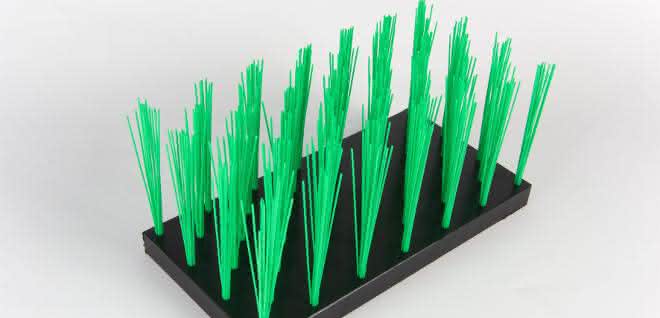
At Blechexpo, the company's specialists will be providing information on the technical factors that need to be considered when selecting suitable brush plates. The load-bearing capacity, elasticity and frictional resistance of the fill material play a key role here. The thermal and mechanical load-bearing capacity of the carrier plate and brush fill are also important. And last but not least, the question of how high or how close the fill should or may be.
Depending on the weight and size of the metal sheets to be picked up, Kullen-Koti manufactures the brush plates with load-bearing capacities of up to 2,000 kg/m2 as standard. High-quality plastic fibers, heat-resistant and flame-retardant special fibers or fine wires are usually used as fillings. Even if increased requirements for noise reduction need to be taken into account or the focus is on handling extremely sensitive sheet metal surfaces, the diverse range of fillings offers various alternatives. The format and dimensions of the brush plates can be individually adapted to the customer's machine design. The standard dimensions range up to 2,500 x 1,200 mm, and larger areas are created by combining several brush plate modules. Curved shapes, circular cut-outs and other special geometries can be realized for seamless connection to conveyor lines.
Pre-treatment and satin finishing
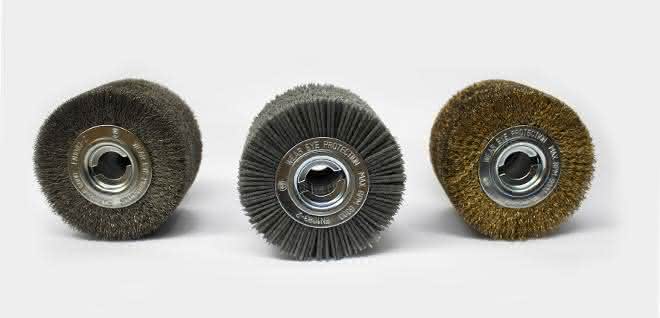
The second focus at Kullen-Koti's Blechexpo stand this year will be on satin finishing brushes. These are mechanical surface treatment tools that are used both for pre-treatment and for the optical finishing of sheet metal. In other words, depending on the process stage, they are used for deburring, derusting and paint stripping of the surfaces as well as their design-oriented structuring and finishing. The components are processed with the round brushes on machine tools or with manual machines.
In contrast to other tools (e.g. grinding wheels), satin finishing brushes do not have a significant material-removing effect. However, production parameters such as the immersion depth or the speed as well as the selection of the suitable filament are fundamentally decisive for the result. At Blechexpo, Kullen-Koti will be exhibiting satin finishing brushes with filaments made of stainless VA steel wire, thin stranded wire and various abrasive filaments. These abrasive filaments are optimized for the application via the grain type (SiC, AlO, diamond, ceramic and others) and different grain sizes. The wire trimmings are adapted via the hardness and diameter of the wires (0.06 to 1.2 mm) and their geometry (crimped, twisted, knotted). In this way, manufacturers and suppliers to the sheet metal working industry can have Kullen-Koti put together a customized range of satin finishing brushes that are perfectly matched to their sheet metal materials and the various objectives of the individual process stages in mechanical surface treatment.
Blechexpo: Hall 3, Stand 3203


You might also be interested in
Competitive advantages with large machines
Whether 3D-printed components for machines and systems, prototypes or aids for design: additive manufacturing is almost indispensable for modern companies in mechanical and plant engineering and automation if they want to play in the premier league.
 read more...
Metal, plastic and ceramic components
The fast track to series production
At Rapid.Tech 2023 in Erfurt, Aim3D is putting the ExAM 255 3D printer at the center of its trade fair presence. The system can print metal, plastic and ceramics and enables an end-to-end digital 3D printing process chain.
read more...Freeformer and 3D printer for liquid silicone
At Rapid.Tech 3D from May 9 to 11, 2023 in Erfurt, Arburg Additive will be presenting its Freeformer 750-3X, which processes original plastic granules, and the LiQ 5 for 3D printing of liquid silicone (LSR). The company will also be providing...
read more...Without corners and edges
Brush deburring is considered one of the most flexible methods of mechanical deburring technology. It offers manufacturers and processors of metallic and polymer semi-finished products and components the option of removing burrs, rounding edges and...
read more...Systems for series production
At Formnext, Arburg will be showcasing the new Freeformer 750-3X, whose installation space is around 2.5 times larger than that of the Freeformer 300-3X, which will also be presented in Frankfurt.
read more...Highly resilient thanks to fiber reinforcement
Igus has developed igumid P190, a new filament for 3D printing that is extremely stiff and strong thanks to its carbon fiber reinforcement. This makes it suitable for structural components and special connecting elements for energy chains as well as...
read more...Bringing color into the 3D game
In product design, the right color is often a decisive factor for success. Of course, this tool can also be used in 3D printing.
read more...Print abrasion-resistant components yourself
Sliding and wear-resistant special parts can often be designed quickly, but special production using injection molding or mechanical processing is costly and can be very expensive for small quantities.
read more...Combined deburring and handling solution
Kadia's portfolio includes a wide variety of deburring machines, most of which are designed for fully automatic operation, for example with the aid of a robot.
read more...