
Hall lighting
Work better with smart lighting
Modern hall lighting has more functions than just light on, light off. For example, it can use the light specifically where it is needed and switch it off where nobody is present. This results in optimum illumination with low energy consumption.
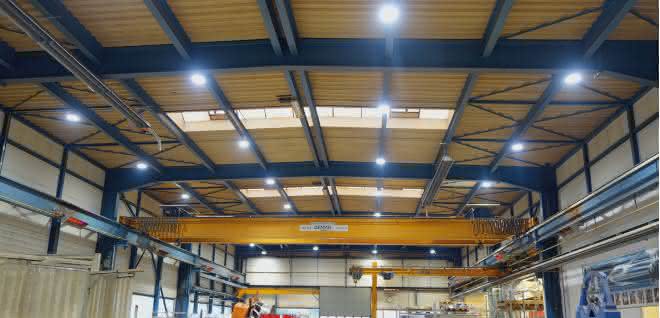
Light influences the well-being of employees in the workplace as well as their performance and motivation. More and more companies are therefore asking themselves the question of workplace-appropriate and customizable lighting systems that simultaneously enable modern lighting management, energy monitoring, light scene management and system monitoring. In the context of advancing digitalization and the Internet of Things as a network of intelligent objects, the control of luminaires is becoming all the more convenient thanks to modern networking and automation. Using sensors, individual luminaires react autonomously to their surroundings and can be monitored and controlled remotely at the same time. Light scene management makes it possible to automatically switch lights on and off as required and adjust their dimming level. In combination with targeted monitoring, this enables additional energy efficiency and therefore electricity cost savings to be achieved. The logged data from the luminaires provides further information about potential faults and failures, enabling predictive maintenance work to be carried out.
Convenient control
Due to the industry's increasing requirements for location-dependent lighting conditions, automated control of lighting systems is becoming more and more popular. Control takes place via cross-system interfaces, and proprietary systems such as 1 to 10 V lighting control, Dali, DMX, KNX and ZigBee are the most widespread. The ZigBee standard is the only one of these to work wirelessly. The sensors that can be integrated into the network report when and how control is required. Passive infrared sensors (PIR sensors) are the most commonly used sensors in motion detection. A distinction must be made between motion detectors and presence detectors. Motion detectors switch the light on as soon as they detect movement, while presence detectors also switch the light off if there is sufficient daylight despite movement. Twilight switches or light sensors regulate the artificial light to the desired illuminance level in line with the current daylight within an area. This makes it possible to achieve uniform lighting throughout the room.
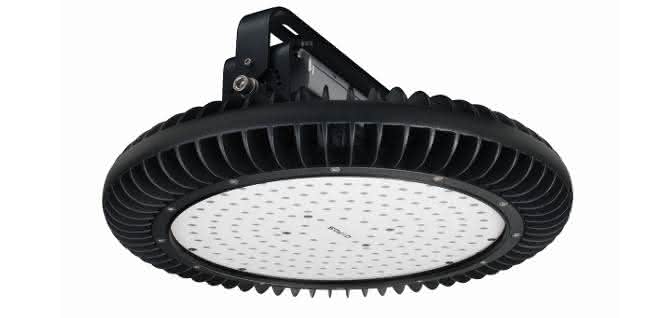
Intelligent lighting systems such as the DeltaLuxx Smart from the manufacturer Gifas Electric provide the right illumination for large work halls. The DeltaLuxx is smart thanks to the built-in ZigBee radio control. ZigBee works in the 2.4 GHz band without interference alongside existing WLAN and Bluetooth networks. The radio range of the high-bay luminaire is up to 100 meters, extended by a network up to several kilometers are possible. The protocol, which records and transmits all status information, is encrypted with AES-128 and therefore offers a high level of network security.
Based on the ZigBee standard, various automation options are possible, such as presence control via motion sensors, daylight control and setting different dimming levels. An optional gateway can be installed to connect to the internal network, allowing real-time monitoring, control via a browser and data acquisition with visual analysis of service life. The DeltaLuxx Smart also enables progressive energy management. The building is illuminated more efficiently, while resources are conserved at the same time. Existing halls can also be retrofitted easily and cost-effectively. The radio-based lighting system saves on complex wiring and electrical installation and its flexibility allows work areas to be modernized as required.
Dirt-repellent for a long service life
In addition to the selected electrotechnical components, the design principle of the luminaire with regard to the structure and choice of housing materials remains important. Modern high-bay luminaires are designed to counteract any loss of luminous flux due to soiling. The cooling fins integrated into an open ring on the housing serve the purpose of allowing ambient air to flow through the luminaire body in a targeted manner and enabling effective thermal management. This is further enhanced by the use of a dirt-repellent and thin PTFE surface coating. Even in demanding working environments with high levels of dirt and dust, this ensures that all the heat generated is dissipated and guarantees a service life of up to 80,000 hours for the luminaires. The correct optical light distribution and selected light color also prevent undesirable glare effects as well as premature signs of fatigue among employees. The use of illuminance and the uniformity of lighting are standardized in DIN EN 12464-1.
In addition to applications in indoor areas, there is also increasing demand for intelligent lighting control for outdoor areas on factory premises. Sensor-based path and street lighting in particular is becoming increasingly popular in terms of lighting control, supplemented by additional features such as WLAN hotspot or camera technology, for example for traffic flow measurement. Product series such as the StreetLED Smart from the Gifas Electric range are ideal for this purpose. The company also offers its customers comprehensive services such as free lighting calculations and on-site advice.
Kristina Becker, Marketing, Gifas Electric / am


You might also be interested in
Housing and inserts for plenty of power
Lapp presented the expansion of its Epic Power series at SPS 2023: four new M23 circular connector inserts and three new M23 housings. The special feature: all housings can be combined with any of the four inserts.
 read more...
News and product updates from Smartgas
Portable gas analyzers for outdoor use
Smartgas is starting the second half of the year with a series of updates to existing products and a number of new products. Portable analyzers expand the range of applications, while new accessories such as protective housings and heating modules...
read more...Everything accurate in switch cabinet construction
To ensure smooth work processes, tools for processing enclosures and housings must function flawlessly and reliably. Häwa rounds off its punching range with the Multi-Press 500.
read more...Shafts and conversion parts
The Rodriguez range includes ball bushings including matching housings, shaft brackets, crossbars and supports.
read more...Cooling and temperature control units
Hygienic packaging sells safely
In few industries are the requirements for hygiene in the production process as strict as in the food sector - the health of consumers has top priority. This results in enormous challenges for all machines and components involved, especially in...
read more...Simple tool change in seconds
With the CMS, Schunk is launching a user-friendly, manual change system for quick component replacement. In addition to its simple and convenient operation, the CMS also stands out with its extensive range of optional modules and complementary end...
read more...Motion controller for small drives
Medium power range covered
Faulhaber has another housing-less and compact motion controller in its range, which is particularly suitable for integration in device construction and medical technology applications.
read more...Welding solutions in the name of resource efficiency
At the Welding & Cutting trade fair in Essen (September 11-15), Fronius will be focusing on the major drivers in welding technology. Quality requirements are increasing in all industries, but the required welding specialists are scarce. In...
read more...Safe solutions for cable installations
From thick power cables to thin sensor lines, cables and lines must be routed safely through systems and machines. A challenge that should not be underestimated, explains Jörg Sokat, Head of Product Management at Pflitsch.
read more...