

Protection against electrostatic discharge
What is important for ESD gloves
Automation, digitalization and AI are part of all areas of our modern working world. The number of processed microchips, processors, semiconductors, diodes and other electrical components is constantly increasing. This is also reflected in the market.
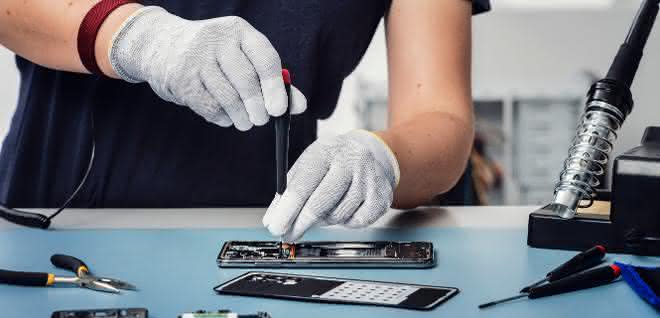
According to the German Electrical and Electronic Manufacturers' Association (ZEVI), turnover in the German electrical and electronics industry was significantly higher than the previous year at EUR 17.5 billion in fall 2021 (+6.2%), despite the coronavirus pandemic. No wonder, because whether smartphones, computers, cars or production machines: electrical and electronic components are an elementary component of processes and industrial production. Personal protective equipment (PPE) is central to the handling and installation of this delicate technology. It serves to ensure product safety and employee protection. ESD gloves are particularly important for precise manual skills. They have to fulfill a variety of tasks.
Electrostatic discharges are 90 percent imperceptible
"The abbreviation stands for Electronic Static Discharge," explains Veronika Seliger, Technical Training & Support Manager at Ejendals. "The charge exchange between two bodies with different voltage potentials creates an electrostatic charge that can lead to extremely high voltages. These voltages are discharged when they come into contact with conductive materials. A person only feels an electrostatic discharge from around 3,000 V.
However, around 90 percent of discharges occur below the threshold of human perception, meaning that microelectronic components can be irreparably destroyed by minimal discharges without this being noticed. This becomes clear when you see ESD destruction in a chip under a microscope. The punctual discharge creates a 'crater' there, which destroys the internal structure.
ESD is one of the most common causes of failure, particularly in semiconductor-based integrated circuits. This can be expensive and is the main risk in the production and processing of sensitive components. Of course, employees must also be protected, as an ESD shock can be painful. ESD protection is therefore a top priority for all industrial and electrical/electronic production facilities."
Employee protection and product safety only through complete ESD equipment
Protection against electrostatic discharge consists primarily of avoiding or minimizing the charge, e.g. by discharging and grounding the body and avoiding rapid discharges. To effectively prevent electrostatic discharge, all components of the system must therefore be earthed: shoes, gloves, clothing, floor and the person themselves. For ESD-sensitive areas, this is tested with an ESD test plate on which the employee must step. This tests whether the prescribed contact resistance is < 100MΩ. "Electrostatic charging cannot be completely prevented, but it can be reduced to a level that protects the product," explains Veronika Seliger, Head of the Ejendals Academy.
It all depends on the right ESD hand protection
ESD gloves are of central importance in the production and processing of electronic components and small processors. "Gloves are the be-all and end-all of production," says Veronika Seliger. "Ejendals has launched nine new ESD glove models on the market since fall 2021 so that we can use the right glove for every ESD work area." The provider of protective solutions for hands and feet aims to achieve the best possible protection for employees and products with its extensive ESD portfolio. "Various properties such as haptics, conductivity and cut protection as well as glove coating designs tailored to the intended use are relevant here," explains Veronika Seliger.
Antistatic ESD gloves must be as thin as possible for good dexterity, have a good grip, be flexible and, of course, be comfortable to wear. "These attributes apply to all of our new nine models," emphasizes the PPE expert. "The ergonomic structure is adapted to the hand and thus supports the natural way it works. To achieve this, the gloves are ergonomically knitted, which makes them particularly adaptable. Stiff gloves would not be comfortable to wear and would hinder work. They must also not scratch or slip. Of course, touchscreen capability is also relevant these days. This offers added safety when the employee is standing at the ESD test station, operating the control panel and doesn't have to take off their gloves to do so." With its extensive range, Ejendals offers customers complete freedom: the glove can be precisely tailored to the employee, workplace and component - for all ESD work areas. "Safety from a single source" is the motto at Ejendals.
Which ESD glove for which application?
There is a general rule of thumb with regard to antistatic properties: An ESD product is always antistatic and primarily serves to protect the product. An antistatic product is used to protect people and is not always ESD-capable; it is important to note that there is no standardized pictogram for work gloves that identifies an ESD glove, so it is essential to ensure compliance with EN 61340-5-1. "Our new Tegera 806 model, for example, is an ultra-thin, uncoated ESD glove that uses our CRF Technology fiber. This high-performance fiber is a true all-rounder: it cools, does not rub or itch and is super light with a molecular weight of less than 40 g/mol. This makes a huge difference to wearing comfort.
At the same time, the glove is ideal for precision work with sharp-edged objects, as it has class C cut protection," explains Ejendals trainer Seliger. Ejendals has developed the Tegera 877 as the thinnest glove with a PU coating and very good grip. The integrated carbon fiber provides the ESD properties. "With this glove, the focus is also on excellent fingertip sensitivity," explains Veronika Seliger. "This glove also has PU-coated palms, while the new Tegera 801 has PU-coated fingertips, which are ideal for inserting circuit boards. Another new model is the Tegera 801, which, with its dipped fingertips and good feel, is ideal for soldering electrical parts or inserting circuit boards." The Swedish manufacturer shows: The better the equipment and coordination with the workplace, the better the product and employee protection.
PU or nitrile?
The coatings of ESD gloves are made of PU or nitrile and are used depending on the activity. "PU is marginally thinner-walled than nitrile, gives a lot of freedom of movement and is particularly suitable when very good grip is required, for example when things can get a little oily during production. The pronounced dexterity is a big plus point," says Veronika Seliger. "Nitrile is also the more elegant solution from an ecological point of view. This coating, or rather the glove, is very durable, has good heat resistance, high abrasion and very good cut resistance. Both coatings offer great advantages and should be selected exactly according to the intended use."
Body climate and room temperature
Thick woollen socks that have an insulating effect, dry hands or feet - ESD protection can be impaired or limited. "We therefore have appropriate ESD socks in our range. They ensure an optimum foot climate. We also offer gloves that are certified according to Ökotex or Dermatex to protect sensitive skin. As we focus on holistic protection, around 97% of all our shoes are also ESD-certified," emphasizes Veronika Seliger. For further safety, the company should pay attention to the standard climate (23+/- 1 °C; relative humidity 25 +/- 5%). Extremely dry air has a negative effect. "If all these requirements are met, employees and products are optimally protected. That is our goal," says Veronika Seliger.


You might also be interested in
Plagiarius 2024 negative prize
On January 26, 2024, the Plagiarius campaign awarded its dreaded "Plagiarius" negative prize for the 48th time to manufacturers and retailers of particularly brazen counterfeits and fakes.
 read more...
Ivalua honors winners of the Generative AI...
AI-supported "add-ons" for buyers within 48 hours
Ivalua, provider of cloud-based spend management solutions, announced the winners and innovations of the first Generative AI Innovation Cup. The competition took place in December 2023. It was open to all Ivalua partners and employees - more than...
read more...Efaflex celebrates 50 years of high-speed...
The emphasis is on "fast"
Since day one, Efaflex has wanted to use new technologies as early as possible and drive progress in the industry. This year, the family business is celebrating its 50th anniversary under the motto "Fast Forward".
read more...Security of supply even during power outages
In the winter of 2022, Germany was worried about energy shortages. The drugstore retailer dm did not paint any horror scenarios, but nevertheless saw the possibility of controlled, temporary, regional power cuts (brownouts).
read more...Safety technology in mechanical engineering
Modules with new functions
Euchner's product highlights at EMO 2023 include the communication-capable solenoid interlocks.
read more...Transforming the paper industry towards climate neutrality
Together with partners from industry and research, Voith is developing a project for the optimization of energy and material flows in paper production. The aim of the research project is to develop a digital framework that enables effective process...
read more...Up to 95 percent less flue gas thanks to direct extraction
The requirements for occupational safety measures and safety technology are also constantly increasing in welding technology. The Technical Rules for Hazardous Substances (TRGS) stipulate that welding fumes and harmful substances must be extracted...
read more...Competitive advantages with large machines
Whether 3D-printed components for machines and systems, prototypes or aids for design: additive manufacturing is almost indispensable for modern companies in mechanical and plant engineering and automation if they want to play in the premier league.
read more...Transport technology from the modular system
Many transport tasks can be realized with the help of linear technology. Pre-configured solutions are available to simplify the interaction between the linear unit, motor, gearbox and controller. This minimizes the effort required for research and...
read more...