
Individualization in connectivity
The plug at the limit
The networked industry is constantly changing. The Zukunftsinstitut has identified twelve global megatrends that affect all levels of society and therefore also influence industrial connectivity. Two of these trends - connectivity and individualization - are the biggest drivers of development.

Connectivity describes the principle of networking based on digital infrastructures. For industry, for example, this means that more and more sensors are being integrated into machines under the buzzword "Industry 4.0", enabling remote access and real-time data availability and making machine-to-machine communication increasingly important. The second trend, growing individualization, is aimed in particular at self-realization in a personal context. However, a strong tendency towards individualization can also be observed in the industrial environment. As a result, plant operators need machines that are tailored to their requirements and therefore have to be developed and manufactured in batch size 1.
These two megatrends - connectivity and individualization - also have a huge impact on connection technology: it must become more robust, more standardized and significantly smaller. After all, more and more connections need to be implemented in the same installation space. This is not possible without miniaturization and power densification.
Lapp also has to face up to this challenge, as components such as cables and connectors are also subject to this constant process of change. In the cable sector, for example, the solution is Single Pair Ethernet. But what about connectors? What influence do standardization and miniaturization have on development, or is the development of connectors already at its limit?
"I am firmly convinced that there is still a lot of room for improvement when it comes to connectors. Miniaturization and increasing connectivity are driving development in the industry. This will also lead to an increase in performance and further standardization in connection technology," emphasizes Georg Stawowy, Chief Innovation and Technology Officer at Lapp Holding.
At Lapp, the connector has always been deeply rooted in the DNA of the Stuttgart-based family business. Before the company was founded in 1959, Oskar Lapp (1921-1987) initially worked for a well-known market leader for industrial connectors, where he was the representative for southern Germany. Even there, he attracted attention with his innovative ideas. For example, he developed the first rectangular connector for the company.
From the very beginning, the founding couple Oskar and Ursula Ida Lapp positioned their company as a "one-stop store" for connection technology - the principle of "everything from a single source" is still a recipe for success today. This is why, soon after the market launch of the first industrially manufactured Ölflex connection and control cable, Lapp also offered connectors under the brand name Epic (Environmental Protected Industrial Connectors). With the worldwide introduction of customized assembly solutions under the name Ölflex Connect, the topic of connectors is also becoming increasingly important for Lapp. Whereas electrical connections used to be hard-wired, soldered and then often not touched for a long time, their place is now taken by connectors that can be disconnected thousands of times and always make reliable contact.
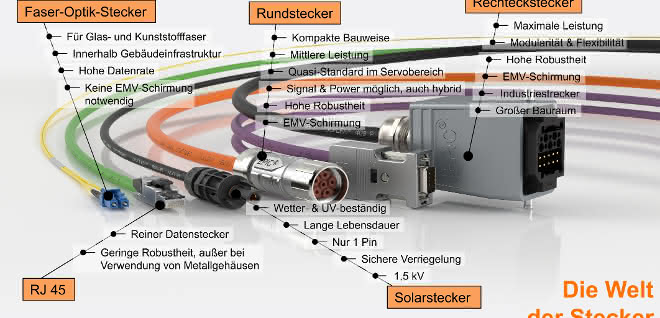
Today, Lapp has a flexible system of rectangular, round and solar connectors made of extremely robust housings, cables, inserts and contacts that enable simple and safe connection and disconnection of cables and wires. All common types of connectors are available in the Lapp portfolio. With the Epic housing configurator alone, users can put together a customized industrial connector housing with locking concept and cable entry. A total of 138 million different configurations are possible. With the particularly robust Epic MH rectangular connector system, the connector frame can be fitted with both LAPP connector modules and modules from the market standard, whereby assembly is significantly easier than with the usual hinged and sliding frames. The user has almost unlimited combination options: 2 to 36 poles, currents up to 100 A, voltages up to 1,000 V, data with bandwidths up to Cat.7.
For the transmission of digital data (signal, power + hybrid), Lapp has rectangular and circular connectors in its portfolio. The standard thread sizes are M23, M17 and space-saving M12 connectors. As a quasi-standard in the servo sector, they are extremely robust and have good EMC shielding. Also worth mentioning are weather and UV-resistant solar connectors with secure locking and a long service life, the RJ 45 data connector and connectors for fiber optic cables for building infrastructure with high data rates.
But what are the prospects for the connector? On the one hand, connectivity is continuously increasing due to more and more functions (sensors, condition monitoring, remote access, etc.) and performance in the machines, while on the other hand the installation space in machines is decreasing or at least remaining the same. As mentioned above, this necessarily requires the miniaturization of connectors. But it is not that simple. Physics also shows connectors their limits. This is because in order to achieve maximum current, the contact thickness is crucial - a particular challenge in the course of miniaturization. Maximum voltage is primarily influenced by two factors: the air gap defines the distance between conductor and conductor, the greater the distance, the greater the voltage. Then there is the so-called creepage distance. This is the connection along the insulator, which influences the voltage depending on the contamination.
But what does this mean for the performance of connectors? Lapp's circular connectors (M12 to M58) are currently available for currents of 12 to 150 amperes. The challenge now is to break through the previous limits with design innovations. The new M12L connector not only handles currents of 16 A (instead of the previous 12 A), it is also very small.
In addition to connectivity, increasing individualization is the second important trend. "This is leading to an increasing number of variants and modularity as well as a high level of standardization among our customers," says Georg Stawowy. Batch size 1 is the goal. The connectors used should therefore be as standardized as possible. Production systems must become increasingly flexible. This requires easy reconfigurability of the modules, which can only be achieved with standardized connectors.
The topic of radio and 5G in comparison to the physical connection with cable and plug is also being discussed time and again. It is clear that radio and cable will coexist in factories in the future. However, cables and connectors will remain the first choice where fast and interference-free communication is essential in industrial processes, for example for transmitting sensor data in real time or for supplying energy to drives. Where data reliability and latency are crucial, there is no way around the plug connection. Another advantage: wired connections are less susceptible to attacks by hackers than wireless connections. Wireless connection technology will therefore not replace cable-based systems and connectors, but at most complement them.
But where is the journey heading? The idea of realizing a simple connection of modules with a simple contact interface - for example, by simply placing the module to be connected on the machine - is being discussed more and more frequently. What speaks against this is that industry requires particularly robust connection solutions that can withstand temperature, dirt and vibration. This is impossible without a connector.
Conclusion: Increasing connectivity and growing individualization are the development drivers for connection technology. To ensure that the connector remains the solution of choice in the industrial environment, it must continue to evolve significantly in terms of miniaturization, standardization, power density and robustness.
Georg Stawowy, Chief Innovation and Technology Officer, Lapp


You might also be interested in
Spectra Launches 5G RedCap Router for Industrial IoT Applications
With its new 5G RedCap routers, Spectra is expanding its portfolio to include a mobile communication technology for industrial applications designed to bridge the gap between traditional 5G and established IoT standards such as LTE-M and NB-IoT.
 read more...
5G in the industrial IoT
The Chair of Production Systems at Ruhr-Universität Bochum LPS is researching industrial applications with a local 5G network in the context of Industry 4.0.
read more...Implement milling tasks economically
Milling covers a wide range of applications - from the machining of large free-form surfaces in the aviation industry and in the manufacture of wind turbines to the milling of cavities and highly automated mass production.
read more...Mitsubishi Electric invests in the future
Further production building in Owariasahi City
Due to the growing importance of the Japanese region of Owarisahi in Aichi, Mitsubishi Electric Corporation is increasing its planned investments and announcing the construction of a second production building.
read more...Industrial Connectivity Lab opens
Siemens customers test wireless technologies
Siemens has opened a new test lab for industrial connectivity technologies at its Erlangen site. Embedded in the Siemens Technology Center on the Erlangen campus, the Industrial Connectivity Lab offers 300 square meters of space for testing...
read more...A sustainable foundation for the industry
The networks are growing together - this refers to the ongoing merging of IT and OT. Christian Korff, Managing Director Global Accounts and Member of the Management Board, Cisco Germany, explains the challenges and levers involved.
read more...It started with a timer for X-ray machines
In 2023, the automation expert Omron can look back on 90 years of innovative company history, in which many technological boundaries have been crossed and milestones set.
read more...Flexible component transport in production
Stein Automation presents the Stein 400 workpiece carrier system for parts weighing up to 80 kilograms and the C5G logistics control system.
read more...Extended image processing options
High-performance multispectral line scan camera with 5GigE
The new Linea2 4k Multispectral 5GigE camera takes machine vision systems to the next level with its performance and value, offering a 5GigE interface with five times the bandwidth of the Linea GigE camera.
read more...