

Safety switch
Security technology the smart way
Optimized communication is the order of the day in safety technology. The focus is not only on the complex Industry 4.0 applications of tomorrow, but also on the more inconspicuous innovations. A safety switch and a safety module promise shorter downtimes, especially in smaller systems.
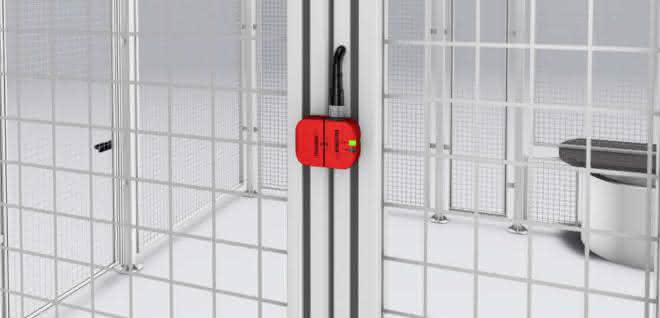
Everyone is talking about Industry 4.0, says Jens Rothenburg, Product Manager at safety specialist Euchner. "As one of the technology leaders in the field of safety, we do of course, but something else is at least as important to us: that our innovations can demonstrate their improved communicative capabilities not just in the fully networked factory of tomorrow, but right now - in the next machine that a plant manufacturer designs or a user commissions or retrofits."
This is precisely the case with the company's two new products. As inconspicuous as the CES-C07 safety switch and the ESM-CB safety module may look at first glance, they are able to communicate at Industry 4.0 level and therefore open up new freedoms when designing efficient safety solutions for smaller systems up to category 4/PLe.
With safety switches without the possibility of communication, it was only possible to localize the switch that triggered a machine stop with great effort when sensors were connected in series. The subsequent troubleshooting was often quite difficult and resulted in long downtimes. The CES-C07, on the other hand, now provides process-relevant parameters in real time. This allows acute problems to be identified and also provides information for preventive maintenance. For example, the sensors measure relevant environmental parameters and signal in good time whether a system failure is imminent. The system even reports tampering attempts.
Localize errors quickly
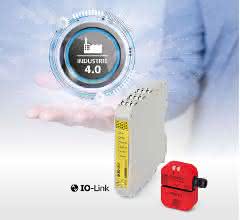
To avoid overloading the data traffic on the bus, the developers have developed an intelligent information hierarchy. "With the process data, we can justifiably say that every single bit gives the user essential information about what they need to pay attention to in a particular problem situation," says Rothenburg. "They can then conveniently call up more detailed explanations via the acyclic data." A single cable is all that is needed for communication, with an integrated eight-pin M12 plug for connection. This saves on hardware and makes the entire system lean and transparent.
Each switch transmits 4 bits of process data to the control unit. The OD signal indicates, for example, whether the safety guard is open. The operator therefore knows exactly which door is responsible for the system standstill. If the weak area display OW appears, there is an actuator in the edge area of the transponder field. This is usually caused by the doors being lowered after prolonged use. Previously, the switches only drew attention to this by flashing, which was easy to overlook in everyday industrial use. With the corresponding message from the control unit on the HMI, the OI display informs the operator that there is a current message that should be called up as soon as possible via the acyclical data. This data includes, for example, the current diagnostic codes that describe exactly what is wrong with the switch in question. A total of over 30 different messages are stored. Each wiring error is displayed, which saves time, especially during commissioning. At the same time, the code contains precise instructions for the operator to quickly rectify the fault in question.
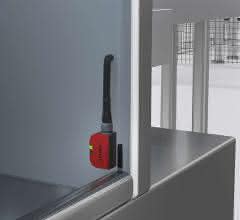
The displays of the voltage currently applied to the CES-C07 and the temperature measured in the switch provide valuable information for predictive maintenance. If certain threshold values are exceeded or not reached, preventive maintenance can be requested automatically. The recording of the number of switching cycles provides further indications of an impending defect. Although the switch itself is wear-free, the mechanics of the safety gate, which can be monitored in this way, are not. The fact that the safety switches can be replaced under voltage also helps to avoid downtimes.
Prevent manipulation
A similarly important issue in modern production plants is the protection of systems against manipulation. The acyclic data also provides useful information for this. By checking the number of switches in a row, the control system can detect whether the circuit has changed since the last check, i.e. whether the row has been shortened. And with the function for querying the currently read actuator, it is possible to determine whether this code differs from the learned code for Unicode switches. In the case of multicode switches, the system checks whether the current actuator code matches those stored in the control unit. "This offers a decisive advantage in terms of safety, for example for machine tools whose chip conveyors are only blocked with metal chip baskets," explains Rothenburg. "Verification of the code ensures that the correct basket is always positioned in front of the respective ejection opening, even if baskets of different sizes are in use."
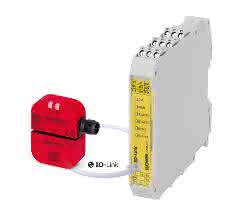
In combination with the ESM-CB safety module, all this information is queried by each switch in the chain and made available to the control system via IO-Link. The slim 18 mm device fulfills several functions: It is an evaluation device, safety relay and IO-Link device all in one. Two safety circuits can be connected on the input side. For example, one with which the device monitors an emergency stop chain or the switching contacts of mechanical safety switches and a second for evaluating a chain of safety switches. Two redundant, safe relay contacts enable the direct switching of loads with up to 6 A. The safety module is in constant dialog with the connected devices and records the system status, the ambient conditions and the sensor's own data for each sensor, among other things.
Communication with almost all devices
In addition to cost aspects, the versatility of the point-to-point wiring system played a major role in the decision to communicate via IO-Link. Whether Profibus or Profinet, AS-Interface, CC-Link or EtherNet/IP - all common automation systems have access to IO-Link. This means that the safety switch and the safety module have a direct connection to the entire automation system in this way.
On the one hand, this makes them interesting for all types of systems - from machine tools and packaging machines to fences that need to be secured. And it also has the advantage for plant manufacturers that they can supply their products with identical safety technology to all regions of the world. "If you want to offer the same machine in both the USA and Europe, you usually have to install different control systems," says Rothenburg. "So it's good to know that at least the safety switches can remain the same."
Ariane Isabel Walther, Corporate Communications at Euchner / am


You might also be interested in
Electronic modules for professionals
RS Components has expanded its RS-Pro range with the introduction of 4,000 new products. The expansion of the product range focuses on industrial automation applications.
 read more...
It started with a timer for X-ray machines
In 2023, the automation expert Omron can look back on 90 years of innovative company history, in which many technological boundaries have been crossed and milestones set.
read more...Pilz cracks the 400 million euro mark
Pilz breaks the 400 million euro sales mark for the first time. The company has succeeded in "making the best of such unfavorable and unpredictable economic conditions". For the coming years, the company has announced plans to expand its range in...
read more...More space in the switch cabinet
The new generation of compact Varioface interface modules is the link between the remote I/O systems and the field level. An innovative design ensures fast and error-free wiring and saves space in the control cabinet.
read more...Miniature PCB high-power relay
DC relay for mobility applications
Three new PCB relays from Omron Electronic Components Europe are aimed at automotive and mobility applications where space is at a premium and performance is critical. The new Omron G8K, G8G and G8PM relays support the control of high-power DC...
read more...Partnership with Conrad Electronic
Omron expands its European sales network
Omron Electronic Components Europe today announced the signing of a pan-European distribution agreement with Conrad Electronic, the German-based technical sourcing platform operating in 17 European countries.
read more...Revolutionary control cabinets and wireless transport systems
Beckhoff was present in Hanover with a large presence and numerous innovations, and the figures are still good.
read more...Simply digitize processes
Despite a high degree of automation and digitalization, many companies still have unconnected work areas or processes that do not provide centrally accessible information.
read more...Phoenix Contact and TE Connectivity
Partnership to acquire miniature relay technology and production
The Phoenix Contact Group has signed a long-term partnership agreement with TE Connectivity. The collaboration provides for the takeover of the technology for the NSR elementary relay.
read more...