

Peak load management in forklift trucks
Intelligent energy management prevents expensive power peaks
Targeted and efficient energy management is becoming increasingly important for customers in the logistics sector: a high number of devices, different charging cycles and high amounts of electricity ensure that electricity is a critical cost factor for many customers. Intelligent peak load management makes it possible to efficiently distribute the available electricity to the devices to be charged.

Toyota Material Handling (MH) offers a solution for intelligent peak load management of its integrated lithium-ion technology in forklift trucks and warehouse trucks. This makes it possible to synchronize several chargers and charge different industrial trucks at the same time. This makes it possible to plan electricity: a maximum amount of electricity is defined and distributed to the various devices depending on the prioritization of the industrial trucks to be charged. The intelligent chargers regulate the current according to the prioritization. For example, an electric pallet truck that is required at regular intervals can be prioritized accordingly so that it is the first to be fully charged. The other industrial trucks adapt to this prioritization and are also charged according to their position afterwards.
Communication between the intelligent chargers is also possible. The interface in the form of industrial radio can be set up within a few minutes and does not require a great deal of effort. All that is required to install the chargers is a cell phone app that can communicate with the latest generation of chargers via Bluetooth. It is used to program and set up the chargers. The app can be used to set the maximum amount of power available, the charging priority and much more.
Efficient use of PV electricity
As more and more customers are using photovoltaic systems, a solution has also been found for this. The information from the PV systems is transmitted to the chargers via an access point, a separate communication unit, using radio signals. This means that the electricity produced by the system can also be used efficiently. Thanks to intelligent peak load management, expensive power peaks are avoided and the company's energy costs are reduced or saved as a result.
Downward compatibility prevents operating errors
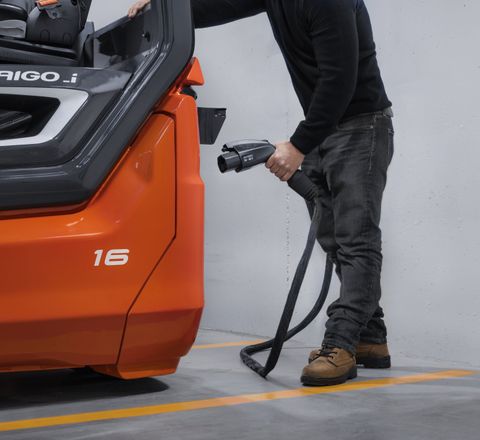
The chargers are also adapted to the needs of the operator. They show the charge status of a battery from a distance. There is no need for an additional trip to the chargers. Instead, a quick check from a distance will be enough in future to get an impression of the charge status. The chargers are also downward compatible. This means progress in terms of safety: a 48 V charger can also be used with 24 V industrial trucks without any problems. This prevents incorrect operation of the chargers, which is particularly important in the case of high current flows.
Safety and advantages during installation
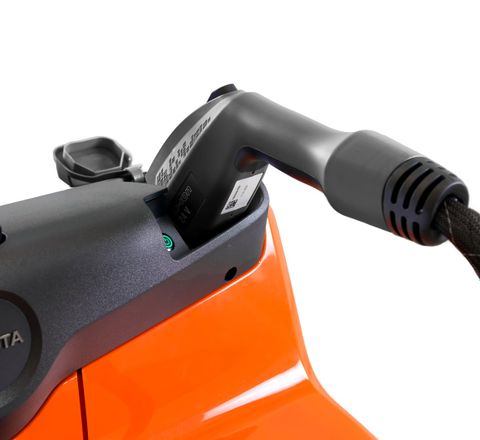
The second generation charging plug is also designed with safety in mind: To remove the charging plug, a stop button on the top of the plug must be pressed, which simultaneously interrupts the charging process on the device. This prevents an electric arc from occurring when the plug is removed, which in turn can pose a fire hazard. This is particularly important with high charging currents.
There is also a solution for customers who are not allowed to mount their chargers on the wall: Instead of the chargers standing around in the hall, which would pose an accident risk, they can be mounted on special racks. This means that the chargers are in the operator's field of vision without having to be bolted to the wall. The fixed position of the chargers means that they need to be checked less often, which results in further cost savings.


You might also be interested in
Energy systems for industrial trucks
Still develops new lithium-ion battery
The intralogistics expert Still is expanding its battery portfolio with a new lithium-ion battery. This covers the most common application profiles in the industry. It is manufactured and installed at the Hamburg site.
 read more...
Articulated stacking
The Aisle Master narrow-aisle articulated forklift replaces several types of forklift such as counterbalance trucks and reach trucks. This minimizes handling times and increases productivity.
read more...Outdoor AGV networks production and logistics
An international company in the plastics industry is automating its intralogistics at its German site with a solution from ek robotics. A specially developed vehicle model from the Out Move series, an outdoor AGV, is being used.
read more...New AMR solution from Omron
Omron, a specialist in automation and robotics, presents the new OL-450S: a flat, omnidirectional autonomous mobile robot (AMR) designed to make material handling processes more efficient, safer and smoother.
read more...AGVs for safe processes in medical technology
A leading German medical technology company has comprehensively modernized its intralogistics - with an individual AGV overall concept from ek robotics. The aim was to achieve a consistently safe, efficiently synchronized material flow along the...
read more...Intralogistics and industrial trucks 2025
A wide variety of systems and vehicles can be found in production and intralogistics. As AI advances, more and more autonomous vehicles are finding their way into production. In this market overview, we show who offers which systems and components.
read more...Electric multidirectional sideloader
Moving long goods inside and outside
With the Maxx 60, Hubtex is adding another series to its Maxx range. The focus here is on combined indoor and outdoor use in long goods handling with a load capacity of between five and six tons.
read more...Stable first quarter for Jungheinrich
Jungheinrich AG recorded a stable business trend in the first quarter of 2024: incoming orders, which comprise the new truck business, short-term hire and used equipment as well as after-sales services, amounted to EUR 1,363 million in the reporting...
read more...Jungheinrich Board of Management reorganizes
In the course of 2024, Jungheinrich will restructure its Board of Management under Chairman Dr. Lars Brzoska. In doing so, the company wants to align its top management for the continuation of its growth strategy until 2030.
read more...