
Rittal and ZutaCore at the 2021 OCP Global Summit
OCP standards with two-phase direct chip cooling
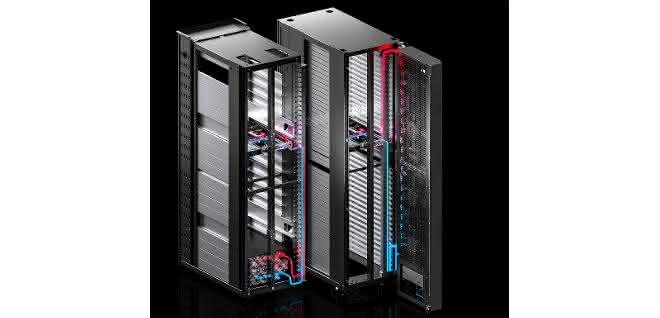
The digital transformation is challenging the data center industry. Applications based on artificial intelligence (AI) or machine learning are increasing the demands on processor performance, data center density and cooling per rack.
Speed is of the essence when setting up and modernizing data centers. Cooling systems must deliver maximum performance in order to avoid hotspots and dissipate the high heat loads in an energy-efficient manner. At the same time, data centers should use as little energy as possible without compromising on performance and availability. At the 2021 OCP Global Summit, partners Rittal and ZutaCore will be demonstrating how the combination of standardized racks according to the OCP specification and two-phase direct chip cooling can help solve this problem.
Standardized technology promotes cost-efficient operation and high scalability of the IT infrastructure. OCP technology with particularly energy-efficient, centralized DC distribution in the IT rack is therefore becoming relevant for more and more CIOs. At the 2021 OCP Global Summit on November 9 and 10, 2021 in San Jose, California, partners Rittal and ZutaCore will be demonstrating how the benefits of the OCP standards for racks can be combined with the high-performance cooling system "Rittal High Density Cooled-by-ZutaCore".
Flexible cooling with the new OpenRack ORV3
Rittal is presenting the new OpenRack ORV3 at the trade fair. It supports 48V DC power supply and enables flexible configuration up to 44 OU / 48 RU. With tool-free installation and 100% pre-configured delivery, it ensures speed. It supports up to 1,600 kg dynamic load. In terms of cooling, it offers flexibility for a wide range of variants including "Rittal High Density Cooled-by-ZutaCore".
Rittal and ZutaCore entered into a strategic partnership in 2020 to make innovative solutions for high-performance cooling and other computing-intensive scenarios available to customers. The "Rittal High Density Cooled-by-ZutaCore" system works on the principle of evaporative cooling and uses the latent energy of the refrigerant to cool the microchips. Users can eliminate local overheating in processors as the system cools exactly where hotspots occur. The waterless, electrically non-conductive refrigerant also reduces the risk of IT failures. In addition, the scalability of the system allows customers to grow together with the dynamic market requirements in a future-proof manner.
Two HPC solutions, fit for OCP
Rittal and ZutaCore offer two designs: Firstly, space-saving rear-door cooling solutions. The principle behind this is as follows: The liquid coolant flows directly onto the microchips (CPU, GPU) in specially developed heat sink cold plates ("Enhanced Nucleation Evaporator"). By absorbing the processor heat, the refrigerant evaporates and becomes gaseous. The gaseous refrigerant 3M Novec TM 7000 Engineered Fluid is liquefied again in the heat exchanger. One or more pumps maintain the supply pressure in order to supply all heat sinks with refrigerant. As almost all components of the cooling solution are integrated in the rear door, this saves a significant amount of space. At the OCP Global Summit, this technology will be available to touch and feel at the OpenRack V2 stand, fit for OCP environments.
The second solution from Rittal and ZutaCore is an in-rack solution that is available as an air-cooled and water-cooled variant. The air-cooled solution supports up to 15 kW heat dissipation per rack with the help of an in-rack air-cooled condenser. It can be easily installed in any rack in almost any environment. The water-cooled in-rack version enables energy-efficient cooling of up to 70 kW heat dissipation per rack using a water-cooled condenser. It is primarily designed for rapidly growing processor and server capacities.


You might also be interested in
Atlas Copco takes over long-standing sales partner
Atlas Copco has taken over Heide-Pumpen. The specialist for mobile pumps has been working closely with Atlas Copco in sales and service for a long time, especially for surface pumps for construction site dewatering and wastewater detour or in the...
 read more...
Lutz Pumpen at the Achema 2024
New mobile drum pump with battery drive
The new B3 Battery from Lutz Pumpen promises mobile and safe working with aggressive liquids without having to compromise on pumping performance compared to wired versions. The battery-powered drum pump will be on display at Achema, the world's...
read more...Maintenance and Pumps&Valves in February
Final preparations are underway in Dortmund: On February 21, 2024, maintenance will start as the leading trade fair for industrial maintenance and with it Pumps&Valves as the trade fair for industrial pumps, fittings and valves.
read more...Liquid separator keeps pumps dry
Vacuum clamping minimizes distortion and enables five sides to be machined in one clamping operation. The use of cooling lubricants poses a challenge: If they get into the vacuum generator, they can cause serious damage.
read more...Spring clutches for construction machinery
Spring clutches from Torsion Control Products (TCP) are ideal for use in construction machinery where modern diesel engines are used.
read more...Protection against cooling lubricant
Liquid separator from Schmalz keeps pumps dry
Anyone clamping with a vacuum during CNC machining must protect the pump from cooling lubricant. The NLS liquid separator from Schmalz separates the cooling lubricant and returns it to the running process - without interrupting the vacuum.
read more...Which clutch for what?
Mechanical engineering and its applications are multifaceted. Every application is special and requires a perfect machine design. Individual components in the system must also be optimally designed.
read more...Energy efficiency needs electrical engineering and IT
The energy crisis makes one thing clear: it is not enough to simply screw a photovoltaic system onto your roof or purchase green electricity. Industry is faced with the challenge of reducing consumption in order to counter the rise in energy prices,...
read more...Solutions for a networked and climate-neutral industry
At the world's leading trade fair for industry, around 4,000 companies from the mechanical engineering, electrical and digital industries as well as the energy sector will be showcasing solutions for the production and energy supply of the future.
read more...