
E-mobility connection cable
Highly flexible single core for HV test benches
E-mobility requires suitable connection and connection technology in the field of HV measurement technology on the component or vehicle test bench. The high voltage classes for various components and power electronics require cables that are specially adapted to the needs of test engineers.
SAB Bröckskes has introduced a highly flexible B 110 C cable to adapt the test specimens to the test bench technology. The copper cable can be used as a supply cable between generators on construction machinery or as a supply cable on large electric motors. The single conductor can also be used wherever high currents have to be transmitted and high power is required.
The highly flexible cable not only meets the safety-critical requirements of the high-voltage environment, but also offers the user additional benefits: The highly flexible stranded wire construction and the use of silicone as insulation material make the single core particularly easy to install. Even with tighter bending radii, the feel is optimal and the cable "hugs" its surroundings.
The notch-resistant silicone compound ensures a long service life and offers increased protection against abrasion, even if the test specimens are changed frequently and the test equipment is modified. The embedded double shielding made of copper braiding and aluminum foil ensures 100 % EMC protection. This prevents interference with the sensitive measuring equipment due to EMC radiation from the connecting cable.
The worldwide use of the vehicles under the most varied and sometimes extreme climatic conditions is also taken into account in the testing. The cable materials are selected so that they can be used in the range from -40 to 180 °C. The B 110 C stranded copper wire covers all standard voltage ranges in the e-mobility sector. Future, possibly higher voltage classes have also already been taken into account.
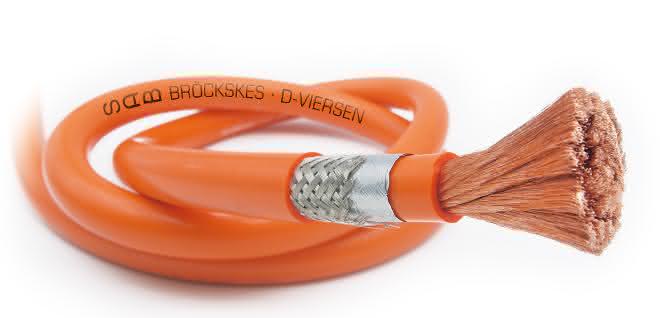
The CU cable is available up to 1.8/3.0 kV AC or 2.7/5.4 kV DC. The SAB developers are thus responding to the investment security of users. The combination of heat-resistant materials and cross-sections up to 240 mm² also allows testing with high currents.


You might also be interested in
Hebotec at the Hannover Messe 2025
Connecting consumers without tools
Additional robots, control cabinets, control panels or other consumers can be easily integrated into the EMC concept of an existing production line using the PAK 25 equipotential bonding terminal from Hebotec.
 read more...
Motion controller for small drives
Medium power range covered
Faulhaber has another housing-less and compact motion controller in its range, which is particularly suitable for integration in device construction and medical technology applications.
read more...Safe solutions for cable installations
From thick power cables to thin sensor lines, cables and lines must be routed safely through systems and machines. A challenge that should not be underestimated, explains Jörg Sokat, Head of Product Management at Pflitsch.
read more...Displacement measuring systems
Economic positioning
The integrated position measuring system IMS from Bosch Rexroth is now also available as IMS-compact for absolute measurement. The non-contact solution with magnetic measuring principle enables robust and economical position detection for linear...
read more...Economic positioning
The integrated position measuring system IMS from Bosch Rexroth is now also available as IMS-compact for absolute measurement. The non-contact solution with magnetic measuring principle enables robust and economical position detection for linear...
read more...Sensors with IO-Link for extruders
The melting pressure always in view
Macchi, a manufacturer of blown film extrusion lines, optimized its extruders for Industry 4.0 by integrating melt pressure transmitters with digital IO-Link output for precise recording of the melt pressure and magnetostrictive displacement...
read more...Vision with good visitor response
6505 visitors and 378 exhibitors attended the machine vision trade fair in Stuttgart.
read more...Würth Elektronik at the embedded world
Würth Elektronik, manufacturer of electronic and electromechanical components, is presenting itself as a partner to developers at embedded world. At stand 110 in hall 2, the company will be presenting its portfolio and the associated services.
read more...Die-cast electronics housing
CTX Thermal Solutions manufactures cost-effective die-cast housings in application-specific geometries.
read more...