

Networked switch cabinet construction
Control cabinet construction 4.0
Automation is also advancing in switch cabinet construction. One manufacturer wants to further improve its concept for modern control cabinet construction with end-to-end communication between project planning software and terminal strip assembly. By Sophia Bulmahn
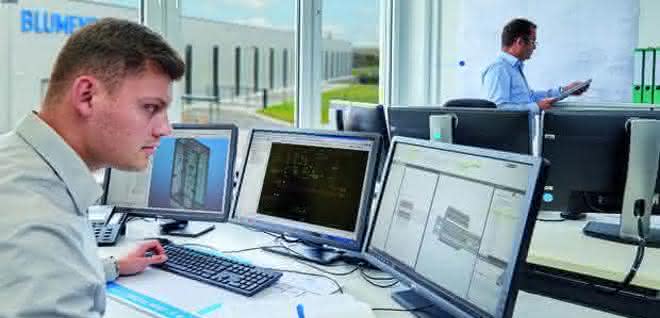
Blumenbecker Automatisierungstechnik, based in Beckum, Westphalia, is part of the internationally active Blumenbecker Group with three business segments: Industrial Automation, Industrial Service and Industrial Trade. With 1,450 employees, the group offers individual solutions and services for process automation, control technology, industrial maintenance and industrial supplies. "We cover the entire range of services for the production and assembly of a wide variety of switchgear - from individual switchgear to highly complex technical equipment," explains Florian Sontowski, Project Manager in Innovation Process Management at Blumenbecker. "As a driver of innovation, we deal extensively with all the latest trends in automation."
From digital planning in the CAE system and the assembly of terminal strips to labeling, wiring and in-house UL labeling by its own standards officer, the company has in-depth expertise in all areas of control cabinet construction. As a technology supplier for a large customer base from a wide range of industries, Blumenbecker uses a broad spectrum of components. Sontowski: "This often involves the question of how we can most efficiently get the wide range of items to the right position in the control cabinet."
In research and industry, the topic of efficiency in enclosure construction is nothing new: consistency in processes, high-quality data and seamless interfaces have long been demanded. In theory, there is a broad consensus - but how do you get the issue off the ground? Blumenbecker saves costs in the double-digit percentage range, depending on the work order, by using a "smart" picking system. The company sees similar savings potential in the optimization of the entire workflow, right through to the assembly of the terminal strip with the help of the planning and marking software Project complete.
From paper layout plan to digital
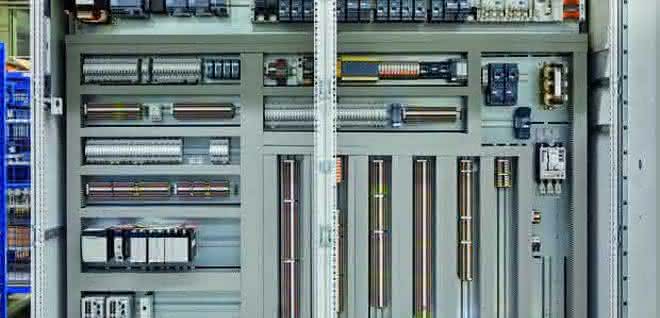
Conventional parts lists and assembly plans on paper require long search routines for the electricians. With the high item variance for many different control cabinet assemblies, each electrician had to gain extensive experience in order to be able to work quickly and effectively.
"In times when there is an increasing shortage of skilled workers, our skilled workers should be able to use their expertise to wire things up quickly," explains Sontowski. "Manually searching for components on paper printouts is simply no longer up to date."
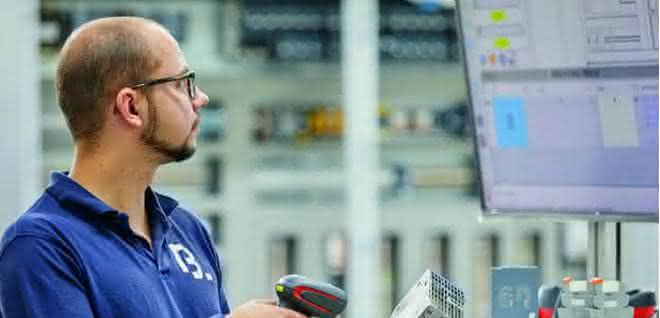
In addition to the paperless component search, the focus is on optimized handling of the terminal block. This is not exactly a cost-driving factor in control cabinet construction. But with small quantities down to one, the items to be used are often not stored in the terminal block diagrams. "As a result, terminal strip engineering was often outsourced directly from the office to production," says Sontowski.
If you look at the process costs for a simple connection point in the control cabinet from planning to production from this perspective, the situation is different. The engineering process accounts for a large proportion of the total costs, while the material costs of the terminal block play a subordinate role. "When looking at the process chain as a whole, the high savings potential becomes clear," notes Sontowski. "That's why we are working on a terminal block solution that provides us with digital support from engineering to production."
Smart solution for enclosure construction 4.0
For a continuous process chain, the entire approach was put to the test. The EIP system was designed under the maxim "flexibility through modularity" - the abbreviation stands for "Easy Intelligent Process". The electrician can scan in pre-picked and labeled article assemblies. He is immediately shown the correct positioning, either in the digital layout plan or even via a light point in the actual control cabinet. Assembly is then carried out directly - without having to laboriously search through paper plans.
In order to optimize the process chain and improve terminal block handling, Blumenbecker Automatisierungstechnik opted for a test setup with the planning and marking software Project complete from Phoenix Contact. The deep integration of the software in all common CAE systems such as Eplan Electric P8, Eplan Pro Panel, WSCAD Suite X and the E³ series from Zuken ensures the necessary data consistency. This saves valuable time in the engineering process.
The connection points are transferred at the click of a mouse and Project complete uses them to create a fully equipped digital terminal strip. The bidirectional interface then writes all the required article numbers, including the required accessories such as end caps and end clamps, back into the CAE system. "This information is rarely maintained in our customers' CAE projects, as the effort involved is relatively high. This interface is a real potential efficiency factor for us," says Sontowski, assessing the decision to test the software.
Project complete can also be used directly in production. At the station with Project complete, mounting rails with terminal blocks can also be permanently assembled according to their digital image - paperless and directly from engineering. In this way, the optimized assembly process around the article assemblies then also extends to the terminal blocks.
The challenge in switching to the new digital solution in day-to-day production lies in gaining acceptance among employees. "It's about a fundamental change in the production process," says Sontowski, "and we want to actively involve our employees and show them the benefits right from the start. Our colleagues already don't want to do without the new EIP system, and we expect the same effect when using Project complete."
B.Eng. MLitt. Sophia Bulmahn, Senior Project Manager Digitalization & Engineering, Business Unit Industrial Cabinet Solutions, Phoenix Contact


You might also be interested in
Protection against electrostatic discharge
StoFloor ESD KU 614 from StoCretec: dissipative flooring with the latest technology meets all ESD standards, is economical, extremely durable, mechanically and chemically resistant. The surface can be adjusted to be slip-resistant. The system is...
 read more...
Cables and wires from Helukabel
Food cultivation on a new level
Vertical farming - cultivation in multi-storey greenhouses - is considered one of the most exciting trends in food production. One of the pioneers in this field is the Romanian start-up Ultragreens. The company relies on solutions from Helukabel to...
read more...Further training for specialists to become security experts
With the "CESA - Certified Expert for Security in Automation" qualification, automation expert Pilz offers a two-day expert course designed to provide participants with compact security knowledge in line with the latest standards.
read more...Meaningful data on the service life of the seal
Seals prevent substances from penetrating or entering technical components. The intelligent seals from Freudenberg Sealing Technologies can significantly expand this core task in the future: the seal itself is also a sensor and becomes a "smart...
read more...Online stud configurator according to drawing
For standard bolts, with head, thread or hole
For standard bolts, with head, thread, bore or as a version with recess, mbo Osswald configurators map the standard specifications, are very easy to use, take a lot of work off the user's hands and save a lot of time.
read more...Safe palletizing with the Cobot
Verla-Pharm's medicinal products and food supplements have been available for decades. Ever-increasing throughputs result in ever-increasing logistics costs, whereby optimum utilization of the available production space is necessary.
read more...The tiger among processors
Since the move towards the Industrial Internet of Things (IIoT) and Industry 4.0 has picked up speed, processor boards and modules must be able to process exponentially growing amounts of data.
read more...VDWF publishes "Sustainability Compendium"
Nowadays, nobody can avoid "sustainability": In addition to a far-reaching presence in the media, it is also becoming increasingly important for companies in the tool and mold making industry to develop and implement appropriate concepts.
read more...More transparency and synergies with QM software
Weber, manufacturer of wood and metal sanding machines and extruders, has reorganized its quality management with ConSense IMS Professional. The software solution enables transparent documentation and more efficient processes.
read more...