


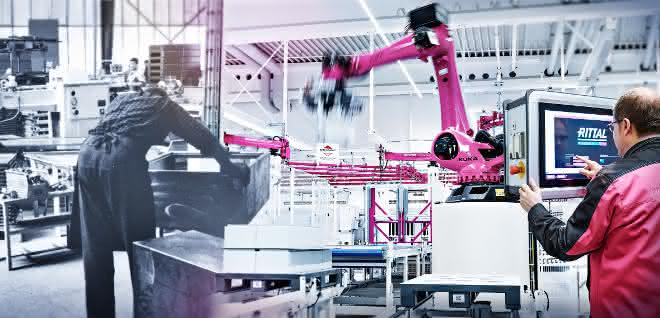
Rittershausenin Dietzhölztal - nobody knew in 1961 that a small community in central Hesse would one day give its name to a globally successful company. Rudolf Loh bought an old weaving mill here and founded Rittal. The idea: standard enclosures in series, immediately available from stock, faster and better than the sheet metal enclosures for machine control components that were individually manufactured at the time. Long delivery times and quality defects were now a thing of the past. The boom of the post-war years had changed industrial production. Machines were linked together and produced products in large series as consumption grew. So Rudolf Loh's idea came at just the right time.
A lot has happened since then. Rittal solutions are used in control and switchgear construction as well as in IT and the energy market, in shipbuilding, hospitals and soccer stadiums. 58 subsidiaries provide sales and service for Rittal products worldwide. Rittal is the largest employer in the region and recently invested over 250 million euros in the construction of a new, fully digitally integrated plant in Haiger.
From the system to the cloud
In the course of industrial automation, Rittal developed the enclosure into an entire enclosure system. The products were intended to solve several customer problems at once, for example with climate control and power distribution solutions. To this day, the company and its corporate culture are characterized by the system concept - and the aspiration to drive change rather than just react to it. The system prevailed, not only in industry, but also in IT, where Rittal made a name for itself as a "newcomer". To this day, energy efficiency, climate change and fail-safe power distribution are highly relevant topics in which Rittal makes its customers successful with innovative solutions for industrial and IT infrastructures of all sizes.
At the same time, Rittal invested in a small company with two employees in the mid-1980s and set up Eplan - at a time when hardly anyone was thinking about software solutions for enclosure technology. Over the next few years and decades, a wide range of engineering software and services was developed. Today, Rittal's sister company is one of the world's leading software providers for electrical engineering. Together, Eplan and Rittal optimize and industrialize the entire value chain of customers in control and switchgear manufacturing. The current range includes automation solutions such as processing machines for enclosures as well as sophisticated enclosure system technology.
From the digital twin to edge computing
Helping to shape technological change in the industry worldwide and taking responsibility for its home in Central Hesse - that was Rittal's goal when it invested in the construction of the world's most modern compact and small enclosure production facility to Industry 4.0 standards in Haiger five years ago. The plant was launched in 2020. Hundreds of machines and workstations were networked in order to digitally handle highly complex processes from ordering to production and logistics. In the course of this, the company joined forces with its sister start-up German Edge Cloud to create intelligent edge and cloud solutions tailored to the needs of industry, housed in its own data center and tested in-house. Rittal is thus once again on the path to standardization, also in the field of digitalization: German Edge Cloud is a founding member of Gaia-X, the European data infrastructure consortium, and a member of Catena-X, the automotive network for secure data exchange.
People in the family business
For decades, the company's employees have shaped change - from the youngest trainees to the most experienced specialists, from the development of innovations to the integration of refugees. The largest employer in the Central Hesse region and a family business by conviction: Every year, the employees of the Friedhelm Loh Group - Rittal and its sister companies Eplan, Cideon, Stahlo, LKH, German Edge Cloud and Loh Services - donate together for a good cause, already totaling well over 5 million euros. To mark the 50th anniversary, owner Prof. Friedhelm Loh established the Rittal Foundation, which has been supporting social, educational and cultural projects and institutions ever since.
"I am very proud of the 60-year success story that we have written together with all our employees," says Prof. Friedhelm Loh, owner and CEO of the Friedhelm Loh Group: "What sets us apart is curiosity, customer focus, the courage to take risks and the joy of shared success. Because we love the future."


