
Mechanical engineering economy
VDMA also sees a decline in production in 2020
The consequences of the trade dispute between the USA and China are becoming increasingly noticeable. Production and incoming orders in the mechanical engineering sector are declining. The industry is expecting more short-time working.
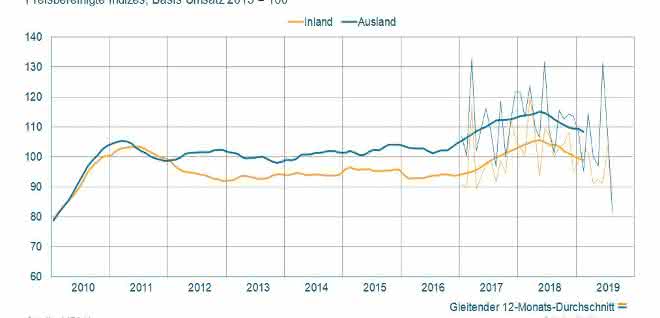
Germany's export-oriented mechanical engineering sector is increasingly suffering from the turmoil on the international markets. In particular, the still unresolved trade dispute between the USA and China is causing problems for companies, as it is having a direct and indirect impact on more and more sectors and countries.
A recent VDMA survey of German mechanical engineering companies in China shows that the mood there is also suffering from the trade conflict. 40% of the companies surveyed described their current business situation as "poor" and a further 40% as "satisfactory". These are the worst figures since this VDMA survey began three years ago. And companies in China do not expect the situation to improve in the fourth quarter of 2019 or the first quarter of 2020.
Decline in incoming orders
As a result, trade disputes, increasing protectionism around the globe and the unresolved Brexit are leaving their mark ever more clearly on the mechanical engineering sector's books - as is the far-reaching structural change in the automotive industry. Overall, orders in the mechanical engineering sector in the first eight months of the year were 9% lower in real terms than in the previous year.
According to preliminary figures, production fell by 1.6% in the same period. "It is still unclear whether we are only in a phase of economic weakness or at the beginning of a real recession. But a rapid upturn is definitely not in sight," says VDMA President Carl Martin Welcker. "We are therefore sticking to our production forecast, which predicts a real decline of 2 percent for both this year and 2020."
Short-time work becomes more important again
In July, 1.06 million people were employed in mechanical engineering companies with more than 50 employees. This was 1.1 percent more than in the previous year. And many companies are still looking for skilled workers, for example to implement the digital transformation.
However, short-time work is becoming more significant again in view of the slump in orders in some branches of mechanical engineering. In the first half of the year, an estimated 5,000 people in the mechanical engineering sector in Germany were on short-time work, compared to just 3,200 employees in the first quarter of 2019. "Should there be a further economic downturn in the country, it would make sense to extend short-time work to 24 months - as was the case in the crisis year 2009. Clarity on this must be created now so that companies can plan," says Welcker. The VDMA is calling for it to be written into law now that the Federal Employment Agency will once again pay social security contributions if companies then provide their employees with further training.


You might also be interested in
Plagiarius 2024 negative prize
On January 26, 2024, the Plagiarius campaign awarded its dreaded "Plagiarius" negative prize for the 48th time to manufacturers and retailers of particularly brazen counterfeits and fakes.
 read more...
Ivalua honors winners of the Generative AI...
AI-supported "add-ons" for buyers within 48 hours
Ivalua, provider of cloud-based spend management solutions, announced the winners and innovations of the first Generative AI Innovation Cup. The competition took place in December 2023. It was open to all Ivalua partners and employees - more than...
read more...Efaflex celebrates 50 years of high-speed...
The emphasis is on "fast"
Since day one, Efaflex has wanted to use new technologies as early as possible and drive progress in the industry. This year, the family business is celebrating its 50th anniversary under the motto "Fast Forward".
read more...Security of supply even during power outages
In the winter of 2022, Germany was worried about energy shortages. The drugstore retailer dm did not paint any horror scenarios, but nevertheless saw the possibility of controlled, temporary, regional power cuts (brownouts).
read more...Safety technology in mechanical engineering
Modules with new functions
Euchner's product highlights at EMO 2023 include the communication-capable solenoid interlocks.
read more...Transforming the paper industry towards climate neutrality
Together with partners from industry and research, Voith is developing a project for the optimization of energy and material flows in paper production. The aim of the research project is to develop a digital framework that enables effective process...
read more...Up to 95 percent less flue gas thanks to direct extraction
The requirements for occupational safety measures and safety technology are also constantly increasing in welding technology. The Technical Rules for Hazardous Substances (TRGS) stipulate that welding fumes and harmful substances must be extracted...
read more...Competitive advantages with large machines
Whether 3D-printed components for machines and systems, prototypes or aids for design: additive manufacturing is almost indispensable for modern companies in mechanical and plant engineering and automation if they want to play in the premier league.
read more...Transport technology from the modular system
Many transport tasks can be realized with the help of linear technology. Pre-configured solutions are available to simplify the interaction between the linear unit, motor, gearbox and controller. This minimizes the effort required for research and...
read more...