
VDMA annual press conference
Mechanical engineering remains robust in a difficult environment
According to the VDMA, mechanical engineering companies in Germany successfully weathered the trade policy storms in 2018 and even increased their workforces despite many uncertainties.
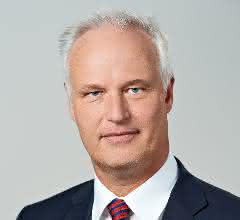
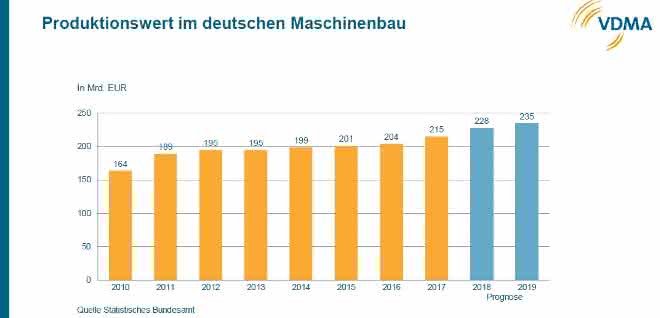
"Our production growth forecast for 2018 of 5 percent to a record value of 228 billion euros is ambitious, but achievable," said VDMA President Carl Martin Welcker at the association's annual press conference. After ten months of the current year, the mechanical engineering sector recorded an increase in production of 3.7 percent. This makes 2018 the second year of growth in a row.
In the first ten months of the current year, incoming orders in the mechanical engineering sector increased by 7% compared to the previous year. At the same time, the number of employees (in companies with more than 50 employees) in Germany rose by 34,000 to 1.067 million by September - an increase of 3.4 percent. "This shows that mechanical engineering companies are not afraid of the future and want to continue investing," explained Welcker. The number of people employed in the mechanical engineering sector is more than 1.3 million, making it the largest industrial employer in the country.
However, companies are concerned about bottlenecks both in the supply chain and in terms of skilled workers. According to recent surveys, 27% of mechanical engineering companies in Germany are suffering from a shortage of labor, while 28% of companies are experiencing production bottlenecks due to material shortages. "These bottlenecks could continue to limit growth this year," said Welcker.
2019 with less momentum
For the coming year, VDMA economists only expect production growth of 2% in real terms in the mechanical engineering sector. The pace of the global economy is expected to slow down. This will also be felt in the mechanical engineering sector, which has an export ratio of almost 80 percent. On a positive note, orders on the books currently still have an average range of 8.6 months.
However, the ongoing trade dispute between the USA and China, in which the EU could also be drawn into even more, the threat of a hard Brexit, the sanctions against Russia and Italy's debt crisis are only the most obvious hurdles to further growth. "We have to expect that all these restrictions on free trade will also have a greater impact on the mechanical engineering sector," said Welcker.
On the other hand, the medium-sized industry is hoping for continued momentum from the domestic market: although investments have already picked up in Germany, they are still below average. "In addition, automation solutions offered by the mechanical engineering sector are becoming indispensable for many companies, especially in times of a shortage of skilled workers," said the VDMA President.
Tussle for the top spot between China and the USA
Exports by mechanical engineering companies from Germany increased by a nominal 5.2% to 131.9 billion euros in the first nine months of 2018. China (up 11.4% to EUR 14.23 billion) and the USA (up 6.9% to EUR 14.16 billion) are neck and neck, with the People's Republic just ahead. However, the increase in exports to China in this period is clouded by the prospects of a weakening Chinese domestic economy, which is also suffering from the punitive tariffs imposed by the US government.
At the same time, labor and production costs in China are continuing to rise. The economy in the United States is currently still benefiting from lower corporate taxes, but domestic investment is already weakening here too. "We therefore expect the EU to vigorously push ahead with negotiations on both a lean free trade agreement with the USA and an investment agreement with China," demanded Welcker. The European Union is also called upon to ensure greater cohesion between the member states in its own region, especially in the year of the European elections.
In order to strengthen the economy within the EU, it is also necessary to reduce excessive bureaucracy, which causes enormous additional costs, especially for SMEs, Welcker emphasized.
Welcker emphasized, citing the national implementation of the Posting of Workers Directive as an example. Fitters or service specialists often have to travel to customers within Europe at very short notice - but this is basically made impossible by the regulations.
Danger of a hard Brexit remains
Brexit is still proving to be a burden on business that is difficult to assess. Exports by mechanical engineering companies from Germany to the UK increased by 4.5% in the first nine months of 2019 - a strong build-up of stocks and investments brought forward are likely to have played an important role here. However, the risk of a hard Brexit with all its difficult-to-assess consequences remains until the UK parliament approves the withdrawal agreement. "In view of the unclear situation, our companies must prepare for a hard Brexit at full speed. The chances of avoiding this scenario are getting smaller every day," warned Welcker.
Politics must not favor any technology
The mechanical engineering industry has clear expectations for the further work of the grand coalition in Berlin. "Objective policy instead of personnel debates is now imperative," emphasized the VDMA President. This includes continuing to fight for free global trade, but also an innovation policy that promotes digitalization in many areas of society and is technology-neutral at the same time. "The state does not know better than companies and their customers which technology will prevail," warned Welcker. The mechanical engineering president also reminded the government of its promise of tax incentives for research.


You might also be interested in
German industry under pressure
Industry association cancels growth forecast
The Federation of German Industries (BDI) believes that German industry remains under pressure and expects stagnation instead of growth. At the same time, the association is emphasizing the industry's innovative strength at the Hannover Messe.
 read more...
Why eleven federal states are calling for the use of low-emission steel in the automotive industry
Heads of federal states put pressure on Brussels: Eleven German federal states appeal to the EU to promote low-emission steel in the automotive industry more strongly. The German Steel Federation supports the initiative as an important lever for...
read more...Setting the course for Germany's technological future
The Federal Cabinet adopted the microelectronics strategy today. Germany wants to become a leader in microelectronics. The Federal Government's new strategy: bundling topics such as research, skilled workers and production in order to strengthen...
read more...European elections FSK 16
Good news: over the past 20 years, voter turnout in European elections in Germany has risen continuously - from 43.0% to just under 64.8% recently. I like the idea of allowing young people aged 16 and over to participate in politics in the form of...
read more...Democracy project
Many people are taking to the streets these days because they are fed up with right-wing hatred and populism. Industry is also aware of its social responsibility. "Transformation as the project of the century" is the title of a paper published...
read more...Artificial intelligence in Germany
Microsoft invests 3.2 billion euros in AI infrastructure
Microsoft has announced the largest investment in its 40-year history in Germany to accelerate the possibilities and benefits of artificial intelligence (AI) in the country.
read more...Plagiarius 2024 negative prize
On January 26, 2024, the Plagiarius campaign awarded its dreaded "Plagiarius" negative prize for the 48th time to manufacturers and retailers of particularly brazen counterfeits and fakes.
read more...100 years of Conrad Electronic
One hundred years of change
Conrad Electronic celebrated its centenary on June 21, 2023 with a gigantic event in the spirit of change. 400 high-ranking guests from business and politics as well as long-time Conrad companions were invited to the logistics center in...
read more...Loss of competitiveness?
The major associations BDI, VDMA and ZVEI are calling for more efforts to ensure that Germany remains competitive on an international level.
read more...