

VDMA annual press conference
Mechanical engineering must hold its own in a difficult environment
The year 2019 was characterized by a weak global economy, increasingly harsh threats and sanctions in global trade disputes and far-reaching structural change in the automotive industry.
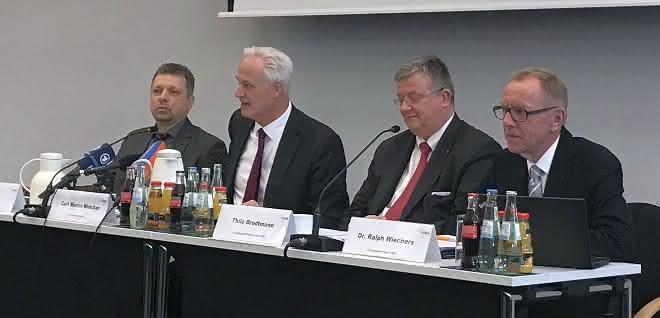
"These three developments were largely responsible for the fact that incoming orders and production in 2019 slipped significantly below the previous year's level," said VDMA President Carl Martin Welcker at the association's annual press conference in Frankfurt.
Production in the German mechanical engineering sector fell by 1.8% in real terms in the first ten months of the year compared to the previous year, while incoming orders fell by 9% in the same period. At 83.9%, capacity utilization in October was below the long-term average of 86.2%. "Our industry is not in crisis, but many of our customers are unsettled and are currently postponing or stopping their investments. We will therefore probably close 2019 with a 2% drop in production to around EUR 218 billion," said Welcker.
No new momentum in sight in 2020
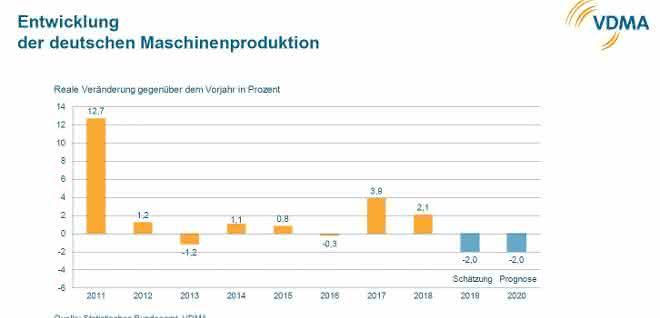
For the coming year, VDMA economists continue to expect a further decline in production of
further decline in production of 2 percent in real terms. A rapid improvement is
in sight. The order books will only fill up again in the course of the year, assuming more positive business climate data. Due to technical lead times, these orders would not lead to production growth again before the second half of the year. The prerequisite for this is that the trade war between the USA and China in particular does not escalate further.
"The economic recovery currently being observed in Germany and on important foreign markets is little more than an end to the downward process. It may herald a slight recovery over the course of 2020
and hopefully it will. However, it is too early to sound the all-clear
the all-clear, as global economic development continues to be burdened by a
still burdened by a high degree of uncertainty," said the VDMA President.
Good employment situation comes under pressure
The good employment situation in the German mechanical engineering sector could therefore
come under pressure. In September 2019, there were a total of 1.073 million
employees in companies with more than 50 employees, up 0.6% on the previous year. This means that mechanical engineering remains the largest industrial employer in Germany and is also the most important engineering employer. A record number of 200,000 engineers were recently employed in the mechanical engineering sector. "Every third company, 35% to be exact, is now complaining about a lack of orders," said Welcker.
USA outstrips China in the export rankings
Exports by mechanical engineering companies from Germany increased in the first nine
months of 2019 by a nominal 0.6 percent compared to the previous year to 134.6
billion euros. The USA remained the most important sales market (up 6.2
percent to 15 billion euros). In contrast, business with China (second place) shrank by 0.7% to 14.1 billion euros.
This reflected the consequences of weaker domestic growth in the
Republic and the trade war with the United States. Exports to the
exports to the USA, on the other hand, were still able to benefit from the impetus
corporate tax reform there, although VDMA economists expect US growth to be less dynamic in 2020.
The repeatedly postponed Brexit decision is now also having a clear impact, with exports to the UK falling by 4.8% to just under 5.7 billion euros. As a result, the country slipped to sixth place in the rankings. In the first nine months of the year, mechanical engineering companies from Germany exported goods worth 64.6 billion euros to the European Union's neighboring countries - an increase of 1.1 percent compared to the previous year.


You might also be interested in
Plagiarius 2024 negative prize
On January 26, 2024, the Plagiarius campaign awarded its dreaded "Plagiarius" negative prize for the 48th time to manufacturers and retailers of particularly brazen counterfeits and fakes.
 read more...
Ivalua honors winners of the Generative AI...
AI-supported "add-ons" for buyers within 48 hours
Ivalua, provider of cloud-based spend management solutions, announced the winners and innovations of the first Generative AI Innovation Cup. The competition took place in December 2023. It was open to all Ivalua partners and employees - more than...
read more...Efaflex celebrates 50 years of high-speed...
The emphasis is on "fast"
Since day one, Efaflex has wanted to use new technologies as early as possible and drive progress in the industry. This year, the family business is celebrating its 50th anniversary under the motto "Fast Forward".
read more...Security of supply even during power outages
In the winter of 2022, Germany was worried about energy shortages. The drugstore retailer dm did not paint any horror scenarios, but nevertheless saw the possibility of controlled, temporary, regional power cuts (brownouts).
read more...Safety technology in mechanical engineering
Modules with new functions
Euchner's product highlights at EMO 2023 include the communication-capable solenoid interlocks.
read more...Transforming the paper industry towards climate neutrality
Together with partners from industry and research, Voith is developing a project for the optimization of energy and material flows in paper production. The aim of the research project is to develop a digital framework that enables effective process...
read more...Up to 95 percent less flue gas thanks to direct extraction
The requirements for occupational safety measures and safety technology are also constantly increasing in welding technology. The Technical Rules for Hazardous Substances (TRGS) stipulate that welding fumes and harmful substances must be extracted...
read more...Competitive advantages with large machines
Whether 3D-printed components for machines and systems, prototypes or aids for design: additive manufacturing is almost indispensable for modern companies in mechanical and plant engineering and automation if they want to play in the premier league.
read more...Transport technology from the modular system
Many transport tasks can be realized with the help of linear technology. Pre-configured solutions are available to simplify the interaction between the linear unit, motor, gearbox and controller. This minimizes the effort required for research and...
read more...