

New Work
The focus is on people
How do we create spaces and structures that enable employees to work independently and creatively? The medium-sized Berlin.Industrial.Group. (B.I.G.) is tackling this key question of "New Work".
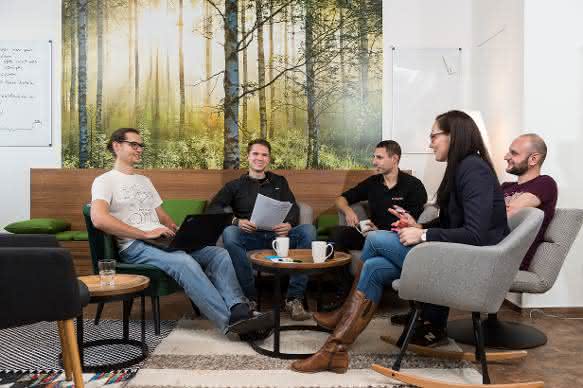
At B.I.G., silos disappear, teams decide on budgets themselves, communication takes place on an equal footing even with different areas of expertise, and customers are involved in development right from the start.
If you enter the keyword "innovation cycles" into Google, you get over 118,000 results, most of which include the phrase "ever shorter". Despite this, the majority of companies still work with project management methods from the 1980s. These are based on the assumption that even processes that take years to complete can be planned down to the last detail and all the way to the goal. Constantly adapting these plans therefore requires a great deal of effort. At the same time, "management by objectives" is also reaching its limits: Today, junior staff can no longer be won over with money and promotion opportunities alone. Millennials and representatives of "Generation Z" demand meaningfulness and autonomy in their work.
B.I.G. has been tackling these problem areas for many years. The group unites six high-tech companies that are active in promising niches. They develop and produce diode lasers, laser processing optics, optical measuring devices, turbine seals, 3D metal printing machines or individual parts and small series from the 3D metal printer. The aim in each case is to achieve a leading market position. B.I.G. employs around 320 people. The workforce is young, with an average age of 35. What all companies have in common are flat hierarchies, teamwork and the possibility of mobile working. The "you" attitude practiced there also includes the founder and shareholder Igor Haschke.
Increase satisfaction - serve customers faster
B.I.G.'s largest company goes one step further: Scansonic introduced agile working methods three years ago. Founded in 2000, the expert develops laser and automation technology for the production of metal parts. Self-learning systems in image processing lead to ever more accurate results. Its customers include major car manufacturers as well as users in rail vehicle construction and energy technology. Scansonic is the global market leader for laser-based joining systems in car body construction.
Half of the 130 employees work in development; designers, laser specialists, electronics engineers, software developers, production engineers and process developers. Impulses for new developments often come from customers themselves, who contact Scansonic with a production problem. The specialists therefore do not supply "one fits all" solutions. Each product is individually adapted to the respective order and developed and tested in the company's own application laboratory with its eleven laboratory rooms until it is suitable for everyday use.
"In 2016, we were at the point where we were considering how we could maintain the enthusiasm and motivation of our highly qualified employees in the long term," says Igor Haschke. "And how we can continue - or even better - to respond to our customers' requirements." Both became increasingly difficult due to the growing complexity of customer projects and increasing competitive pressure.
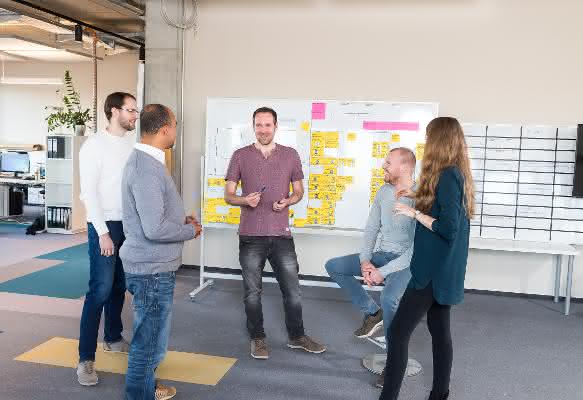
Intensive discussions with the workforce revealed that hierarchies and the resulting coordination loops generated a great deal of emotional pressure, as did rigid planning and control systems. The Scansonic development department became the blueprint for new structures and processes. Initiated and driven by the shareholder, one of the largest restructuring processes in the company's history began.
Employees take responsibility
Haschke is convinced that everyone strives for self-determination and creativity, but that the existing structures too often restrict them. He found inspiration for the planned reorganization from former McKinsey consultant Frédéric Laloux. He analyzed companies that had successfully broken new ground and were extremely successful on the market. They all have three things in common: teams organize themselves and take responsibility for their decisions. The focus is on people as a whole, because where status and competitive thinking disappear, it becomes possible to make an authentic and empathetic contribution. And thirdly, these companies allow for an evolutionary development of the company by not bindingly defining strategies.
Scansonic systematically eliminated management levels and replaced them with teams, which are now located directly below the management level. Decisions are made in the teams. Scansonic follows the Scrum method for collaboration. Originally used in software development, Scrum has long since proven itself in agile project management in other areas too. Projects are not planned down to the last detail. The illusion of predictability is abandoned. Instead, only the most important milestones are defined. The team works its way forward in bi-weekly sprints. Modifications can be taken into account immediately and customers also gain flexibility as a result. A so-called product owner keeps an eye on the topics. The days of contractually stipulated specifications are a thing of the past at Scansonic.
The experience gained at Scansonic was incorporated into the establishment of Gefertec, which was founded in 2015. The start-up developed 3DMP, a new process for the 3D printing of metallic components of up to 3 m³. Over the past four years, Gefertec has grown from three to 42 employees. From the very beginning, the company has focused on agile working methods and flat hierarchies. The newest member of the B.I.G. family, flying-parts, is a laboratory for new working structures. The company uses Gefertec machines to produce everything from individual parts to small batches. Three employees take turns, sometimes in unison, to take on the tasks of work preparation, production and customer support. Each employee can make almost every decision on an equal footing with the managing director.
The heart beats high-tech
How can the experience at B.I.G. be summarized? Like all major changes in organizations, the restructuring at Scansonic initially caused unrest. Not all employees wanted to go down the new path. Nevertheless, the majority were open-minded. "Change doesn't happen overnight and requires patience and trust from the company management," emphasizes Haschke. Perhaps the biggest challenge was to give the teams the necessary freedom. He sees this as the most important reason for the failure of many companies to switch to agile working methods: Teams are formed, but decisions are still ultimately made by the line manager. "If necessary, you have to protect the teams from the managers!"
The transformation has paid off for Scansonic. Development cycles were shortened. Customer satisfaction, measured in regular surveys, increased. The company is increasingly perceived as a partner rather than a supplier. Identification with the company and its own role has increased and continues to do so, as shown by the employee survey conducted twice a year. Last year, over 70 employees took part in focus groups to develop the new employer branding strategy. The apt claim combines people and product and gets to the heart of the matter for everyone: "My heart beats high tech". The open cooperation - even across company boundaries within B.I.G. - even catches the eye of visitors.

All of this is accompanied by a series of measures on campus that you would expect to find in Silicon Valley: from vending machines with free coffee specialties and the barbecue hut on the flower meadow to the beach volleyball court and free yoga classes during working hours. "But that's really just the icing on the cake - not the core of a New Work strategy," emphasizes Haschke. His tip for companies that are just starting to deal with the topic of New Work: "Don't start implementing it until the most important decision-makers in the company are really on board."
Christiane Herzer, Press & Public Relations, B.I.G. Marketing Consulting


You might also be interested in
High-speed transportation and positioning
In the networked factory, everything has to mesh seamlessly and quickly. This also applies to the transportation and positioning of products and materials. The linear motion system ctrlX FlowHS achieves this through flexibility and high speed with...
 read more...
Displacement measuring systems
Economic positioning
The integrated position measuring system IMS from Bosch Rexroth is now also available as IMS-compact for absolute measurement. The non-contact solution with magnetic measuring principle enables robust and economical position detection for linear...
read more...CU-Flex copper processing center
Process copper in three stations
Boschert also presented the revised CU-Flex copper processing center with its three stations for punching, bending and shearing in Hanover. This allows users to completely manufacture copper parts in just one work process.
read more...Economic positioning
The integrated position measuring system IMS from Bosch Rexroth is now also available as IMS-compact for absolute measurement. The non-contact solution with magnetic measuring principle enables robust and economical position detection for linear...
read more...Mastering logistics transparently and flexibly
In order to master the current and future challenges facing the logistics industry, logistics planners and service providers, system integrators and automation specialists must design their systems to be smart and future-proof.
read more...31 percent more sales, 10 percent more employees
Despite geopolitical and economic challenges, the Lapp Group once again closed the past 2021/2022 financial year (October 1 to September 30) successfully.
read more...Timmer at the Intec for the first time
At Intec, Timmer is presenting two compact and powerful vacuum tube lifters, the lightLift and the quickLift.
read more...Voith continues on course for sustainable growth
The Voith Group developed satisfactorily in the 2021/22 fiscal year (ending September 30) in a challenging environment and is in robust shape both operationally and financially.
read more...Punching with precision
Wink Stanzwerkzeuge from Neuenhaus has automated its punching sheet production. The company has teamed up with proven project partners for the linear technology and automation.
read more...