
Start-up Evolime
Manufacture spoked wheels efficiently from composite materials
Researchers at the Technical University of Kaiserslautern have developed a process with which spoked wheels made of fiber-plastic composites can be produced efficiently and without waste. This enables automated production tailored to customer requirements.
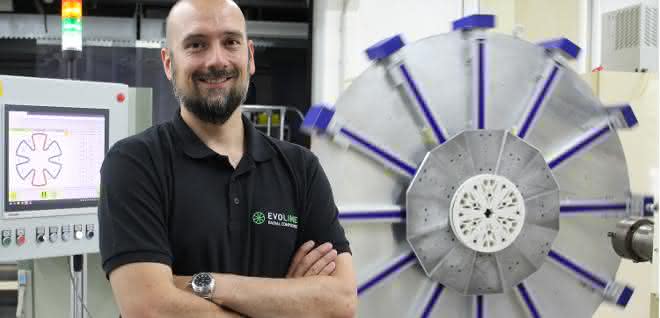
They appear in frescoes in ancient Egypt: spoked wheels. Their basic shape has not changed. They can be found on bicycles, cars and in industry. In sports, spoked wheels made of lightweight fiber-plastic composites are widespread. Until now, their production has been associated with high costs, making them unattractive for many applications. The situation is different with a new process developed by researchers in Kaiserslautern: It enables automated production tailored to customer requirements. The Kaiserslautern researchers are marketing their technology in the newly founded start-up Evolime.
It takes a lot of time to build spoked wheels from fiber-reinforced plastic composites, or FRP for short. "The process involves numerous steps, and much of it can only be done by hand," says Dr. Marcel Bücker, who has been working with fiber-reinforced plastic composites for a long time. "In addition, a lot of the expensive material has to be used, as a large amount of waste is produced," continues Bücker.
However, the process developed by Bücker and his colleagues Dr. Thomas Robbert, Valentin Hörtdörfer and Frank Belyea at the Institute for Composite Materials at the Technical University of Kaiserslautern is different. "Compared to conventional processes, we can produce the wheels much more efficiently with our three-stage process," explains Robbert. The process is also waste-free and therefore has a very good environmental balance.
"At its core, it is a so-called wet winding process in which fibers are automatically wound onto small molded parts and simultaneously formed into wheel structures," explains Bücker. First, the engineers use a 3D printer to produce molds made of biodegradable plastic. The exact shape is determined by a computer program. They are then used in the production of the wheels and are wrapped with a fiber tape on a rotating tool plate. "This continues until the desired thickness for the spokes is achieved. The still soft tape is then formed into spokes," continues Bücker. In a final step, another fiber tape is wrapped around the spokes to create a complete wheel. Once the plastic has hardened, the molded parts are removed. The spoked wheel is finished.
The special feature: Depending on customer requirements, the size of the wheel or the number of spokes, for example, can be adjusted as required. In many cases, this can be done at the touch of a button using specially developed software. This means that individual solutions can be realized for customers very quickly. The strong digital integration enables the start-up to achieve short delivery times for a wide range of components, opening up access to industries for which low weight and high performance are crucial. Applications include mechanical and plant engineering, such as high-performance grinding wheels or gearwheels for wind turbine gearboxes. Mobility applications such as bicycle wheels or car rims also offer good potential uses.
The Kaiserslautern researchers are marketing their idea in their newly founded start-up Evolime. The development to market maturity is being funded by the Federal Ministry for Economic Affairs and Energy and the European Social Fund as part of an Exist research transfer called CompoSpoke. In addition, the start-up office at TU Kaiserslautern and Kaiserslautern University of Applied Sciences is on hand to advise them. as


You might also be interested in
BS Rollen Strengthens Its Presence in North Rhine-Westphalia
With the groundbreaking ceremony, BS Rollen is launching the construction of a new company facility in Hückeswagen. The new building will house administrative offices, an assembly line, and a high-bay warehouse, and is intended to facilitate further...
 read more...
Micro motors as the driving force behind intralogistics
Suitable transport structures in intralogistics are a prerequisite in all industries in order to withstand competitive pressure in the future. The basis for this is comprehensive automation, which would be inconceivable without an armada of powerful...
read more...E-scooter with customizable damping
The startup Scuddy has significantly improved the flexibility, performance, customizability and ergonomics of its second-generation foldable e-scooter of the same name - thanks in part to damping technology from ACE.
read more...Electric multidirectional counterbalanced...
360-degree steering on three wheels
Hubtex has given its FluX electric multidirectional counterbalanced truck an update: The new generation for the three-ton capacity class.
read more...New FLUX: 360-degree steering on 3 wheels
HUBTEX presents the new generation of the FLUX 30 electric multidirectional counterbalanced truck (load capacity 3 t). The innovative 2-in-1 stacker is both a front and sideloader. With its patented 360-degree HX steering, it transports both long...
read more...Norelem supports VDI Racing Camp
Mastering the challenges of e-mobility
Promoting young talent has been a priority at Norelem for many years: the company supports young talents with components and the necessary know-how and provides schools with illustrative material.
read more...igus:bike honored with German Design Award 2023
A wide, angular frame made of plastic, black wheels with Y-spokes: The futuristic look of the bicycle designed by Dutch bicycle developer mtrl with motion plastics from Igus can look forward to the prestigious German Design Award 2023.
read more...Floating garbage trap cleans up the Rhine
Every day, a ton of garbage flows down the Rhine. To catch some of it, the Cologne-based Krake association has now inaugurated a floating garbage trap. One of the sponsors of the so-called Rhine octopus is the plastics specialist Igus.
read more...Torwegge presents FlexO rollers
Visitors to the FMB - Supplier Fair for Mechanical Engineering can once again look forward to a new product at the Torwegge stand this year: the FlexO rollers.
read more...