

Lightweight construction
The mobility of tomorrow
Lightweight construction is no longer just about increasing payloads and reducing fuel consumption by lowering vehicle weight. New possibilities are opening up thanks to concept lightweight construction.
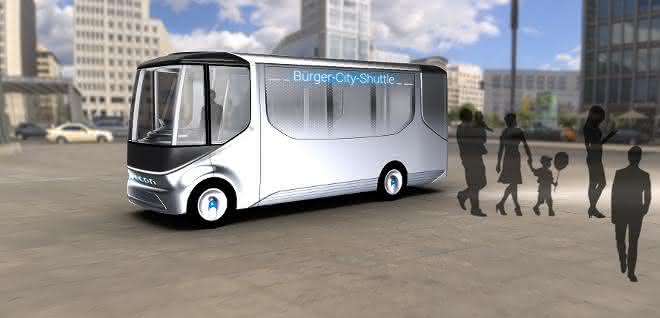
Whether "Vision Urbanetic" from Mercedes-Benz, the EZ-PRO study from Renault or the Uccon from Teamobility - this year's IAA focused on new mobility concepts. However, the ideas presented in Hanover cannot be implemented without lightweight construction.
"If we move away from a classic car with a heavy engine and a large radiator at the front and a tank at the back of the vehicle, then we have completely different possibilities for completely rethinking and redesigning a car thanks to concept lightweight construction," says Dr. Wolfgang Seeliger, Managing Director of Leichtbau BW. "I believe that the potential of conventional lightweight construction, in which steel is replaced by aluminum or carbon fibers, has largely been exploited in the automotive industry," says Seeliger and therefore demands: "We have to understand lightweight construction differently - and with concept lightweight construction we have completely new ways of thinking about a vehicle in order to increase the payload not just by 50 or 60 kilograms, but by several hundred kilograms."
Concept lightweight construction starts with the question of exactly which customer requirements and user functionalities the product must fulfill. "The design and construction are then tailored precisely to the fulfillment of these identified functions," says Prof. Johann Tomforde from Teamobility. "A vehicle that transports goods or people over comparatively short distances in inner-city traffic places completely different demands on the chassis, construction and design than, for example, a vehicle that is to transport goods over long distances at high speeds on the highway," explains Tomforde.
Vehicle weight is playing an increasingly important role here. With a lower weight, more payload can be transported and energy consumption and emissions can be reduced. "And with regard to electric drives, a lower weight increases the range of a vehicle - but range in the form of more batteries is very heavy and expensive. So lightweight construction can save money here," adds Seeliger. Studies by Renault and Mercedes-Benz show that the topic has long since reached the major OEMs. "Without lightweight construction, there will be no mobility of tomorrow," Dr. Wolfgang Seeliger is certain.
Teamobility from Böblingen presented the Uccon, a prime example of lightweight design, at the IAA: The lightweight rolling chassis developed can be used as a universal platform for bodies of all kinds and can also accommodate various sustainable drive systems depending on industry requirements or customer needs.
Changed cityscape
If mobility concepts change in the coming years and decades, the image of our cities will also change. "Not least because the challenges and the pressure to act are already there today - I'm thinking, for example, of the headlines at the beginning of the year that sand is becoming scarce and building is becoming more expensive as a result, or the unbroken run on the metropolitan areas. In future, we will have to create more living space for people with less material," says Seeliger. To achieve this, architecture and mobility need to grow closer together and complement each other. "In our network, we are developing ideas and solutions for what the city of tomorrow could look like, such as how we will live or get to work in the future. With our vision of 'lightweight construction in the urban system', we want to help conserve resources and make our built environment more liveable for people," says Seeliger. And Prof. Tomforde adds: "In order to maintain and provide people with mobility, we need low-emission and resource-conserving overall systems. On the one hand, this requires a close interlinking of politics and municipal urban and district development with innovative product development processes - and on the other hand, we need the consistent implementation of resource-saving lightweight construction."
Joint stand at the IAA Commercial Vehicles
Making the mobility concepts of tomorrow a reality requires the expertise and products of smart suppliers - as presented by the seven exhibitors at the "Lightweight Construction from Baden-Württemberg" joint stand in Hanover over the past few days. From lightweight core materials and ultra-lightweight aluminum wheels to cost-effective lightweight components made of fiber composites for body structures, the companies from Baden-Württemberg demonstrated their expertise in making components and vehicles lighter.


You might also be interested in
German industry under pressure
Industry association cancels growth forecast
The Federation of German Industries (BDI) believes that German industry remains under pressure and expects stagnation instead of growth. At the same time, the association is emphasizing the industry's innovative strength at the Hannover Messe.
 read more...
Why eleven federal states are calling for the use of low-emission steel in the automotive industry
Heads of federal states put pressure on Brussels: Eleven German federal states appeal to the EU to promote low-emission steel in the automotive industry more strongly. The German Steel Federation supports the initiative as an important lever for...
read more...Setting the course for Germany's technological future
The Federal Cabinet adopted the microelectronics strategy today. Germany wants to become a leader in microelectronics. The Federal Government's new strategy: bundling topics such as research, skilled workers and production in order to strengthen...
read more...European elections FSK 16
Good news: over the past 20 years, voter turnout in European elections in Germany has risen continuously - from 43.0% to just under 64.8% recently. I like the idea of allowing young people aged 16 and over to participate in politics in the form of...
read more...Democracy project
Many people are taking to the streets these days because they are fed up with right-wing hatred and populism. Industry is also aware of its social responsibility. "Transformation as the project of the century" is the title of a paper published...
read more...Artificial intelligence in Germany
Microsoft invests 3.2 billion euros in AI infrastructure
Microsoft has announced the largest investment in its 40-year history in Germany to accelerate the possibilities and benefits of artificial intelligence (AI) in the country.
read more...Plagiarius 2024 negative prize
On January 26, 2024, the Plagiarius campaign awarded its dreaded "Plagiarius" negative prize for the 48th time to manufacturers and retailers of particularly brazen counterfeits and fakes.
read more...100 years of Conrad Electronic
One hundred years of change
Conrad Electronic celebrated its centenary on June 21, 2023 with a gigantic event in the spirit of change. 400 high-ranking guests from business and politics as well as long-time Conrad companions were invited to the logistics center in...
read more...Loss of competitiveness?
The major associations BDI, VDMA and ZVEI are calling for more efforts to ensure that Germany remains competitive on an international level.
read more...