
Education
Learning on an automated object
At the electronics school in Tettnang, students learn in a practical way, and in the iLearning Factory 4.0 a production chain is realistically mapped, which packs plastic chips in containers, for example.Murrelektronik provided hardware for the automation technology.
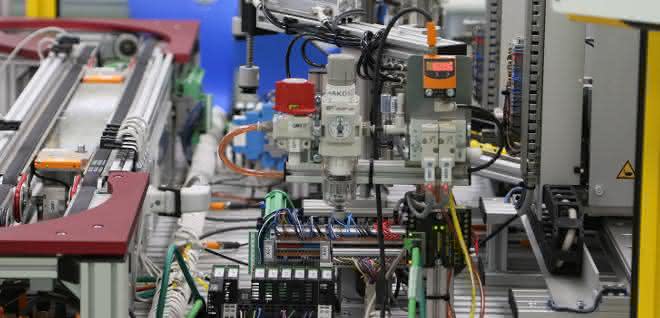
Almost 1000 students attend the electronics school in Tettnang every school year. They are trained and educated in the fields of automation technology, electrical engineering and information technology. This kind of specialization is unique in Germany. Some students come to the electronics school full-time, others attend part-time, in the evenings and at weekends. They attend classes voluntarily, so to speak - and that is why the school is very committed to offering them an attractive program. This applies to lesson times, close cooperation with companies - and learning content that captivates and inspires the students and motivates them to attend school.
The electronics school submitted a determined application when the Baden-Württemberg Ministry of Economic Affairs, Labor and Housing invited tenders for a measure to set up learning factories at vocational schools. The aim is to prepare skilled and junior staff for the demands of digitalization in a practical way. The electronics school was awarded the contract for such a laboratory and received financial support from the state and the school authority, the Lake Constance district.
This covered the first part of the investment volume of 1.1 million euros - beyond this, the electronics school had to find partners from industry for its project. The idea was not to collect checks. Rather, the companies provided products and components as well as working time and expertise for the creation of the iLearning Factory 4.0. The laboratory was put into operation with a ceremony in October 2018.
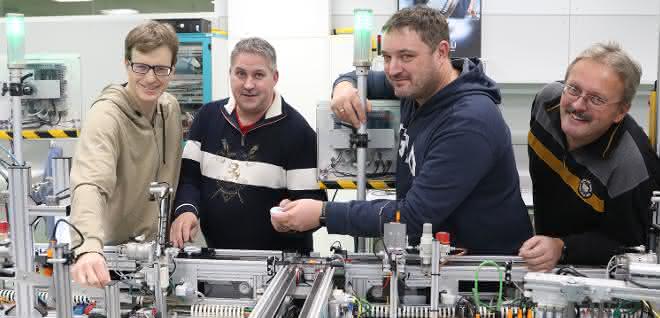
Automation components from many manufacturers are now installed in the system. This is entirely desirable, says teacher Christian Schick: "The students should see and understand how the components work together." The system consists of six modules with numerous sensors and actuators. These work cooperatively and - after an order has been entered via a web interface - pack plastic chips into containers in several work steps. This is done in a high degree of variance, with containers in different shapes, sizes and colors. This requires a high degree of flexibility from the automation solution.
Hardware from Murrelektronik
Murrelektronik is represented with hardware in the iLearning Factory 4.0. The Cube20S fieldbus station and the compact Cube20 fieldbus modules are used for the electrical connection of the sensors and actuators to the controller. These systems offer a high packing density to connect a large number of channels in a small space. With these modules, students can see how individual wires in the IP20 range are connected to terminals.
Thanks to the modular design of the Cube20S, additional modules can be added quickly and easily if further functions need to be added to the system. To effectively integrate sensors and actuators that are located slightly outside the core area of the system, modules from the Cube67 field bus system are installed. They are installed in the immediate vicinity of the process, from where the components are integrated into the system with the shortest possible connection cables.
Pre-assembled M8 and M12 connection technology is used here, which reduces the risk of wiring errors to a minimum. The compact Impact67 fieldbus module from Murrelektronik is also part of the installation solution; it provides another way of integrating sensors and actuators into the installation economically.
At the iLernfabrik 4.0, students learn in a particularly practical way. They work on issues that they also encounter in everyday working life. This can include, for example, students working on the task of how to integrate a button, a signal light or even an entire functional unit such as an automatic feed unit into the iLearning Factory 4.0 and thereby increase the degree of automation.
Some other examples: How can you proceed to replace a device in the system without causing a long-lasting machine downtime, which would be cost-intensive in "real life"? How can processes within the system be visualized in order to identify whether the signal exchange between the individual participants is working smoothly? How can a solution for predictive maintenance be integrated into the system?
"Many of the tasks that we work on with the students on the system are also dealt with in their companies," says teacher Andreas Greck, who also sees this as an interesting aspect for the companies that have provided material for the iLearning Factory 4.0: "The students work with the components and get to know them. If they have to choose a manufacturer's products in their day-to-day work, they are naturally happy to fall back on those with which they have already had good experiences."
Jürgen Zeltwanger, Managing Director of Murrelektronik (CSO, CTO), is happy to support the ambitious work of the school and the teachers: "We are committed to the iLernfabrik 4.0 electronics school because we want the students to enjoy the best possible education. This is achieved in Tettnang thanks to the impressive practical orientation." as


You might also be interested in
Everything accurate in switch cabinet construction
To ensure smooth work processes, tools for processing enclosures and housings must function flawlessly and reliably. Häwa rounds off its punching range with the Multi-Press 500.
 read more...
Fast connection
In addition to the XTV terminal blocks with side conductor routing, the first terminal blocks with front Push-X connection are now also available from Phoenix Contact.
read more...Automate without control cabinets
Beckhoff wants to revolutionize the market with the MX modular automation system. Andrea Gillhuber spoke to Product Manager Daniel Siegenbrink about the possibilities that the system offers users, what experiences have already been made and where...
read more...Simply assemble cobots
Grip Handhabungstechnik focused primarily on aesthetics when designing its new cobot tables. However, functional and ergonomic aspects also played a major role in creating a perfect working environment for the operation of lightweight robots.
read more...3D printing drone supports fire department in operations
Every day, firefighters risk their lives in unknown environments. With the help of 3D-printed parts, David Häusermann and his team at Empa have spent six months developing and testing a heat-resistant reconnaissance drone. The "fire drone" is...
read more...Wago platform for 3D printing ideas celebrates its birthday
3D printing is in vogue. This is also demonstrated by the digital think tank and 3D printing community Wago Creators. It is celebrating its second birthday this year. Since then, the online community has grown to almost 4,000 users - time for a look...
read more...More efficiency in the control cabinet
clipx Engineer, the engineering software from Phoenix Contact, is the software for control cabinet construction that optimizes data consistency from the circuit diagram to the control cabinet.
read more...Printing and appliqué in one step
Good legibility and permanent marking are of the utmost importance for industrial marking. At the same time, it is considered time-consuming and laborious to assemble the individual markers, especially when many conductors and cables need to be...
read more...Resource-saving plastics processing
Efficient all the way to the cloud
PC-based control, the PC- and Ethercat-based control and drive technology from Beckhoff, offers the potential to make machines and systems for the plastics processing industry work more sustainably.
read more...