
Technology network
it's OWL: Projects start in fall
The it's OWL technology network is launching new projects in the fall. Companies and research institutions are developing approaches in the areas of artificial intelligence, digital platforms, digital twins and the working world of the future.
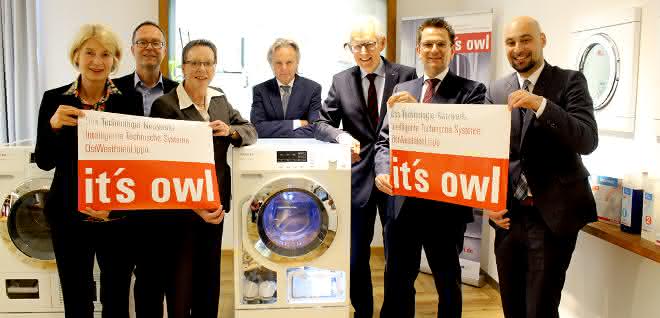
In addition, companies can apply for transfer projects in which they work together with a research institution to solve specific digital transformation challenges. The state of NRW is providing funding of 50 million euros for projects, with at least the same amount coming from industry. In total, projects worth 200 million euros are to be implemented in the Leading-Edge Cluster by 2022. In addition to the state funding, federal and EU funds will also be used for this.
Prof. Jürgen Gausemeier, Chairman of the Cluster Board, draws a positive interim balance and explains the new orientation of the technology network: "The cooperation between companies and research institutions at it's OWL is a model for success. Over the past five years, for example, around 7,500 new jobs have been created in the core industries and seven new research institutes, and 34 companies have been founded from the leading-edge cluster. With the realignment of it's OWL, we are offering companies a platform to tap into the potential of digitalization and remain competitive. This involves both the development and application of new technologies - for example in the areas of machine learning, IT security and cross-disciplinary product development. But also about shaping the world of work, training opportunities, new business models and start-ups."
Machine learning for intelligent production
Over the past six months, the 24 core companies and six universities in the technology network have developed five projects in the above-mentioned subject areas in a working committee. One of these is machine learning in production. The aim of the project is to ensure that machines and systems not only react to programmed patterns, but also learn from experience. This enables them to improve their performance over the course of their service life and automatically adapt to changing conditions. Six companies - including Miele - and four research institutes want to develop new methods for this and make them available to other companies on a platform.
Digital platforms and digital twin
In two other projects, nine companies and four research institutions are working to exploit the potential of digital platforms for small and medium-sized enterprises. The background to this is that the proportion of digital business in mechanical engineering is continuously increasing. In order to remain competitive and maintain their access to customers, companies must increasingly interlink their products with services. Digital platforms enable them to offer an end-to-end solution for customers, from incoming orders to production and logistics.
Another project focuses on the development, use and interaction of digital twins. This refers to a digital representation of a machine that connects the real and virtual worlds. The image in virtual space is created using data that is determined by sensors, for example. Digital twins can be used to depict machines and systems over their entire life cycle. For example, digital simulations can already be used during the planning of a new system in order to optimize the real processes.
New jobs and relief for employees
Information and communication technologies are increasingly finding their way into production and development work. In particular, the social aspects of workplace design are coming to the fore. In another it's OWL project, companies want to work together with universities and IG Metall to tap into the potential of digitalization for the world of work and test it in companies. This involves new approaches to management and personnel development, learning platforms and the user-friendliness of assistance systems. For example, Weidmüller is researching how augmented and virtual reality can be used in vocational training to enable individualized learning.
Supporting SMEs in the digital transformation
Successful technology transfer to SMEs is a unique selling point of it's OWL. Companies - especially small and medium-sized enterprises - can use new technologies in transfer projects with a university or research institution to solve specific challenges of digital transformation. Prof. Roman Dumitrescu, Managing Director of it's OWL Cluster Management, explains: "The transfer projects offer quick and easy access to new technologies and the latest research knowledge. The effects are directly visible in the company. This enables companies to take important steps on the path to Industry 4.0." Areas of application include the introduction of assistance systems, approaches for machine learning, new product development processes or the development of smart services. Companies receive funding of between 60 and 80 percent of the total costs for transfer projects. A company can receive up to 60,000 euros in funding.
New business concepts for intelligent manufacturing
Another focus is the development of new business ideas in the areas of smart manufacturing and digitalization. "Many approaches for smart services will emerge from our projects. Over the next five years, we want to identify 30 new business ideas and work with companies and universities to develop them into successful business concepts. The region and our cluster offer an ideal environment for this. Start-ups have direct access to their customers here. We want to support them with our network," explains Günter Korder, Managing Director of it's OWL Cluster Management. as


You might also be interested in
Conrad continues to grow
Conrad Electronic now generates 80% of its sales with business customers and has successfully developed from a traditional technology retailer into a B2B procurement platform. The company aims to become Europe's leading procurement platform for...
 read more...
AI finds its way into automotive customer service
In addition to computer solutions for vehicle diagnostics, Getac now also offers AI-based digital tools that support customer contact in service operations.
read more...SMC: "Preferred Supplier" from Bosch
The technology and service company Bosch has recognized SMC for the performance of its automation technology in factory and process automation and awarded it the status of "Preferred Supplier" in the material group "Standardized Pneumatic Devices".
read more...Combined ERP forces
The medium-sized ERP providers Step Ahead Software, Godesys and Informing merge to form the Step Ahead Group.
read more...Cybersecurity for asset-intensive companies
Forge Cybersecurity Platform, the new software platform from Honeywell, has been developed for the cybersecurity of asset-intensive companies and critical infrastructures. The platform is available in three versions.
read more...Automated machine tool as a success factor
Industry 4.0 is the hot topic of the moment. For small and medium-sized companies and contract manufacturers, it holds great potential for increasing production efficiency step by step. The focus here is on efficient and user-specific automation...
read more...Nemo hand vacuum lifts all materials
A new addition to the Eurotech portfolio is the battery-operated Nemo vacuum cleaner, which is suitable for handling almost all surfaces.
read more...Future-oriented cobot projects
Three pillars of successful cobot initiatives
What is important if cobot projects are to be future-oriented? Automation and robotics expert Omron has identified three aspects for human-machine collaboration.
read more...Short-stroke linear actuator instead of pneumatic cylinders
The new short-stroke linear actuator from Ketterer Antriebe and halstrup-walcher is characterized by high dynamics and a large stroke in a compact size. Thanks to the integrated electronics, the drive is easy to control compared to pneumatic...
read more...