
Preliminary report
Hannover Messe in the starting blocks
From 23 to 27 April, the five leading trade fairs at Hannover Messe - Industrial Automation, Motion & Drives, Digital Factory, Energy, Industrial Supply and Research & Technology - will focus on the digitalization of production and Industry 4.0. Cemat will take place at the same time.
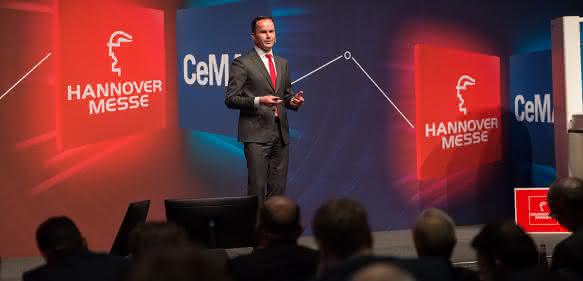
"The interplay of automation technology, platforms and machine learning takes Industry 4.0 to the next level," says Dr. Jochen Köckler, Chairman of the Board of Management of Deutsche Messe. Visitors to Hannover Messe, whose main theme is "Integrated Industry - Connect & Collaborate", will therefore be able to experience how networking in industry is creating new ways of doing business, working and collaborating. "The result: more productivity, sustainable jobs and new business models," continues Köckler.
Factory technology is becoming ever more powerful, industrial IT platforms are entering the market and suppliers are digitally connected to their customers. Added to this are machine learning approaches that enable machines and robots to make decisions.
Networking production and logistics
At the same time, digitalization is also one of the key drivers of logistics. It is about mastering complex processes and designing them efficiently. In the future, new logistics processes will be necessary to cope with the complexity of supply chains. This begins in the automated warehouse, where processes are controlled by software programs, robots navigate independently through the halls around the clock and bring goods to their destination at the right time and in the right quantity.
Production and logistics processes are also becoming ever more closely and intelligently networked. Cemat, which is integrated into Hannover for the first time this year, is intended to illustrate this fusion.
Combining IT and integrated automation
And there is another innovation this year: the new leading trade fair Integrated Automation, Motion & Drives (IMDA), a merger of the annual Industrial Automation (IA) and the biennial Motion, Drives & Automation (MDA). IMDA is intended to cover the entire spectrum of industrial automation, IT, drive and fluid technology.
In the IAMD and Digital Factory halls, companies will show how they are currently changing and what new solutions and business models are being created by combining IT and integrated automation. "IT and industry have moved towards each other from two directions," says Arno Reich, Global Director IAMD and Digital Factory in the Hannover Messe team. "Automation companies now have great software expertise and are upgrading their products and services using digital technologies. At the same time, IT and internet companies are turning their attention to the industry and are finding a highly attractive field of application there with adaptations of their existing offerings - keyword platform economy."
In order to tap into the potential of digital transformation in industry, companies need to rethink and change. As a result, automation companies are also becoming software companies and machine manufacturers are becoming providers of digital products and services. "We are currently experiencing a radical upheaval," says Rainer Glatz, Managing Director of the VDMA's Electrical Automation and Software and Digitalization associations. "For a number of years, digitalization technologies such as PLM, MES or CRM had to contend with the prejudice that they mainly generate costs. That's different now. Digitalization is increasingly seen as an enabler for new business models and additional sales."
Interlocking of energy systems
Digitalization is also changing the energy market. Innovative technologies are making the electricity system more flexible, linking sectors intelligently and integrating new market participants. With its energy section, Hannover Messe not only shows how industrial companies can save enormous costs through efficient energy use and make an important contribution to climate protection, but also how the energy transition can succeed.
"Everyone is talking about the mobility transition. But the fact is that the electricity grid is not prepared for e-cars," says Köckler. The energy industry assumes that significantly higher peak loads will occur in the future than in the past. In addition, electric driving is only environmentally friendly and sustainable if the electricity comes from renewable sources. Energy suppliers and municipal utilities are focusing on this megatrend and are starting to build the necessary energy infrastructure. This includes a nationwide supply of charging points, the expansion of distribution grids and electricity highways. And here, too, there is no way around networking: the challenge lies in intelligently optimizing the interaction between renewable energy sources, storage and electromobility. Solutions for an electricity grid that meets the requirements of e-mobility will be on show in Hanover. as


You might also be interested in
Conrad continues to grow
Conrad Electronic now generates 80% of its sales with business customers and has successfully developed from a traditional technology retailer into a B2B procurement platform. The company aims to become Europe's leading procurement platform for...
 read more...
AI finds its way into automotive customer service
In addition to computer solutions for vehicle diagnostics, Getac now also offers AI-based digital tools that support customer contact in service operations.
read more...SMC: "Preferred Supplier" from Bosch
The technology and service company Bosch has recognized SMC for the performance of its automation technology in factory and process automation and awarded it the status of "Preferred Supplier" in the material group "Standardized Pneumatic Devices".
read more...Combined ERP forces
The medium-sized ERP providers Step Ahead Software, Godesys and Informing merge to form the Step Ahead Group.
read more...Cybersecurity for asset-intensive companies
Forge Cybersecurity Platform, the new software platform from Honeywell, has been developed for the cybersecurity of asset-intensive companies and critical infrastructures. The platform is available in three versions.
read more...Automated machine tool as a success factor
Industry 4.0 is the hot topic of the moment. For small and medium-sized companies and contract manufacturers, it holds great potential for increasing production efficiency step by step. The focus here is on efficient and user-specific automation...
read more...Nemo hand vacuum lifts all materials
A new addition to the Eurotech portfolio is the battery-operated Nemo vacuum cleaner, which is suitable for handling almost all surfaces.
read more...Future-oriented cobot projects
Three pillars of successful cobot initiatives
What is important if cobot projects are to be future-oriented? Automation and robotics expert Omron has identified three aspects for human-machine collaboration.
read more...Short-stroke linear actuator instead of pneumatic cylinders
The new short-stroke linear actuator from Ketterer Antriebe and halstrup-walcher is characterized by high dynamics and a large stroke in a compact size. Thanks to the integrated electronics, the drive is easy to control compared to pneumatic...
read more...