
Reichelt survey on IIoT, robotics and AI
German industry under pressure when it comes to digitalization
Ulf Timmerman, Managing Director of Reichelt Elektronik, on the current discussion as to whether Germany can withstand the increasing competitive pressure of digitization compared to other countries.
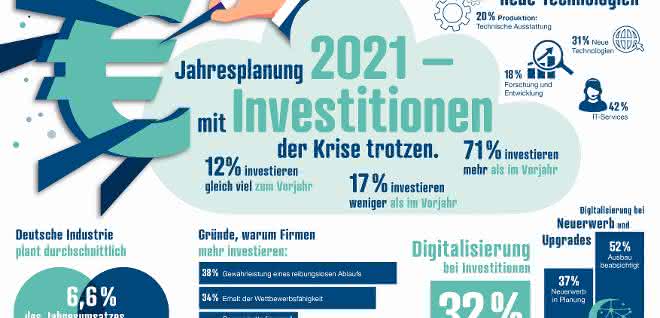
Digitalization affects us all - at least that's one lesson we've learned from the Covid-19 pandemic. In the industrial sector, it is therefore more important than ever that investments in digital technology are essential in order to maintain Germany as an industrial location - this was also the consensus at this year's Digital Summit in early December 2020. Ulf Timmermann, Managing Director at Reichelt Elektronik, uses a survey on planned investments for 2021 to show where German industrial companies are making progress in the digital transformation compared to other countries and where there is still a need for action.
German industrial companies defy corona pandemic
The coronavirus pandemic and the resulting economic consequences have put a number of German companies to the test, despite record levels of government support. In October 2020, Reichelt Elektronik commissioned the survey institute OnePoll to conduct a survey on industrial companies' budget planning for 2021 in order to find out how strong industrial companies still are in the current situation.
The representative survey results show that the picture is more positive than expected: Companies are planning to invest an average of 6.6% of their current annual turnover this year. At the same time, 71% of respondents say that they are planning to invest more than in the previous year, defying poor forecasts.
Investments in digitalization are particularly important. Around two thirds of respondents cited this task as one of their top priorities (32% as priority 1, 36% as priority 2). For example, 37% of participants are planning new acquisitions in this area, while 52% would like to expand and improve existing solutions.
Pent-up demand in the Industrial Internet of Things
In addition to the positive outlook for planned investments and the focus on digital acquisitions by industrial companies in Germany, the survey also shows that the intensification of international competition could mean that Germany is losing touch when it comes to digitalization.
Although it is known that German industrial companies have recognized IIoT as an enabler of digital transformation, innovations still fall short in a country comparison. At 25%, Germany lags behind the average of 30% when it comes to planning new acquisitions in the IIoT sector compared to other countries. One reason for this could be the still prevalent concerns about data and network security.
Germany has already achieved a high level in the field of robotics. Germany uses the most industrial robots within the EU, particularly in the automotive industry. This is also reflected in the survey, in which German IT representatives state that they want to invest less in robotics in 2021: 23% instead of an average of 31% want to invest in the topic at all. A result that can be attributed to the many investments that have already been made.
In the field of artificial intelligence, it is clear that IT managers in Germany have recognized the benefits of AI in a smart factory. A total of 69% state that they want to focus on this in 2021. Compared to the average figure of 74% for all respondents, Germany is on the right track here.
Germany can remain the number one industrial location
"Overall, Germany is well positioned as one of the world's leading innovation locations. However, global competitive pressure is increasing and there is still a lot of potential for German industry to keep up in this context," says Ulf Timmermann, Managing Director at reichelt elektronik. "In order to actively support German industrial companies in this, it is the task of the German government to promote access to data and the expansion of modern networks based on 5G."
At 36%, German industrial companies are in line with the national average of 37% when it comes to planning new acquisitions in the area of 5G expansions. So they are ready to invest in the future, now the right framework conditions just need to be created. The Digital Summit, which has been taking place since 2016, is an important signal from the German government that the expansion of digitalization in Germany is being taken seriously.
The survey was commissioned by Reichelt Elektronik and conducted with the survey institute OnePoll in October 2020. For the study, 500 industrial companies in Germany, 253 in Italy, 250 in France, 125 in Austria, 125 in Switzerland and 250 in the Netherlands were surveyed.


You might also be interested in
Spectra Launches 5G RedCap Router for Industrial IoT Applications
With its new 5G RedCap routers, Spectra is expanding its portfolio to include a mobile communication technology for industrial applications designed to bridge the gap between traditional 5G and established IoT standards such as LTE-M and NB-IoT.
 read more...
5G in the industrial IoT
The Chair of Production Systems at Ruhr-Universität Bochum LPS is researching industrial applications with a local 5G network in the context of Industry 4.0.
read more...Implement milling tasks economically
Milling covers a wide range of applications - from the machining of large free-form surfaces in the aviation industry and in the manufacture of wind turbines to the milling of cavities and highly automated mass production.
read more...Mitsubishi Electric invests in the future
Further production building in Owariasahi City
Due to the growing importance of the Japanese region of Owarisahi in Aichi, Mitsubishi Electric Corporation is increasing its planned investments and announcing the construction of a second production building.
read more...Industrial Connectivity Lab opens
Siemens customers test wireless technologies
Siemens has opened a new test lab for industrial connectivity technologies at its Erlangen site. Embedded in the Siemens Technology Center on the Erlangen campus, the Industrial Connectivity Lab offers 300 square meters of space for testing...
read more...A sustainable foundation for the industry
The networks are growing together - this refers to the ongoing merging of IT and OT. Christian Korff, Managing Director Global Accounts and Member of the Management Board, Cisco Germany, explains the challenges and levers involved.
read more...It started with a timer for X-ray machines
In 2023, the automation expert Omron can look back on 90 years of innovative company history, in which many technological boundaries have been crossed and milestones set.
read more...Flexible component transport in production
Stein Automation presents the Stein 400 workpiece carrier system for parts weighing up to 80 kilograms and the C5G logistics control system.
read more...Extended image processing options
High-performance multispectral line scan camera with 5GigE
The new Linea2 4k Multispectral 5GigE camera takes machine vision systems to the next level with its performance and value, offering a 5GigE interface with five times the bandwidth of the Linea GigE camera.
read more...