

"Open Integration Partner Meeting"
Endress+Hauser: Manufacturer and user in dialog
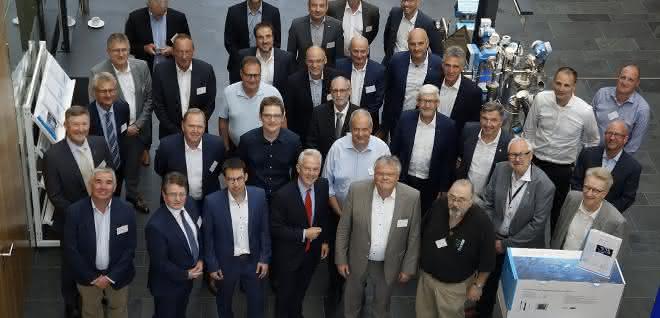
35 "Open Integration" partners met at Endress+Hauser in Reinach, Switzerland, for the first exchange of experiences and ideas. The highlight of the event: global players from the chemical and pharmaceutical industries reported on how they are already benefiting from the partner programme in the digitalization of their process plants - and what they would like to see in the future.
The aim of Endress+Hauser 's "Open Integration" partner program is the simple, fast and manufacturer-independent integration of components and devices with various automation systems and, above all, satisfied customers.
This sounds simple in theory, but it is by no means the case in everyday system operation. Even experienced automation specialists have respect for multi-vendor systems. However, this now also applies to complete solutions "from a single source". This is because digital communication - the prerequisite for the comprehensive use of existing intelligence in the field and system - places serious demands on integration.
With "Open Integration", suppliers of control technology, fieldbus infrastructure, measurement technology and actuators are invited to test and document the interaction of their products even more intensively in the interests of their customers. The cooperation partners include Auma Riester, Bürkert, Festo, Flowserve, Hima Paul Hildebrandt, Honeywell Process Solutions, Mitsubishi Electric, Pepperl + Fuchs, Phoenix Contact, Rockwell Automation, Schneider Electric and Turck.
They are based on open communication standards (Hart, Profibus, Foundation Fieldbus, EtherNet/IP or Profinet) and open integration standards (FDT, EDD, FDI). The reference topologies map practical combinations from an almost infinite number of possibilities - for applications in chemistry, life sciences, food, oil & gas, power plants & energy, raw materials & metals and water & wastewater.
Typical industry requirements such as explosion protection, availability or redundancy are taken into account in these reference topologies. Each topology is comprehensively tested in the test laboratory in Reinach in consultation with the partners, documented and then published as a recommendation.
And how do customers benefit from the "Open Integration" partner program? Every problem that the integration experts find in the run-up to commissioning can be solved much more cost-effectively in the laboratory than later on the construction site. Customers are provided with concrete and validated suggestions for the automation of their systems that go far beyond established conformity and interoperability tests and ensure smooth integration. Last but not least, this saves them a lot of time and money.
Developments such as IIoT and APL will present users with new challenges and give integration tests even more weight. This makes it all the more important for partners to work together sustainably. The company representatives present from both the customer and provider sides agreed on this point. Cyber security will play a central role in the future, as will connectivity. It is also important to counter new entrants to the automation market such as IBM or Amazon with effective strategies.
At the exchange of experiences and ideas in Reinach at the beginning of June, it became clear that the process industry wants open, interoperable systems and not proprietary solutions. One of the users is longing for standardized, structured access to static asset information via QR and RFID-supported type plates in accordance with DIN 91406. Standardized diagnostics in accordance with NE 107 is also at the top of the wish list.
Endress+Hauser intends to address these and other open questions together with its cooperation partners in the near future in order to offer customers even greater added value in the digitalization of their process plants. The common goal: satisfied customers who can make extensive and low-risk use of the opportunities offered by digitalization.


You might also be interested in
RS expands partnership with Phoenix Contact
RS Components has significantly expanded its range of products from Phoenix Contact. The distributor now supplies more than 45,000 products from the manufacturer of products, solutions and digitalization expertise for the electrification, networking...
 read more...
Component design via online tool
mbo Osswald aims to set new standards in the world of fastening technology with its new sleeve configurator. This tool was developed to design individual components for different industries precisely and in line with requirements.
read more...Competitive advantages with large machines
Whether 3D-printed components for machines and systems, prototypes or aids for design: additive manufacturing is almost indispensable for modern companies in mechanical and plant engineering and automation if they want to play in the premier league.
read more...Networking event at Schunk: Expert Days on...
Expert exchange at the highest level
On October 25 and 26, 2023, SCHUNK is once again organizing the Expert Days: an annual international and cross-industry event on the topic of "Robotic Material Removal". 70 specialists from Europe and North America will meet in Brackenheim-Hausen to...
read more...Transport technology from the modular system
Many transport tasks can be realized with the help of linear technology. Pre-configured solutions are available to simplify the interaction between the linear unit, motor, gearbox and controller. This minimizes the effort required for research and...
read more...Purchasing optimization for rolling bearing...
Best choice thanks to pre-classification
With the ABEG method, Findling Wälzlager has created a transparent and calculable decision-making basis for avoiding oversizing and undersizing of rolling bearings. This purchasing optimization helps customers to always select the technically and...
read more...Predictive maintenance on the smart drive
Baumüller offers a drive-based software solution to diagnose the machine status. The Smart Condition Monitoring tool runs on the PLC integrated in the drive controllers and uses the drive to record signals. Sebastian Maul, application engineer at...
read more...Siemens: continued profitable growth and...
Result April to June 2023: strong momentum
Siemens continued its profitable growth trajectory in the third quarter of fiscal year 2023 (ending June 30, 2023). All industrial businesses achieved strong revenue growth. The company also recorded strong order momentum for major projects and in...
read more...How production can benefit from AI
Together with AI technology, IIoT networking makes it possible to better control machine parameters and optimize quality with predictive quality. Downtimes and set-up times can also be further minimized. Cloud platforms also make these technologies...
read more...