
The challenge of generational change
Lapp prepared for social and economic change
The shareholders of the Lapp Group, the Lapp family, planned the generational change in the company at an early stage and thus prepared for the rapid changes in society and the economy. Since 2017, the third generation of the Lapp family has also taken on responsibility in the company.
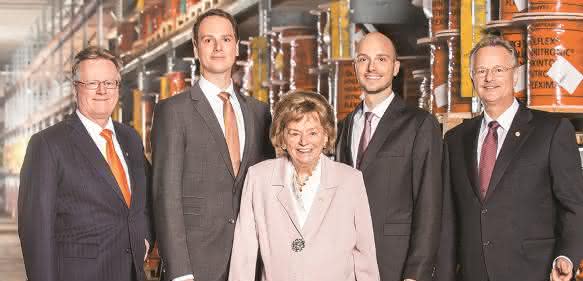
For almost 60 years, Ursula Ida Lapp (87) built up and shaped the company and turned it into a global player. In 2015, she handed over the chairmanship of the Supervisory Board of Lapp Holding to her eldest son Siegbert Lapp (65). His younger brother Andreas Lapp (63) is Chairman of the Management Board of Lapp Holding. Ursula Ida Lapp remains associated with the company as Honorary Chairwoman of the Supervisory Board.
Until June 2017, Ursula Ida Lapp remained Chairwoman of the Supervisory Board of U.I. Lapp GmbH, named after her and the largest single company within the Lapp Group. Andreas Lapp took over this role in July 2017. At the same time, he handed over his position as CEO of U.I. Lapp GmbH to Ursula Ida Lapp's grandson Matthias (35). Matthias Lapp is now responsible for the Europe, Middle East, Africa and South America region. In addition, his brother Alexander Lapp (33), the second member of the third generation of the Lapp entrepreneurial family, has assumed global responsibility for the future topic of digitalization and the further development of e-business.
"Lapp is a family business and should remain so. It has always been important to us that younger generations are introduced in good time," says Andreas Lapp. "Particularly in view of the rapid pace of digital change and a globalized economy, it is now more important than ever that the knowledge, new ideas and perspectives of young people flow into the company."
Social change
But at Lapp, it's not just about the entrepreneurial family: "If we want to attract the best employees - and we do - then we have to fulfill the wishes of all generations," said Andreas Lapp. The wishes of the different generations are very different. The so-called Generation Z (born from around 1995), which is currently entering the labor market, has its own ideas about working life and the role that work plays in its life, just like the Baby Boomers and Generations X and Y. While the baby boomers (born around 1955-1969) are primarily concerned with pay and status, the members of Generation X (1963-1981), also known in Germany as "Generation Golf", place greater value on their free time, flexibility and a good work-life balance. Generation Y (1980-2000), on the other hand, is considered to be very tech-savvy; they are the first "digital natives" who don't know life without the internet. In their job, it is important to them that it fulfills their lives with meaning and offers variety. They are career-oriented and are less focused on balancing work and family life. Generation Z, on the other hand, is even more adept at using new technologies - they are not just digital natives, for them the mobile internet has been a matter of course since childhood. Instead of status symbols and material wealth, Generation Z strives for recognition both socially and professionally. For the very self-confident children of Generation Z, their job does not have to be meaningful, it should be clearly separated from their private life and follow clear rules.
Andreas Lapp: "We need a good mix of generations and populations in the company, which is why we want to offer all our employees attractive work opportunities. In view of the different and often conflicting wishes and ideas, this is not easy." During training, for example, Lapp pays particular attention to making young people aware of how they can use digital media sensibly at work - and also what risks and legal restrictions there are. This is why the training officers at Lapp are constantly trained in the use of new technologies and take into account how differently the members of the different generations communicate. The aim is to achieve optimum cooperation in which young and old learn from each other.
For members of Generation X and Baby Boomers, balancing work and family life is often particularly important. Lapp also has numerous offers for this. In addition to flexible working hours, these include measures such as flexible shift planning with shift swaps in logistics, contact retention and re-entry programs for parents on parental leave, an advice workshop for questions about caring for relatives, training employees as care guides, offers on health issues and the establishment of a parent-child room. Employees can also choose from around 40 different part-time models. U.I. Lapp was awarded first place in the "Success Factor Family 2016" company competition for its life-phase-oriented HR policy.
Another important topic for Andreas Lapp is the diversity of the population in the greater Stuttgart area, where the Group has its headquarters. "People from 180 nations live here, speaking over 120 languages. 45 percent of the population have a migration background. These different cultural backgrounds also include different perspectives, experiences and expectations. But I am sure that if we manage to be attractive to this diverse population as a company and integrate them, then it will be a huge opportunity for us."
The new world of work
The digital world is also increasingly dominating everyday working life: "The new Lapp European headquarters is a symbol of change. With short distances and an open, flexible office environment, we offer completely new forms of collaboration. This strengthens communication and collaboration, while our modern IT concept and the entire working environment are designed to inspire and motivate. This increases the innovative strength and commitment of our employees," explains Andreas Lapp. The new working environment also supports internationalization. Employees work together on projects from all over the world. "This allows us to achieve the greatest possible customer proximity and guarantee the best advice for our customers," says Andreas Lapp.
Many companies find it difficult to find a succession plan at such an early stage. According to a KfW study, 1.3 million owners in SMEs are already 55 years old or older. According to a KfW SME panel1: "The ageing process poses major challenges for everyone involved, as it slows down both investment and innovation." The Lapp Group involves the younger generation in company management at an early stage, has planned the generational change in the long term and is implementing it step by step.
Matthias Lapp, Siegbert Lapp's eldest son, has already gained experience abroad, e.g. at Coca Cola in Mexico. He then worked for seven years in various positions at Lapp. Andreas Lapp's children are still in education.
Andreas Lapp: "My brother and I also took on responsibility very early on at the age of 34 and, in my case, 31. We were forced to at the time because our father Oskar Lapp died in 1987. Those were tough times for us at the beginning. The young people can now prepare themselves specifically to take on responsibility in the company." kp


You might also be interested in
Robotics and autonomous order picking
Locus Robotics acquires Nexera Robotics and expands autonomous warehouse logistics
Locus Robotics takes over Nexera Robotics and may have taken a decisive step towards truly universal warehouse automation. A new gripping technology should now make possible what was previously considered difficult to automate.
 read more...
How bridging steps, stairs and catwalks are changing processes in production and logistics
At Logimat 2026, Munk Günzburger Steigtechnik will be showcasing modular bridging steps, stairs, platform and walkway systems for production, warehousing and logistics. With online configurators, distances can be efficiently shortened, processes...
read more...Highly automated warehouse for...
SSI Schaefer implements highly automated warehouse for CERP in France
SSI Schaefer and CERP are building a highly automated logistics center for pharmaceutical logistics in Wissous with shuttle storage, A-Frame, robotics and WAMAS software.
read more...Start of construction for new production hall
Mayr Antriebstechnik invests in its home base and internationally
Mayr Antriebstechnik strengthens location and international logistics: Construction of a new hall in Mauerstetten - parallel expansion of the plant in Poland as a logistics hub.
read more...Conveyor systems that adapt
Modern conveyor systems must reliably transport different product sizes, shapes and materials. The new modular product system from Kipp offers flexible, modular solutions for this: Adjustable side guides ensure precise alignment and gentle...
read more...Focus on sustainability and AI at the trade fair
With more than 120,000 square meters of exhibition space, LogiMAT 2025 will once again occupy all ten halls of the Stuttgart exhibition grounds. From March 11 to 13, global players, medium-sized companies and start-ups will provide an overview of...
read more...Workstation system for shipping and logistics
With Sintro Packing, Karl is launching a workstation system that is designed to meet the specific requirements of shipping and logistics. It is characterized by modular adaptability and ergonomic efficiency.
read more...Deutsche Messe announces Robotics Award
On the occasion of Hannover Messe 2025, Deutsche Messe is once again presenting the Robotics Award after a break of several years. Prizes will be awarded for robot-supported automation and logistics solutions. Companies and institutions from Germany...
read more...Micro motors as the driving force behind intralogistics
Suitable transport structures in intralogistics are a prerequisite in all industries in order to withstand competitive pressure in the future. The basis for this is comprehensive automation, which would be inconceivable without an armada of powerful...
read more...