

Quantum technology
Daimler researches the use of quantum computers with Google
Future mobility requires highly complex problems to be solved, which can push current generations of computers and server systems to their performance limits or even overwhelm them. Quantum computers are expected to be able to solve these tasks much faster or even solve them in the first place.
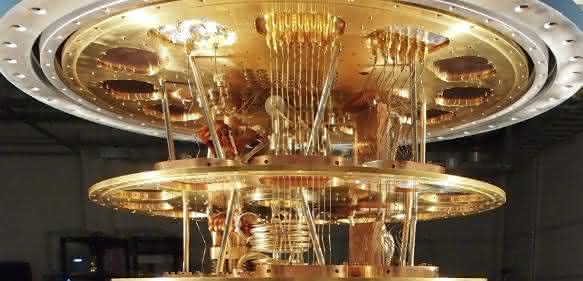
Daimler is therefore focusing on strategic research collaborations in the field of quantum computing and has agreed a further collaboration with Google in this area. With the 72-qubit Bristlecone chip, Google has just built the quantum computer with the highest number of quantum bits. Qubits are the smallest possible memory unit and serve as a measure of the performance of quantum computers.
In this cooperation, specialist teams from Daimler Group Research and IT are using quantum computers from Google to investigate specific issues relating to the mobility of the future. The initiative is in line with Daimler's vision of providing customers with comprehensive support not only as a vehicle manufacturer, but also as a mobility service provider.
"Innovation and inventiveness have always been part of our DNA at Daimler. With the invention of the automobile 132 years ago, we initiated a groundbreaking transformation process for people's individual mobility," says Ola Källenius, Member of the Board of Management of Daimler AG, Group Research & Mercedes-Benz Cars Development. "In the future, quantum computing could play a decisive role in the development of sustainable and efficient mobility solutions, but also in a wide variety of application areas within our company."
Daimler CIO Jan Brecht adds: "Quantum computing has the potential to revolutionize the entire IT sector - and thus all other areas of industry. This technology is still at an early stage of research and development - but the possibilities are enormous. We want to gain experience with this new technology at an early stage. That's why we are incorporating specific use cases from the automotive and mobility sectors into our research collaborations."
New computing dimension: quantum computers
Put simply, a quantum computer is a computer that operates directly according to the laws of quantum physics. Unlike today's computers, it not only works in a binary number system (0 or 1), but also recognizes other states, known as superpositions. These intermediate states cannot be represented by classical computers and extend the computer's computing capabilities enormously. As a result, some complex calculations can be carried out at speeds that were previously unthinkable.
The numerous possible fields of application for quantum computers include
- the choice of new materials based on quantum chemistry, e.g. for the development of battery cells
- the efficient and convenient provision of individual mobility. Autonomous vehicles can be used in urban environments and megacities, which also relieves the traffic infrastructure.
- logistics planning in the van sector. Depending on a large number of variables, routes must be planned and updated in real time.
- the optimization of production planning and production processes
- machine learning for the further development of artificial intelligence.
The broad-based research activities in the field of quantum computing are part of the CASE strategy and underline Daimler AG's transformation from vehicle manufacturer to mobility service provider. CASE stands for the fields of networking (Connected), autonomous driving (Autonomous), flexible use (Shared&Services) and electric drives (Electric). The aim is to create intuitive mobility for customers by intelligently interlinking the CASE topics.
Did you know that...
... quanta are neither particles nor waves? Particles are objects that have clearly defined boundaries. Two essential properties are that particles can be localized and counted. Classical waves consist of many individual particles that are located in different places and have different momentum; waves also form interference. Quanta can take on the properties of classical waves and those of classical particles; this is known as wave-particle duality.
...laws occur in the quantum world that contradict the laws of classical physics and are difficult to grasp? For example, it is impossible to understand from the everyday world how one and the same particle can be in two different places at the same time. Or how two particles can interact with each other over an arbitrarily large distance without being able to measure a force relationship. One of the special features of quantum physics is that neither an exact position nor an exact direction of movement can be determined for the unobserved quanta.
...quanta in microscopic physics are quantities that cannot assume arbitrary values, but only certain discrete values? These include, for example, energy and angular momentum. Quanta are also often used to refer to objects such as atoms or electrons to which quantum physics applies, e.g. which exhibit the phenomena of superposition and entanglement.
...Superposition in quanta means that they are in a state in which several classically mutually exclusive properties are "superimposed" in a certain sense? For example, an elementary particle can be in a superposition of several different locations. This means that although the particle is not definitely located at any one place, it will be detected with a certain probability at one or other of these places when its position is measured.
...entanglement means that two quantum objects lose their individuality and that the properties of one depend on those of the other? An operation on one object has a direct effect on the other object. This dependence is effective over any distance and does not require a known physical carrier medium.
...qubits are microscopic quantum systems that contain two different base states? These correspond to 0 and 1 in the classical bit. These quantum systems exhibit typical quantum properties such as superposition or entanglement. As with classical bits, there are various ways in which qubits can be constructed, e.g. using photons, electrons, atoms or so-called superconducting oscillating circuits. The aim is to achieve a high temporal stability of the qubits (so-called coherence time) in order to be able to carry out as many operations as possible before the stored information becomes faulty due to interaction with the environment. Furthermore, high precision (= low error rates) and good error correction are the aim of current developments.
...you can imagine a qubit as the surface of the earth? If the north pole is 0 and the south pole is 1, then all other points on the earth's surface also exist in a qubit, whereas only the north and south poles exist in a classical bit.
...the search for the exit from a maze is a good illustration of the different ways in which supercomputers and quantum computers work? A modern computer checks all outputs serially until it finds the exit. A quantum computer would search all possible paths in parallel and output the result of the correct path much faster. Some types of calculations can be greatly accelerated as a result.
...a quantum computer is still not always better than today's supercomputers? A quantum computer can calculate exactly the same problems as a classical computer. But it is not better at it in all cases. A quantum computer is better if it can solve computational tasks in an acceptable time that would take the classical computer an unacceptably long time or for which it would require such large amounts of memory that they are physically impossible to realize, as occurs in quantum chemistry, for example. The pre- and post-processing of the data that takes place on classical computers must also be taken into account.
...it is possible to check whether a quantum computer has calculated correctly, even if these calculations are no longer comprehensible for supercomputers? You can let the quantum computer calculate smaller problems that can still be handled by classical supercomputers and compare the results. Some calculation problems are also of such a nature that, although it is very difficult to arrive at a solution, it is very easy to check whether a proposed solution is correct. The results of the quantum computer can then be checked relatively easily. The same applies to optimization problems: if the quantum computer proposes a solution, you can check how good it is by comparing it with the solution proposed by the classical computer. For larger calculation problems, however, the classical computer can only provide approximate solutions based on the best available classical algorithms. In the future, it is conceivable that it will be possible to compare or match the results with those of a quantum computer of the same type or of a different type.


You might also be interested in
Conrad continues to grow
Conrad Electronic now generates 80% of its sales with business customers and has successfully developed from a traditional technology retailer into a B2B procurement platform. The company aims to become Europe's leading procurement platform for...
 read more...
AI finds its way into automotive customer service
In addition to computer solutions for vehicle diagnostics, Getac now also offers AI-based digital tools that support customer contact in service operations.
read more...SMC: "Preferred Supplier" from Bosch
The technology and service company Bosch has recognized SMC for the performance of its automation technology in factory and process automation and awarded it the status of "Preferred Supplier" in the material group "Standardized Pneumatic Devices".
read more...Combined ERP forces
The medium-sized ERP providers Step Ahead Software, Godesys and Informing merge to form the Step Ahead Group.
read more...Cybersecurity for asset-intensive companies
Forge Cybersecurity Platform, the new software platform from Honeywell, has been developed for the cybersecurity of asset-intensive companies and critical infrastructures. The platform is available in three versions.
read more...Automated machine tool as a success factor
Industry 4.0 is the hot topic of the moment. For small and medium-sized companies and contract manufacturers, it holds great potential for increasing production efficiency step by step. The focus here is on efficient and user-specific automation...
read more...Nemo hand vacuum lifts all materials
A new addition to the Eurotech portfolio is the battery-operated Nemo vacuum cleaner, which is suitable for handling almost all surfaces.
read more...Future-oriented cobot projects
Three pillars of successful cobot initiatives
What is important if cobot projects are to be future-oriented? Automation and robotics expert Omron has identified three aspects for human-machine collaboration.
read more...Short-stroke linear actuator instead of pneumatic cylinders
The new short-stroke linear actuator from Ketterer Antriebe and halstrup-walcher is characterized by high dynamics and a large stroke in a compact size. Thanks to the integrated electronics, the drive is easy to control compared to pneumatic...
read more...