

Versatile production
Employees as a success factor
The digital networking of systems enables companies to adapt their products more precisely to customer requirements.
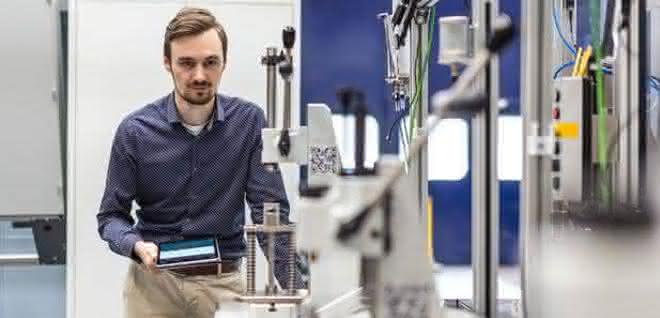
In addition to adaptable systems, employees are a key success factor. This is shown by a study conducted by KIT, LUH and acatech.
Modern information and communication technology, such as sensor technology or data communication, links individual systems and globally distributed locations to form intelligent factories. Digitalization and the technical solutions of Industry 4.0 offer companies the opportunity to implement even the most individual customer requirements - within the price and time constraints of large-scale production.
"However, this new flexibility does not only bring advantages," says Gisela Lanza, Professor and Head of the wbk Institute of Production Engineering at the Karlsruhe Institute of Technology (KIT). "A greater number of variants, shorter product life cycles and unsteady customer demand lead to unpredictable market changes to which companies have to react." In order to be successful and profitable in such a fluctuating environment, companies must adapt their production systems and networks to market conditions in the shortest possible time and at low cost.
However, the successful implementation of such adaptability does not only depend on the technical aspects of the systems, as Lanza explains: "A dynamic organization can only succeed if employees have the necessary expertise and flexibility. The willingness to respond to change is a key aspect of adaptability."
The wbk, the Institute of Production Systems and Logistics (IFA) at Leibniz Universität Hannover (LUH) and the German Academy of Science and Engineering acatech therefore want to use the joint study to show how companies can put people at the center of adaptable structures and how Industry 4.0 can support them in doing so. The basis for this was the close exchange of experience with representatives from industry, employers' and employees' associations, politics and science.
People at the center of adaptable structures
The study shows that employees make a decisive contribution to the successful implementation of adaptability: they stimulate and drive reactions to internal and external changes in production and its environment and "live" the change in organization and working conditions. "Employees can only quickly adapt to new areas of responsibility and make qualified decisions in every situation if they understand the relevant interrelationships in the system and recognize the benefits of change for themselves and their immediate working environment," says Peter Nyhuis, Professor and Director of the IFA.
Digital assistance systems can help to build a comprehensive understanding of the system: Industry 4.0 applications, such as virtual reality, make changes digitally tangible and easier to understand. It is important to increase trust in new systems: "Companies need to sharpen their focus on meaningful changes so that they can reduce employees' fears and concerns about new, previously unknown tasks."
Dynamic and modular company organization
However, adaptability does not only take place at employee level, organizational forms also change. However, the more complex factories or value creation networks are, the more time-consuming and costly it is to adapt them. One possible solution is to incorporate dynamic and modular structures into the company organization. Flexible organization and technology enable employees to plan and manage change.
Industry 4.0 applications can also provide support here. They make it possible to control individual areas of the factory or the entire network in a decentralized manner. Intelligent assistance systems can transparently show employees how changes will affect them. This contributes significantly to the efficiency of adaptability: "Implementing adaptability equally in all areas and at all levels would not be expedient, as the additional costs would be too high," says Gisela Lanza. "Instead, companies need to determine the extent to which each area should be made more adaptable."
These and other results as well as best practice examples are described in detail in the study "Adaptable, human-centered structures in Industry 4.0 factories and networks". "We want to support companies in finding areas where action is needed in their production facilities in order to successfully implement adaptability through technical, organizational and human design options," says Lanza. as


You might also be interested in
German industry under pressure
Industry association cancels growth forecast
The Federation of German Industries (BDI) believes that German industry remains under pressure and expects stagnation instead of growth. At the same time, the association is emphasizing the industry's innovative strength at the Hannover Messe.
 read more...
Why eleven federal states are calling for the use of low-emission steel in the automotive industry
Heads of federal states put pressure on Brussels: Eleven German federal states appeal to the EU to promote low-emission steel in the automotive industry more strongly. The German Steel Federation supports the initiative as an important lever for...
read more...Setting the course for Germany's technological future
The Federal Cabinet adopted the microelectronics strategy today. Germany wants to become a leader in microelectronics. The Federal Government's new strategy: bundling topics such as research, skilled workers and production in order to strengthen...
read more...European elections FSK 16
Good news: over the past 20 years, voter turnout in European elections in Germany has risen continuously - from 43.0% to just under 64.8% recently. I like the idea of allowing young people aged 16 and over to participate in politics in the form of...
read more...Democracy project
Many people are taking to the streets these days because they are fed up with right-wing hatred and populism. Industry is also aware of its social responsibility. "Transformation as the project of the century" is the title of a paper published...
read more...Artificial intelligence in Germany
Microsoft invests 3.2 billion euros in AI infrastructure
Microsoft has announced the largest investment in its 40-year history in Germany to accelerate the possibilities and benefits of artificial intelligence (AI) in the country.
read more...Plagiarius 2024 negative prize
On January 26, 2024, the Plagiarius campaign awarded its dreaded "Plagiarius" negative prize for the 48th time to manufacturers and retailers of particularly brazen counterfeits and fakes.
read more...100 years of Conrad Electronic
One hundred years of change
Conrad Electronic celebrated its centenary on June 21, 2023 with a gigantic event in the spirit of change. 400 high-ranking guests from business and politics as well as long-time Conrad companions were invited to the logistics center in...
read more...Loss of competitiveness?
The major associations BDI, VDMA and ZVEI are calling for more efforts to ensure that Germany remains competitive on an international level.
read more...