
Sustainable production
5 measures to emerge stronger from the crisis
Hopes for an end to the Covid-19 pandemic have risen with the start of vaccinations. Many companies now need to persevere and move forward. After all, those who are currently investing cleverly in structures, processes and tools will not only get through the pandemic better. These companies are also better equipped for future challenges.
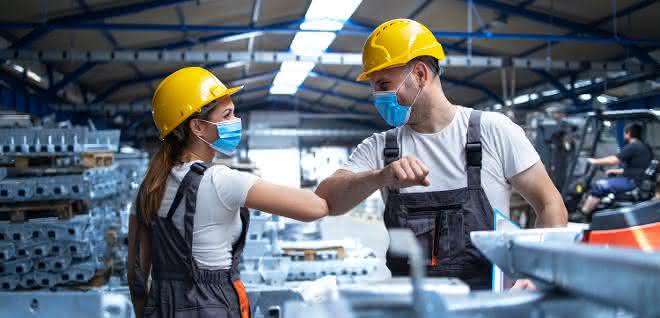
Companies with foresight are thinking about the time after the pandemic. The World Economic Forum surveyed companies in the manufacturing industry worldwide to find out which factors are currently helping them successfully navigate the crisis and making a significant contribution to economic recovery. This revealed five key levers that are worth turning:
1. increase agility through simple technologies
Short-term line changeovers were and are commonplace in many factories in order to manufacture different products, product sizes and combinations. Just as frequently, colleagues have to stand in for employees who are ill or in quarantine - often at workplaces that are unfamiliar or even new to them.
These are just two examples of how the pandemic has made constant change part of everyday life. The positive effect: manufacturers who learn to master these challenges today will also be able to cope more easily and quickly with frequent changes in operational processes tomorrow. As a result, they can face the constant change of future working environments more calmly.
But how can we achieve this goal? Firstly, we need technologies that support location-independent working. These include digital twins, augmented reality, remote monitoring of machines and digital dashboards. They will help companies to significantly increase their flexibility now and in the coming years. They will be supported by more automation and robotics.
But that alone is not enough: in order to overcome a crisis, industrial workers need to be equipped with digital tools so that they can complete their tasks more easily, more quickly and with the necessary quality. Because the pandemic has clearly demonstrated one thing: Without people, nothing works on the factory floor.
2. enable professional development "on the job
If employees are to cope well with unforeseen or very rapid changes, they need support. For example, in the form of software that provides just-in-time digital instructions and learning opportunities. One concrete example is worker assistance systems such as the Parsable platform for networked working. With their help, standard operating procedures (SOPs) can be introduced and updated simultaneously across multiple shifts and even locations.
Workers receive comprehensive step-by-step instructions on mobile devices, enhanced with videos, photos, graphics or PDFs as required. Interactive forms and checklists also ensure that workers and technicians comply with the latest local regulations and standards. And all this without lengthy training sessions in advance, directly "on the job".
In this way, new skills are developed directly at work. These range from technical and operational know-how to soft skills such as personal responsibility, collaboration and problem solving. In the long term, companies increase their ability to deal with change with confidence.
3. increase occupational safety and improve work ability
The security provided by the permanent support of such worker assistance also contributes to a second issue that has come into focus during the crisis: occupational safety and mental well-being. In Germany, ensuring both is one of the employer's statutory obligations, enshrined in the Occupational Health and Safety Act and the German Social Code, among other things.
But never before has it been as clear what this obligation means as it has been over the past year. All of a sudden, new hygiene and safety measures had to be introduced within just a few days. It was equally important to strengthen workers' confidence in their employer's ability to protect their health - and that of their families. And the longer the pandemic lasted, the greater the focus on employees' mental well-being.
Connected worker platforms and equipping the workforce with smart devices provide valuable services in this regard. They help to make collaboration as natural and personal as possible despite the 1.5-meter distancing rules - both at the workplace and during shift changes. The direct integration of health and safety regulations into work processes ensures greater safety and hygiene. This ranges from reminders to wash hands, to wearing the correct protective equipment, to enforcing visiting rules.
In the future, these technical aids can also bring about more exchange, solidarity and participation within the workforce. This is because workers and technicians can use them to obtain advice from colleagues or superiors in the simplest and most direct way, report back a status directly from their work situation or make suggestions for improvement - and not just in terms of health and safety.
Corona has made it clear to companies and managers: Those who feel anxiety and are emotionally exhausted do not bring their full potential to work. Creating a sense of stability and balance within the company is therefore an important factor in business success. This insight and the changes derived from it therefore sustainably strengthen job satisfaction and the ability to work - and thus help to keep skilled workers in the company and reduce the number of sick days.
4. remote work: turning lessons from corona into success factors
The professional world has made a real quantum leap in terms of virtual collaboration. Almost overnight during the first lockdown in spring 2020, it became normal to shift large parts of work to Zoom, Microsoft Teams and other collaboration platforms. As a result of the urgency, the associated software skills, acceptance of these tools and social interaction in the digital space skyrocketed. Even production audits were carried out remotely. Last but not least, managers and leaders learned the art of leading from home.
There is great potential for the future in these newly acquired skills: even if face-to-face meetings are possible again, working remotely can save a lot of time and money. Remote work also opens up great opportunities to respond to employees' personal, health and family circumstances. A mix of remote and on-site work can become an important factor in reconciling the interests of employers and employees in times of an impending shortage of skilled workers.
5. increase corporate resilience
The word resilience comes from the Latin resilire: to rebound, bounce back, not cling. It refers to the ability of individuals, groups or societies to adapt to challenges and changes in such a way that they emerge unscathed or even stronger. Against this backdrop, the Covid-19 crisis is an opportunity to build resilience by developing new coping strategies - and thus prepare for future challenges.
Countless managers and companies have done and continue to do just that: together with their staff, they are taking bold measures, empowering their employees and investing in technological innovations that make them fitter and therefore more fit for the future.
Carsten Hunfeld, Head of D/A/CH, Parsable, Munich


You might also be interested in
Fraunhofer IOSB Opens Humanoid Robots Lab
The Fraunhofer IOSB is opening a Humanoid Robots Experience Lab in Karlsruhe, Lemgo, and Ilmenau. Companies and organizations can use these facilities to test potential applications for humanoid robots and develop pilot projects.
 read more...
Artificial Intelligence in Manufacturing
Trumpf and IPAI Are Expanding a European AI Network for Industry
The high-tech company Trumpf is an official partner of the IPAI AI network in Heilbronn. Together, the partners aim to exchange experiences, develop new AI applications for industrial use, and advance the development of artificial intelligence in...
read more...Case Study: Networked Manufacturing Platform for Toolmaking
Using a networked manufacturing platform, Escha GmbH & Co. KG, a manufacturer of industrial fastening technology, has comprehensively modernized its toolmaking operations.
read more...Barcelona Declaration on Robotics and...
Robotics Associations Adopt Global Automation Strategy
The global robotics industry is stepping up its collaboration. The associations AER Automation, A3, IFR, and VDMA Robotics + Automation have formed a long-term alliance by signing the “Barcelona Declaration on Robotics and Automation 2026.” The...
read more...Jane Heffner is the new president of the International Federation of Robotics
Jane Heffner is the new president of the International Federation of Robotics. Adrien Brouillard has been appointed vice president of the global federation.
read more...Greater Transparency in the Robotics Market
RoboFinder Launches as an Independent Comparison Platform
Launch at Gitex Europe: 'RoboFinder' aims to bring more transparency to the professional service robotics market. In this interview, founder and CEO Brian Engels discusses market potential, challenges, and the goals of the new platform.
read more...Artificial Intelligence for the Physical Space
Alibaba Expands Qwen Model Family with a Robotics Suite for Physical AI
Alibaba is expanding its Qwen model family with a robotics suite for Physical AI. The three models—for manipulation, navigation, and simulation—are designed to assist autonomous robots with complex tasks in real-world environments.
read more...International Federation of Robotics
U.S. Robotics Industry Sees Double-Digit Growth
In the U.S., sales of industrial robots rose by 11% compared to the previous year: 38,000 units were newly installed in 2025. This significant recovery is driven by robust growth in the food industry and other non-manufacturing sectors. However, the...
read more...Development Collaboration for Humanoid Robotic Hands Launched
Schunk is entering into a new development partnership with Robert Bosch Robotics. Their shared goal is to develop an industrial-grade robotic hand that can be integrated into various humanoid robot systems.
read more...