
Motion control for micro-assembly
The servo does it!
Micro-screwing processes in the micro-assembly of cell phones or hearing aids - with fast cycle times and integrated feeding - place the highest demands on automated screwdriving systems. Stöger Automation has developed a pioneering handling and assembly solution with small servomotors and real-time capable drive amplifiers from Wittenstein.
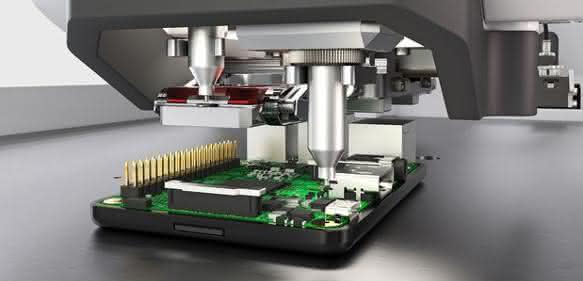
The space-saving external dimensions of the industrial small servo motors and their low mass, as well as intelligent drive amplifiers with a high switching frequency and exceptionally high current resolution, are key features of this servo drive solution for Stöger Automation. Added to this is the variable design of the interfaces to higher-level control systems, as the screwdriving robots can be used and integrated both as individual devices and in large systems. With the small motors and drive amplifiers from Wittenstein, a solution for the reliable provision, screwing in and tightening of miniature screws could be realized that was previously unavailable on the procurement market for electronics manufacturers and similar users, explains Stöger. For its part, Wittenstein has succeeded in developing a linear actuator for the Z-axis based on standard components, which impresses with its functionality and cost-effectiveness.
Stöger Automation in Königsdorf, Bavaria, is a technological leader in the development and manufacture of solutions for the reliable fastening of components. The spectrum ranges from manual screwdrivers in stand-alone operation to integration-capable, complex fully automatic machines with automatic feeding of fasteners for medium and large-scale production. It takes less than a second to screw in a screw that is only two millimetres long, has a thread diameter of just one millimetre, a screw head that is only two millimetres wide and has to be processed reliably without sensor-based torque measurement - that is a task that is quite a challenge. There is also another challenge: the high process speed. Cycle times of less than one second are only possible with an intelligently designed screw feed system. Stöger has risen to this challenge.
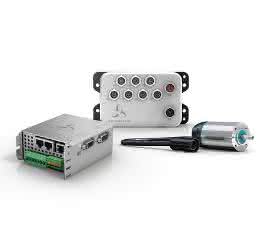
Feed hoses were ruled out due to the screw dimensions, and pick-and-place would have been too slow. Stöger has therefore developed a double screwdriving system in which one drive is screwing while the other is already being supplied with a new screw. This reduces non-productive time. Stöger can therefore reliably maintain a machine cycle of 0.8 seconds. In addition, the delicate screws have to be screwed in with great sensitivity; this is done with a torque of less than 0.05 Newton meters. The speed when tightening the screw is reduced via a motion task to ensure an optimum, error-free connection with a defined tightening torque. Finally, during development, Stöger also had the variance of possible screw applications in mind, to which the system should be easily adaptable in terms of screw sizes, screw types, thread lengths and torques and speeds. With the small servomotors from the cyber dynamic line family for the screwdriving movement and for guiding the screw to the workpiece, as well as the drive amplifiers from the simco drive series, a servo technology solution could be used that meets all the relevant requirements of micro screwdriving processes.
The small servomotors in their robust stainless steel housings with various diameters are characterized by their high torque density. The dynamic line 22 size used by Stöger offers an optimum performance ratio of speed and torque for this application and also minimizes the centre distance between the two double screwdriver segments. This makes it possible to screw in places that are difficult to access. Thanks to its high dynamic factor, the motor is just as suitable for fast acceleration as it is for short movements with frequent speed changes. A total of four small servomotors are used in the double screwdriving system. Two of them are designed with an integrated ball screw drive. They form a high-precision solution for the Z-axis for guiding the screw to the workpiece. The other two small servomotors carry out the rotary screwdriving movement - in accordance with an individually programmed motion control (motion task) stored in the Simco-Drive drive amplifier; this enables precise torque detection without additional sensors.
Part two of the miniature drive systems for the miniature screwdriver is a drive amplifier from the simco drive series for each motor. The servo controller was developed for high-performance applications with sinusoidal commutated servo motors in the voltage range of 24 and 48 volts DC and a peak power of up to 1.5 kilowatts. Measurement features of the simco drive include high-resolution current control with up to 14 bits and a high sampling rate of 32 kilohertz. This is ideal for high dynamics in the current control loop and for measuring and controlling torques directly via the current consumption. Torque measurements with an external sensor have confirmed the high system accuracy of the small motor and servo controller. pb


You might also be interested in
Plagiarius 2024 negative prize
On January 26, 2024, the Plagiarius campaign awarded its dreaded "Plagiarius" negative prize for the 48th time to manufacturers and retailers of particularly brazen counterfeits and fakes.
 read more...
Ivalua honors winners of the Generative AI...
AI-supported "add-ons" for buyers within 48 hours
Ivalua, provider of cloud-based spend management solutions, announced the winners and innovations of the first Generative AI Innovation Cup. The competition took place in December 2023. It was open to all Ivalua partners and employees - more than...
read more...Efaflex celebrates 50 years of high-speed...
The emphasis is on "fast"
Since day one, Efaflex has wanted to use new technologies as early as possible and drive progress in the industry. This year, the family business is celebrating its 50th anniversary under the motto "Fast Forward".
read more...Security of supply even during power outages
In the winter of 2022, Germany was worried about energy shortages. The drugstore retailer dm did not paint any horror scenarios, but nevertheless saw the possibility of controlled, temporary, regional power cuts (brownouts).
read more...Safety technology in mechanical engineering
Modules with new functions
Euchner's product highlights at EMO 2023 include the communication-capable solenoid interlocks.
read more...Transforming the paper industry towards climate neutrality
Together with partners from industry and research, Voith is developing a project for the optimization of energy and material flows in paper production. The aim of the research project is to develop a digital framework that enables effective process...
read more...Up to 95 percent less flue gas thanks to direct extraction
The requirements for occupational safety measures and safety technology are also constantly increasing in welding technology. The Technical Rules for Hazardous Substances (TRGS) stipulate that welding fumes and harmful substances must be extracted...
read more...Competitive advantages with large machines
Whether 3D-printed components for machines and systems, prototypes or aids for design: additive manufacturing is almost indispensable for modern companies in mechanical and plant engineering and automation if they want to play in the premier league.
read more...Transport technology from the modular system
Many transport tasks can be realized with the help of linear technology. Pre-configured solutions are available to simplify the interaction between the linear unit, motor, gearbox and controller. This minimizes the effort required for research and...
read more...