
Condition-based maintenance
Predictive maintenance with ultrasound
Nasa uses ultrasound to detect bearing damage at an early stage. This technology, combined with artificial intelligence, could now help condition-based maintenance, in the sense of predictive maintenance, to achieve a breakthrough.

Condition-based maintenance saves costs and time, as spare parts are not replaced on the basis of time intervals or operating hours, but on the basis of actual wear and tear. The basic technology portfolio for condition-based maintenance has hardly changed in recent years. Essentially, maintenance can make use of the following technologies: oil analysis, vibration analysis (simple, primarily based on threshold values), vibration analysis (complex, in the sense of vibration analysis), ultrasound (passive, by recording sound waves in the frequency range above 20 kHz) and infrared/thermography.
Against the background of cost-efficient maintenance, a good cost-benefit ratio is particularly important. The benefit can primarily be derived from the depth of results delivered, while the cost is driven by investment in sensor technology and the ongoing cost of evaluations. If the individual technologies are presented according to these criteria, the following picture emerges:
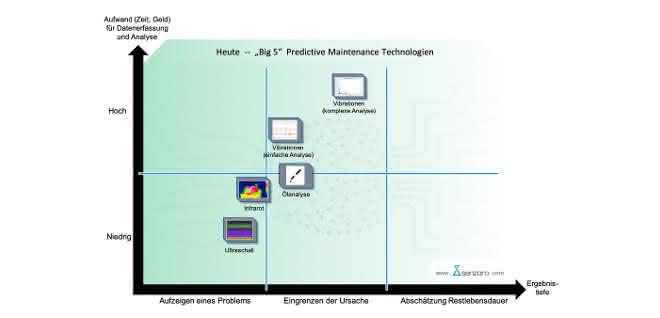
Each of these technologies has its place in the predictive maintenance portfolio and, ideally, a maintenance department would master all of them. However, due to the complexity and limited resources, this is a rather unrealistic undertaking. Therefore, the question that every company must ask itself is: Which predictive maintenance technology do I use against the backdrop of limited resources?
Ultrasound stands out from other technologies due to its unique (physical) properties, which could make it the technology of choice.
- Ultrasonic technology will experience the greatest progress through artificial intelligence due to its physical properties.
- Ultrasound has a very broad field of application that goes far beyond the monitoring of bearings and rotating components.
- Ultrasound is a technology with a very good cost/benefit ratio and is easy to use.
- Ultrasound does not require permanent sensors.
The reasons for the excellent cost/benefit ratio of ultrasound lie primarily in the simple and non-invasive measurement option. Systems such as motors, pumps or gearboxes can be measured completely non-invasively during normal operation and areas of application can be covered in which, for example, the common vibration technology fails (slowly rotating components, high vibration environment).
As the introduction of a new technology is always associated with expense, it should also be ensured that the technology in question is future-proof. As digitalization does not stop at maintenance and the use of artificial intelligence and machine learning is becoming increasingly important, a crucial question for the future-proofing of ultrasound is: Why will ultrasound experience the greatest progress in combination with artificial intelligence?
Due to its physical properties, ultrasound can only perform "mode changes" to a very small extent. This means that two motors in close proximity do not negatively influence the measurement. Ultrasound does not "migrate" from the housing of one motor into the air and then penetrate the housing of the next motor.
Factories generate little ultrasonic noise, so the data is very "pure" and free of background noise. Isolated sources of airborne ultrasound (leaks) do not mix with the structure-borne noise generated by the equipment.
Ultrasound has a high information density and a few seconds of measurement time on a system are sufficient for evaluation.
These properties make it possible to learn from data sources from different factories and systems. Similar motors from different factories and of different ages can be combined to form a "virtual" motor. Due to the expected progress through the combination of ultrasound with artificial intelligence, the overview shown at the beginning will also change in favor of ultrasound.
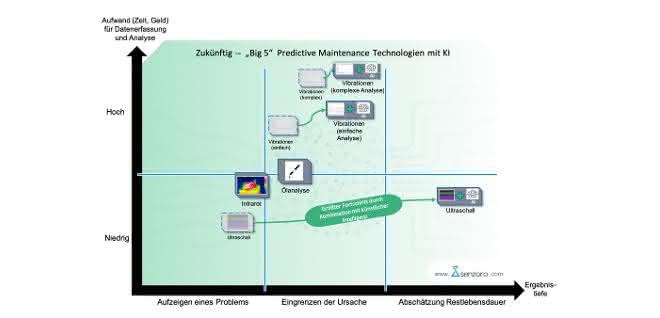
Another advantage of ultrasonic technology is the ability to dispense with permanent sensors and carry out weekly, monthly or quarterly measurements with a hand-held device. Depending on the criticality of the system, this approach can also replace permanent monitoring with sensors for critical systems. This saves the complexity of a permanent sensor landscape and the manual measurements mean that the maintenance team is intensively involved. Mobile sensors also make it possible to test the technology and the potential added value without investment costs.
The concept of the "virtual engine", which is possible with ultrasound and artificial intelligence, is an easy way to get started with predictive maintenance. However, a company's sustainable competitive advantage will come from enriching this general data with measurements of its own systems in order to make the estimation of remaining service life increasingly accurate. as


You might also be interested in
Atlas Copco takes over long-standing sales partner
Atlas Copco has taken over Heide-Pumpen. The specialist for mobile pumps has been working closely with Atlas Copco in sales and service for a long time, especially for surface pumps for construction site dewatering and wastewater detour or in the...
 read more...
Lutz Pumpen at the Achema 2024
New mobile drum pump with battery drive
The new B3 Battery from Lutz Pumpen promises mobile and safe working with aggressive liquids without having to compromise on pumping performance compared to wired versions. The battery-powered drum pump will be on display at Achema, the world's...
read more...Maintenance and Pumps&Valves in February
Final preparations are underway in Dortmund: On February 21, 2024, maintenance will start as the leading trade fair for industrial maintenance and with it Pumps&Valves as the trade fair for industrial pumps, fittings and valves.
read more...Liquid separator keeps pumps dry
Vacuum clamping minimizes distortion and enables five sides to be machined in one clamping operation. The use of cooling lubricants poses a challenge: If they get into the vacuum generator, they can cause serious damage.
read more...Spring clutches for construction machinery
Spring clutches from Torsion Control Products (TCP) are ideal for use in construction machinery where modern diesel engines are used.
read more...Protection against cooling lubricant
Liquid separator from Schmalz keeps pumps dry
Anyone clamping with a vacuum during CNC machining must protect the pump from cooling lubricant. The NLS liquid separator from Schmalz separates the cooling lubricant and returns it to the running process - without interrupting the vacuum.
read more...Which clutch for what?
Mechanical engineering and its applications are multifaceted. Every application is special and requires a perfect machine design. Individual components in the system must also be optimally designed.
read more...Energy efficiency needs electrical engineering and IT
The energy crisis makes one thing clear: it is not enough to simply screw a photovoltaic system onto your roof or purchase green electricity. Industry is faced with the challenge of reducing consumption in order to counter the rise in energy prices,...
read more...Solutions for a networked and climate-neutral industry
At the world's leading trade fair for industry, around 4,000 companies from the mechanical engineering, electrical and digital industries as well as the energy sector will be showcasing solutions for the production and energy supply of the future.
read more...