

Needle roller bearing
High load capacity in a small installation space
Needle roller bearings are characterized by thin cylindrical rolling elements. Despite their small cross-section, they can withstand very high loads and are therefore used in applications where only limited installation space is available.
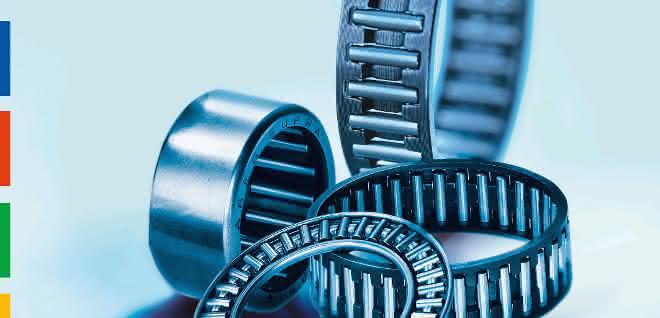
Findling Wälzlager offers needle roller bearings in various sizes and designs. The company also offers themed training courses where experts can delve deep into the subject of needle roller bearings.
"The range of applications for needle roller bearings extends far beyond the automotive industry, where they are used to support pistons," explains Klaus Findling, Managing Director of Findling Wälzlager GmbH. "Due to the small installation space, particularly compact components are required here that can still transmit high forces." Needle roller bearings make this possible. Their distinguishing feature is the thin cylindrical rolling elements. With this design, the highest loads of all rolling bearings can be achieved with a defined cross-section. Needle roller bearings are therefore ideal for applications where only limited installation space is available.
Different types, one product family
The best-known form of this type of rolling bearing is the so-called needle roller and cage assembly - i.e. needle rollers guided in a cage. However, many other designs have since been developed that belong to the needle roller bearing family, including special designs such as yoke and stud type track rollers.
As with ball bearings, a general distinction is made between radial and axial designs for needle roller bearings. Radial needle roller bearings with or without an inner ring can only support radial forces and are designed for medium loads at medium speeds. They are mainly used in gearboxes and in general mechanical engineering. By dispensing with an inner ring, the size can be further reduced. However, in this case the shaft serves as the raceway - in order to achieve the full load-bearing capacity, it must be hardened and ground. This also applies to needle roller and cage assemblies. Here, the bearings run directly on the shaft or housing.
A hardened raceway of 58-64HRC is also necessary for axial needle roller bearings, but can be avoided by using optionally available raceway washers. These designs only absorb axial forces; this is made possible by a flat, stable cage in which several needle rollers are guided next to each other.
Here, too, there is a wide range of designs and components. Depending on the load capacity of the substructure, axial needle roller and cage assemblies can be paired with axial or thrust washers. Multi-row needle roller and cage assemblies for maximum load ratings are used in axial piston pumps, for example, while designs with integrated axial pulleys are installed in lifting gear and auxiliary units of rail vehicles, among other things.
The application determines the nail bearing type
Last but not least, needle roller bearings can also be used in combined radial/axial solutions. For example, a ball and needle roller bearing pairing is suitable for lower axial loads. Combined bearings are particularly straightforward to fit and easy to handle. Compared to conventional solutions, a number of improvements can also be achieved with combined bearings. Instead of two separate bearings, only one compact combined system is installed, which means that less space is required for storage. Combined bearings are usually used in applications where very high forces are exerted, but where only limited installation space is available.
"We are happy to advise on which needle roller bearing design is suitable for the respective application," says Klaus Findling. "It is particularly important to us that our customers always receive the most economical, technologically sensible and reliable solution." Thanks to decades of experience with needle roller bearings, Findling has built up special expertise from which customers benefit. There are a number of things to consider when using needle roller bearings. One example is greasing, which is problematic with needle bearings due to the small installation space: It is difficult to provide enough grease for an optimum lubrication situation. "For lubrication, users should preferably use oil, especially at high speeds, while ensuring a sufficient oil flow," says Klaus Findling. "At medium speeds, an external lubrication option via a lubrication groove or slot is essential, regardless of whether oil or grease is used." At low speeds, lifetime lubrication with grease is also possible. In this case, it is advisable to order the bearing pre-greased for reasons of convenience. In principle, at least lithium complex soap greases should be used for needle bearings due to the special requirements.
From the range: Needle roller bearings from JNS
In the area of needle roller bearings, Findling Wälzlager works together with Japanese manufacturer JNS, among others. "We have been the JNS factory representative in Germany for 16 years," explains Findling. "The company has made a name for itself primarily as a reliable manufacturer of needle roller bearings and cam followers." The needle roller bearings from JNS are characterized, among other things, by an optimized profiling on the rolling elements. This prevents the occurrence of edge stresses and thus ensures a higher load capacity of the components.
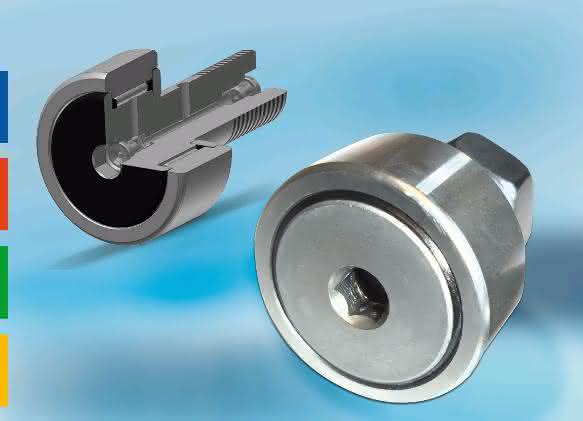
A special feature is that JNS also has particularly compact cam rollers as well as solid needle roller bearings and yoke type track rollers in stainless steel versions in its range. Thanks to the low corrosion properties of this material, the bearings are particularly suitable for use in the pharmaceutical and semiconductor industries, medical technology and the food and beverage sector.
The stainless steel bearings are made entirely from highly hardenable martensitic SUS440C or AISI440C. This material exhibits high dimensional stability up to 200 °C and impresses as a high-temperature bearing with extremely smooth running and running precision. "In combination with the right lubrication, the stainless steel bearings from JNS are real all-round wonders," emphasizes Klaus Findling. "Which greases are used depends on the respective application and requires extensive consultation."
Build up your own knowledge of needle roller bearings
It's good to have an expert on hand - and even better if you can also build up your own knowledge. Findling Wälzlager can also help with this: The company offers a special training course on this product group as part of its rolling bearing academy. The target group are employees or users with previous knowledge who want to gain in-depth insights into the respective subject matter of a special product group.
In addition to needle roller bearings, one-day training courses are also offered on deep groove ball bearings from the eXtreme series as well as on housing bearings, spherical roller bearing units and plummer blocks. "The training course on needle roller bearings is something special, because this is the first time we are providing concentrated knowledge about this product group on the German market," concludes Klaus Findling. "From designs and materials to important standards, participants will receive all the relevant information about these very special components."


You might also be interested in
Protection against electrostatic discharge
StoFloor ESD KU 614 from StoCretec: dissipative flooring with the latest technology meets all ESD standards, is economical, extremely durable, mechanically and chemically resistant. The surface can be adjusted to be slip-resistant. The system is...
 read more...
Cables and wires from Helukabel
Food cultivation on a new level
Vertical farming - cultivation in multi-storey greenhouses - is considered one of the most exciting trends in food production. One of the pioneers in this field is the Romanian start-up Ultragreens. The company relies on solutions from Helukabel to...
read more...Further training for specialists to become security experts
With the "CESA - Certified Expert for Security in Automation" qualification, automation expert Pilz offers a two-day expert course designed to provide participants with compact security knowledge in line with the latest standards.
read more...Meaningful data on the service life of the seal
Seals prevent substances from penetrating or entering technical components. The intelligent seals from Freudenberg Sealing Technologies can significantly expand this core task in the future: the seal itself is also a sensor and becomes a "smart...
read more...Online stud configurator according to drawing
For standard bolts, with head, thread or hole
For standard bolts, with head, thread, bore or as a version with recess, mbo Osswald configurators map the standard specifications, are very easy to use, take a lot of work off the user's hands and save a lot of time.
read more...Safe palletizing with the Cobot
Verla-Pharm's medicinal products and food supplements have been available for decades. Ever-increasing throughputs result in ever-increasing logistics costs, whereby optimum utilization of the available production space is necessary.
read more...The tiger among processors
Since the move towards the Industrial Internet of Things (IIoT) and Industry 4.0 has picked up speed, processor boards and modules must be able to process exponentially growing amounts of data.
read more...VDWF publishes "Sustainability Compendium"
Nowadays, nobody can avoid "sustainability": In addition to a far-reaching presence in the media, it is also becoming increasingly important for companies in the tool and mold making industry to develop and implement appropriate concepts.
read more...More transparency and synergies with QM software
Weber, manufacturer of wood and metal sanding machines and extruders, has reorganized its quality management with ConSense IMS Professional. The software solution enables transparent documentation and more efficient processes.
read more...