
Robots support logistics processes
Container unloading needs to be regulated
A sea container contains between 20 and 30 tons of cargo. Unloading them is a logistical, time-consuming and physical feat. This is where intelligent robot systems from Copal can provide support, with SEW supplying the appropriate drive and automation technology.
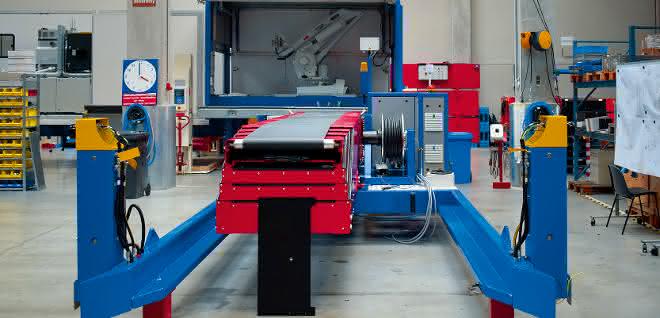
The global volume of goods transported is exceptionally high: it is estimated that around 100 million containers are transported around the world. Because customers want their goods delivered faster and faster or just in time, the transport and logistics industry is facing major challenges. Time pressure has been constantly increasing for years, and now there is also a growing shortage of skilled workers. According to a newspaper report from May 2019, there was a shortage of around 10,000 drivers at haulage companies alone. Many shy away from physical strain such as heavy lifting and long and irregular working hours. The existing workforce is over-aged and will retire in the coming years. An alternative to manual unloading of containers would also make sense for reasons of accident prevention.
The Dutch town of 's-Heerenberg (Gelderland province), right on the border with Emmerich on the Lower Rhine, is home to Copal Handling Systems. It manufactures such alternatives: robot systems that achieve top logistical performance in confined spaces. The Dutch company sees a huge gap in the market here. The company began with the development and construction of systems for unloading bagged goods. In future, Copal will focus more on cartons and the technical possibilities for smoothly unloading, sorting and stacking them.
Copal's first unloading system was originally an ergonomic lifting tool - an operator-controlled hydraulic balancer, which has since been optimized to a point-to-point control without hydraulics. Jan Grasmeijer, Technical Director at Copal, says: "Wim Bosman was a shareholder and CEO of the Wim Bosman Group, a global logistics company. In 2011, he immediately recognized the potential of the Copal C1 container unloader and palletizer prototype and saw opportunities for further development. He wanted to change the way people had to lift and transport such heavy loads when unloading containers." Benedikt Geib, Project Engineer at SEW-Eurodrive, explains: "There are increasingly strict regulations for lifting loads. With its systems, Copal wants to contribute to the sustainability and social responsibility of its customers worldwide - to healthier working conditions, fewer injuries and better process quality."
Ready for use in 15 minutes
A new application from Copal is the C2 unloader, a mobile handling solution. The unloaders are ready for use within 15 minutes and can be set up to unload bags both indoors and outdoors at several locations. Only one operator monitors the operation with cameras and makes small adjustments from his cabin using a touchscreen and joystick.
With the so-called Spider Gripper, jute sacks containing nuts, coffee or cocoa weighing up to 100 kilograms can be lifted and rotated 360 degrees. A motion controller automatically positions the gripper. The software is used to scan the sacks and determine the unloading sequence. The gripper is equipped with a flexible mechanism with several pivot and tilt points. It grips the bags with needles and moves them in a fluid motion. Thanks to these smooth machine movements, the work can be completed more quickly. This increases productivity without any physical effort on the part of the operator. Bags that lie diagonally on top of each other, for example, can also be picked up and placed straight onto a conveyor belt. A robot palletizer then stacks the bags in various patterns up to a height of two meters. Optionally, the moisture level of the bags can be checked by sensors and random samples can be taken.
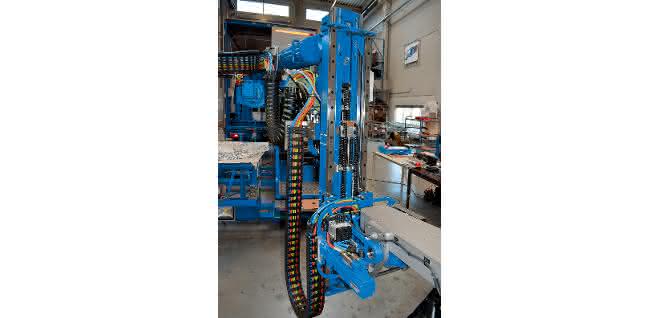
Copal's systems are complex. Corresponding requirements apply to the drive and control technology. In its search for a suitable supplier, the company turned to SEW-Eurodrive. Chief engineer Versteeg: "It was important for us to find a supplier with a global presence who could respond to failures within a few hours. Copal wanted to optimize its own service costs and looked for modern service capabilities, such as predictive maintenance and remote diagnostics, when choosing a supplier. In addition, SEW is also available on site, from program creation to the replacement of defective parts. "We believe that responsibility must be shared across several shoulders over the entire life cycle," says Director Grasmeijer, explaining the decision.
Motion controller controls kinematics
SEW supported Copal in calculating the kinematic model. It describes all the necessary movements. Essentially, there are four movements that follow a so-called LRRL pattern (linear-rotary-rotary-linear). Three of these four movements (X-axis horizontal, parallel arm and lifting column) are carried out via electrically driven axes. The fourth axis, linear lifting column, is hydraulically controlled, but is integrated into the motion model and is controlled by a motion controller from SEW. This is the Movi-C UHX84 type.
Benedikt Geib explains: "It is the heart of the control system for the kinematic model, which calculates the required paths. The motion axes are controlled via Ethercat and supplied with new position data every millisecond. There are a total of six axis modules for ten servomotors. The cylinders of the hydraulic lifting column are controlled via Ethercat Remote IO from SEW."
Restricted freedom of movement
One challenge in the design and construction of the robot system was the limited freedom of movement, which meant that a conventional industrial robot was not an option. For this reason, the Movi-C modular automation platform was chosen. It comprises the engineering software, control technology, motors and central and decentralized inverters. The Movi-C dual-axis modules can control two motors and are very compact.
Due to cramped conditions, the space on which the bags are placed must always be taken into account. Speed and reliability must be weighed up. After all, the aim is to choose the fastest route without the machine's boom touching the container and damaging itself. While the container width is standardized, the height of the container (standard or large capacity) determines the movement space of the machine.
The gearboxes used, including the bevel gearbox series in a shaft-mounted design for space-limited installation, have as little backlash as possible. This ensures precise positioning. For larger loads, asynchronous servomotors from the DRL../DR2L. (the energy-saving IE3 versions) from SEW are used for larger loads. They have a higher intrinsic inertia than standard synchronous motors on the market and are therefore ideal for applications where a balanced inertia ratio between load and motor is required for control reasons. Andrea Balser, SEW-Eurodrive /as


You might also be interested in
Further simplify assembly processes
In addition to the proven racks with a length of one meter, Wittenstein alpha now offers optional two-meter racks for linear systems. They are particularly suitable for use in short axes, for example, in order to simplify assembly even further.
 read more...
Hiwin manufactures its own shaft gearboxes
Have you ever waited several months for an urgently needed corrugated gearbox? Hiwin has too. That's why the Offenburg-based drive specialist has decided to produce its own space and weight-saving reduction talent.
read more...Human-robot interaction at the trade fair
Sumitomo Drive Technologies is presenting its drive solutions for automation and robotics at Automatica 2023 together with the Lafert Group. The company will be showcasing two different applications of the Tuaka drive system for robot applications...
read more...Partial automation with robots
At Automatica, Promess will be showcasing its modular individual workstations and how these can be partially automated with robot support. The servo press manufacturer will also be providing information about the latest features of its Revolution X...
read more...A new benchmark for collaborative robots
At this year's Automatica, Denso Robotics will be showcasing its innovations in the field of robotics. The collaborative Cobotta Pro product family will be the focus of the presentations. Visitors to the trade fair can see all variants in various...
read more...Clamping system for a new milling machine
Investments in machinery often lead to further purchases - as is the case at Joma-Maschinenbau, whose modern production facility has recently been supplemented by a 5-axis milling machine.
read more...Schunk wants to simplify processes in automated production
The declared aim of automation specialist Schunk is to make its customers' processes comprehensible, simple and efficient. Data transparency plays an important role in this. It enables reliable processes and provides the basis for resource-saving...
read more...Festo and Hahn Automation develop battery tester for greater safety
The success and reputation of electric vehicle manufacturers depend on the safe and flawless functioning of batteries. Hahn Automation has therefore developed a battery tester that performs a fully automated 100% test of mobile energy storage...
read more...SPN Schwaben Präzision presents gearbox solutions for automation and industrial robotics
Short cycle times, robust technology, wear-free surfaces and compact designs have always been relevant for automation and robotics solutions. This year's Automatica trend topics include "Sustainable production" and "Digitalization and AI". SPN aims...
read more...