
New NASA mission
Maxon drives fly to Mars again
NASA is sending its fifth rover to Mars in the next few weeks. In its luggage is a helicopter that will carry out flights on the Red Planet for the first time. Motors from Maxon are responsible for several mission-critical tasks.
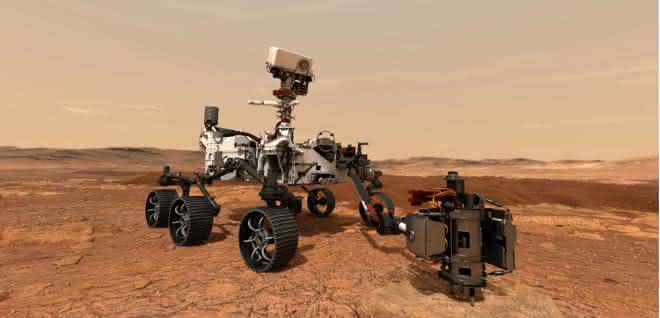
It is impossible to imagine Mars without Maxon's drive systems. Electric motors from Switzerland have been used in practically all successful robotic missions over the last three decades. There are now more than 100 of them on the Red Planet and there are likely to be more soon. This is because the time window for NASA's next mission opens on July 22. It is sending the Perseverance rover to Mars with an Atlas V rocket to find traces of ancient life.
However, its most important task is to take several soil samples, seal them in containers and place them in a targeted manner so that they can be brought back to Earth on a later mission. Several Maxon motors are used to handle the samples inside the rover. Among other things, they are installed in the robotic arm that navigates the samples from station to station. Maxon motors are also used to seal and place the sample containers.
NASA's Jet Propulsion Laboratory (JPL), which is carrying out the mission, has ordered ten drives for the rover from Maxon. These are based on standard catalog products - as with almost all previous Mars missions, but have been modified. Brushless DC motors have been chosen for the first time: Nine EC 32 flat and one EC 20 flat in combination with a GP 22 UP planetary gearhead.
The engineers worked with the specialists from JPL to develop the drives over several years and tested them extensively. "This exciting project has taught us a great deal," says Robin Phillips, Head of SpaceLab at Maxon. "We now have a very broad knowledge of space and have established quality processes that meet the expectations of the industry. This also benefits customers from other sectors, such as medicine, where the requirements are sometimes similar."
Space missions place the highest demands on propulsion systems: vibrations during the rocket launch, vacuum during the journey, shocks on landing and finally harsh conditions on the surface of Mars, where temperatures fluctuate between minus 125 and plus 20 degrees Celsius and dust penetrates everywhere.
DC motors control the Mars helicopter
The Perseverance Rover is expected to land on Mars on February 18, 2021 - but not alone. Mounted on the underside of the vehicle is a helicopter drone called Ingenuity. It weighs 1.8 kilograms, is solar-powered and will make a few short flights and take aerial photos. This experiment is primarily intended to test the concept for other drones of this kind.
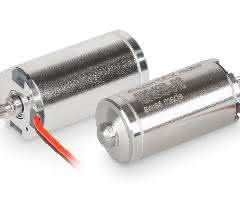
The drive specialist is also involved in this device. Six brushed DCX motors with a diameter of ten millimetres control the inclination of the rotor blades and thus the direction of flight. The drives are lightweight, dynamic and energy-efficient. These properties are crucial, as every gram counts for the Mars helicopter - after all, flying on Mars is not easy.
The atmosphere is extremely thin, roughly comparable to the conditions that prevail here at an altitude of 30 kilometers. The helicopter drone has already flown in a simulated test environment in the JPL laboratory. Whether it will also take off on Mars remains to be seen. First, other obstacles such as the rocket launch have to be overcome. "We hope that everything goes well and that we will soon see our drives in action on Mars," says Maxon CEO Eugen Elmiger. as


You might also be interested in
Motors, gearboxes and encoders: Faulhaber expands Ø 16 mm portfolio
Faulhaber is expanding its portfolio with new DC motors from the SXR and GXR family, a 16 mm planetary gearbox and the IEX3 magnetic encoder for compact drive solutions.
 read more...
New drive solutions for industrial automation and robotics
Faulhaber presents drive solutions with the new GXR and SXR motor family, which offer high efficiency and flexibility in combination with powerful gearboxes and encoders. These optimized components open up new possibilities for applications in...
read more...Marco Altherr becomes new Chief Financial Officer
The Supervisory Board of Ziehl-Abegg has appointed Marco Altherr as the company's new Chief Financial Officer (CFO). Altherr will take up his post in May 2025.
read more...Hydrogen storage in metal hydride
With its focus on storage systems for green hydrogen in solid form (metal hydride), GKN Hydrogen presents itself as a pioneer in safety and efficiency for the industry. GKN Hydrogen offers safe storage systems for green hydrogen and focuses on two...
read more...INDUSTRIAL Production Products of the year...
2nd place, Robotics category: EGS Automation
The SUMO automation systems from EGS Automation - economical standard solutions for automating a wide range of processes in plastics and metalworking - took second place in the robotics category in the competition for Product of the Year 2024.
read more...More productivity with Drive Intelligence
The trends in automation are productivity, sustainability and connectivity. Baumüller is launching new products on the market that address these trends, including new tools for smart energy monitoring, condition monitoring in the drive and new...
read more...Intelligence in Motion
At SPS, Koco Motion will be showcasing its expertise in customized drive solutions based on DC and BLDC motors, stepper motors, servo motors, linear drives and controllers.
read more...Nomination Products of the Year 2024
EGS Automation: SUMO automation systems
The SUMO automation systems from EGS Automation, economical standard solutions for automating a wide range of processes in plastics and metalworking, have been nominated in the Robotics category in the competition for Product of the Year 2024.
read more...Transport technology from the modular system
Many transport tasks can be realized with the help of linear technology. Pre-configured solutions are available to simplify the interaction between the linear unit, motor, gearbox and controller. This minimizes the effort required for research and...
read more...