
SEW Eurodrive
Magnet mounting on the rotors of synchronous servomotors
SEW-Eurodrive automatically equips the rotors of synchronous servomotors with permanent magnets in its production. A rotor assembly system from IEF-Werner is used for this, which has been equipped with components from the new Movi-C modular automation system from SEW-Eurodrive. This allows the system to be optimally integrated into Industry 4.0 production processes.
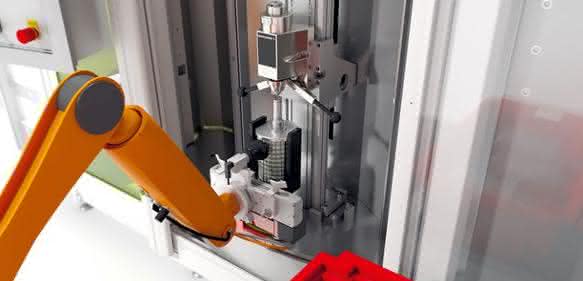
Like most industrial processes, the assembly of synchronous motors is now largely automated. A central process step is the gluing/mounting of the permanent magnets onto the rotor. SEW-Eurodrive has been working with IEF-Werner from Furtwangen on this technology for some time. The automation specialist from the central Black Forest had already built placement systems for the drive specialist from Bruchsal in the past. The current rotor assembly system was built using the latest drive and automation technology from SEW-Eurodrive - with the Movi-C modular automation system. The new system is being used at the SEW site in Graben-Neudorf.
Automatic rotor loading
The core of the machine is a rotary indexing table with four positions, each offset by 90°. At the first position, the rotor is clamped in a movable holder with two mandrels. It is positioned at the bottom on the shaft collar and is held at the top on the shaft mirror. Clamping can be done by hand or with the help of a handling robot. The system can be seamlessly integrated into Industry 4.0 production processes.
The rotor is cleaned in the subsequent cycle. To do this, a plasma laser moves along the rotor for surface treatment. It removes any adhering layers of oil or dirt in a gentle and environmentally friendly way - using only focused light. The laser enables precise and homogeneous processing with high productivity.
In the next step, a two-axis linear handling system positions the adhesive nozzle on the vertically held rotor. The sheet stack has a polygonal cross-section, on the outer surfaces of which the adhesive is applied as a smooth adhesive bead. This bead is continuously monitored by a scanner to ensure that no air is trapped.
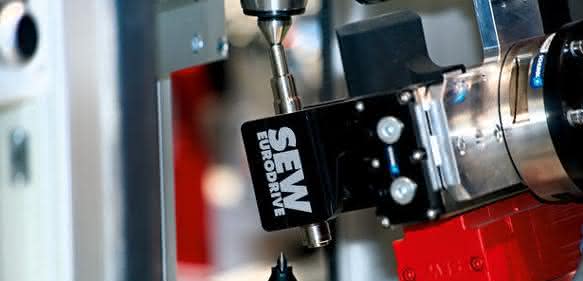
The rare earth magnets are fed to the system in blister packs. A portal sucks in the magnets and places them in rows on a small conveyor belt. Depending on the length and circumference of the rotors, a gripper picks up the required number of magnets from above, rotates them by 90° and presses them onto the adhesive with a defined contact pressure. The rotor and magnets are not yet magnetized at this point. Once assembly is complete, the rotors are treated in a curing oven to permanently strengthen the bond. The curing time varies depending on the size of the rotors. Shortly before the rotor meets the stator in the assembly process, the magnets on the rotor are magnetized in a magnetizing coil.
All rotors for synchronous motors with permanent magnets can be processed on the placement system - from the smallest size 1 of the Movigear mechatronic drive system to the CMP 112E, the largest motor in the CMP dynamic servomotor series from SEW-Eurodrive.
Automation from the modular system
The Movidrive modular multi-axis inverter system provides the drive power required for the placement system. A 10 kW Movidrive modular MDP feed supplies a total of 18 axes in the system: eight double-axis modules and two single-axis modules. They are connected via a common DC link. One advantage of the Movi-C modular automation system is that it saves space thanks to its compact design and integrated safety technology. For example, a double-axis module can accommodate two drive cards in the same installation space as a single-axis module.
All processes in the placement machine are controlled by the Movi-C Controller power. Its motion control and visualization functions can be easily programmed using the sophisticated functions of the IEC programming system Codesys 3.5. This makes the machine builder's work much easier.
The intuitive Movisuite engineering tool was developed for the modular automation system. It helps to significantly simplify and speed up commissioning. Drive solutions in machines can be very diverse - from simple speed specification, positioning and synchronized axis movements to robotics, where several axes have to follow a precisely defined space curve. The Movikit MultiMotion motion control software platform helps users to master this diversity and achieve their goals quickly with efficient engineering. This means as much parameterization as possible and as little programming as necessary, as well as support through graphical interfaces for guided parameterization of standard functions and convenient diagnostics.
The DOP11C series of digital operator panels from SEW-Eurodrive enables realistic and powerful machine visualization. The DOP11C 150 panels are used in the rotor placement system for operation and the DOP11C 100 for adjusting the gluing unit. ee


You might also be interested in
Further simplify assembly processes
In addition to the proven racks with a length of one meter, Wittenstein alpha now offers optional two-meter racks for linear systems. They are particularly suitable for use in short axes, for example, in order to simplify assembly even further.
 read more...
Hiwin manufactures its own shaft gearboxes
Have you ever waited several months for an urgently needed corrugated gearbox? Hiwin has too. That's why the Offenburg-based drive specialist has decided to produce its own space and weight-saving reduction talent.
read more...Human-robot interaction at the trade fair
Sumitomo Drive Technologies is presenting its drive solutions for automation and robotics at Automatica 2023 together with the Lafert Group. The company will be showcasing two different applications of the Tuaka drive system for robot applications...
read more...Partial automation with robots
At Automatica, Promess will be showcasing its modular individual workstations and how these can be partially automated with robot support. The servo press manufacturer will also be providing information about the latest features of its Revolution X...
read more...A new benchmark for collaborative robots
At this year's Automatica, Denso Robotics will be showcasing its innovations in the field of robotics. The collaborative Cobotta Pro product family will be the focus of the presentations. Visitors to the trade fair can see all variants in various...
read more...Clamping system for a new milling machine
Investments in machinery often lead to further purchases - as is the case at Joma-Maschinenbau, whose modern production facility has recently been supplemented by a 5-axis milling machine.
read more...Schunk wants to simplify processes in automated production
The declared aim of automation specialist Schunk is to make its customers' processes comprehensible, simple and efficient. Data transparency plays an important role in this. It enables reliable processes and provides the basis for resource-saving...
read more...Festo and Hahn Automation develop battery tester for greater safety
The success and reputation of electric vehicle manufacturers depend on the safe and flawless functioning of batteries. Hahn Automation has therefore developed a battery tester that performs a fully automated 100% test of mobile energy storage...
read more...SPN Schwaben Präzision presents gearbox solutions for automation and industrial robotics
Short cycle times, robust technology, wear-free surfaces and compact designs have always been relevant for automation and robotics solutions. This year's Automatica trend topics include "Sustainable production" and "Digitalization and AI". SPN aims...
read more...