

Sculpture project Anthozoa
Kinetic art project runs with Faulhaber motor
Today, microdrives achieve remarkable things in a wide variety of applications, and not just in industrial applications. In the kinetic sculpture "Project Anthozoa", which imitates the movement patterns of invertebrate flower animals, many small linear DC servomotors ensure fluid, dynamic and therefore lifelike movements.
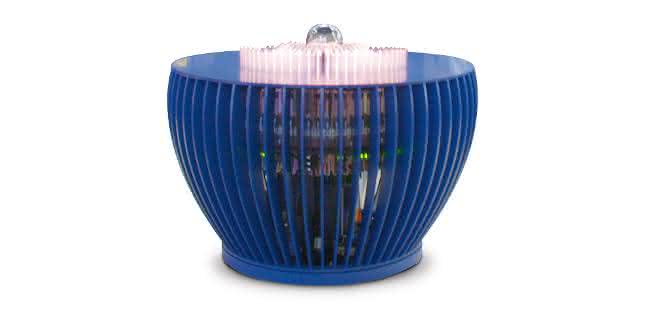
Linear motors can be designed in many different ways, because in principle, "rotating" electric motors of all principles can be converted into linear motors by mapping the circular air gap onto a straight line. The electrical excitation windings, which were originally arranged in a circle, are unwound along a straight line. The magnetic field then pulls the rotor along the track. However, there are also other possibilities.
The DC linear actuators in the "Quickshaft" series from Faulhaber, for example, are not designed as "surface sliders" with a carriage and guide. Instead, the slider rod is guided within a self-supporting three-phase coil. This innovative design results in an extremely good linear force/current ratio and high dynamics. In addition, there are no cogging torques, which makes the linear motors particularly suitable for use in micropositioning systems.
Typical applications range from handling and positioning systems to scanning applications, for example in microscopy. However, the compact DC linear drives have now also proven themselves in more unusual applications. The kinetic sculpture "Project Anthozoa" - a collaboration between MTK, flying saucer and Faulerher - provides an example of this and illustrates what the small drives can achieve.
Artificially and artistically recreating nature
With a passion for inspiring people and bringing knowledge to life, as well as the conviction that any topic, however abstract and technical, can be turned into an exciting experience, the designers at flying saucer (Berlin) and the engineers at MKT (Olching) are continuing an age-old human endeavor with "Project Anthozoa": Artificially recreating nature. From the first cave paintings to modern robotics, technology has always set limits here, but has also constantly opened up new possibilities. Now the aim was to move away from the rather clumsy imitation generally associated with "robots" and instead achieve a flowing, natural-looking movement without any recognizable technical limitations, with the help of Faulhaber DC servomotors.
The small drives are well equipped for this: they combine the speed and robustness of pneumatic systems with the flexibility and reliability of electromechanical linear motors. Their design with the self-supporting three-phase coil in the solid, anti-magnetic stator housing ensures high performance and dynamics with a strictly linear force/current ratio - with a surprisingly small installation volume. On this basis, highly dynamic movements without cogging torques, i.e. also fluid, lifelike movements, can be realized, especially as exact position control is easily possible via the Hall sensors integrated in the motors.
Balance and weightlessness
With these characteristics in mind, the industrial designers and engineers came across the book "Art Forms of Nature" by natural scientist and polymath Ernst Haeckel (1834 to 1919), which contains 100 prints with illustrated plates of various organisms, most of which were described by Haeckel for the first time. They were particularly taken with the Anthozoa (flowering animals). This largest class of cnidarians became the source of inspiration and gave the art-technology project its name. The invertebrates move very smoothly and virtually float in the water. "This is exactly what the sculpture 'Project Anthozoa' recreates. It enchants in a perfect choreography that visualizes the fusion of two movement concepts to spherical sounds: Underwater weightlessness and balancing," says Axel Haschkamp from MKT.
A total of 120 linear DC servomotors with just as many Ether-Cat controllers from Faulhaber are used in this work of art to impressively demonstrate the choreography. This places special demands on the control system and the bus system used to control it. A decentralized control structure was therefore chosen for Anthozoa. The MC 5004 series motion controllers control the drives independently of the bus runtime, i.e. the drives are controlled at the internal clock rate of 100 microseconds in order to follow the target position specified in milliseconds. This combination enables perfect synchronization of the 120 drives.
Remarkable performance
Despite the compact stator dimensions of 20 x 20 x 70 millimetres, the LM 2070 linear motors used in the kinetic sculptures deliver impressive mechanical performance figures. The continuous force of the slider rod is 9.2 Newtons, with peak or impact forces of up to 27.6 Newtons available. The standard stroke lengths are 40, 80, 120, 160 or 220 millimeters. Depending on the load, a maximum acceleration of 93.9 m/s2 can be achieved with the 40 millimeter stroke variant, which corresponds to almost 10 g. With a 220 millimeter stroke, the maximum possible acceleration is still 36.8 m/s² or just under 4 g. The robust plain bearing of the slider rod can easily cope with speeds of up to 2.8 meters per second. The drive's permissible operating temperature range of -minus 20 to 125 degrees Celsius covers all common areas of application. Despite these performance values, the linear motor can be controlled sensitively. The repeat accuracy is between 100 micrometres with a 40 millimetre stroke and 120 micrometres with a 120 millimetre stroke.
The linear DC servomotors are also available in two smaller versions. The LM 1247 with stator dimensions of twelve by twelve by 49.4 millimetres also operates with a stroke of 40 to 120 millimetres; the even smaller version with stator dimensions of eight by eight by 33 millimetres is available with a stroke of 15 or 40 millimetres. This means that a suitable solution can be found for various applications that require compact, dynamic and smooth-running drives. "Project Anthozoa" has already impressed trade fair visitors in Amsterdam, Hanover, Bern, Munich and Nuremberg in 2018. The exhibitions and trade fairs at which the artwork can be seen in 2019 will be published on the website http://www.project-anthozoa.com. as


You might also be interested in
Motors, gearboxes and encoders: Faulhaber expands Ø 16 mm portfolio
Faulhaber is expanding its portfolio with new DC motors from the SXR and GXR family, a 16 mm planetary gearbox and the IEX3 magnetic encoder for compact drive solutions.
 read more...
New drive solutions for industrial automation and robotics
Faulhaber presents drive solutions with the new GXR and SXR motor family, which offer high efficiency and flexibility in combination with powerful gearboxes and encoders. These optimized components open up new possibilities for applications in...
read more...Marco Altherr becomes new Chief Financial Officer
The Supervisory Board of Ziehl-Abegg has appointed Marco Altherr as the company's new Chief Financial Officer (CFO). Altherr will take up his post in May 2025.
read more...Hydrogen storage in metal hydride
With its focus on storage systems for green hydrogen in solid form (metal hydride), GKN Hydrogen presents itself as a pioneer in safety and efficiency for the industry. GKN Hydrogen offers safe storage systems for green hydrogen and focuses on two...
read more...INDUSTRIAL Production Products of the year...
2nd place, Robotics category: EGS Automation
The SUMO automation systems from EGS Automation - economical standard solutions for automating a wide range of processes in plastics and metalworking - took second place in the robotics category in the competition for Product of the Year 2024.
read more...More productivity with Drive Intelligence
The trends in automation are productivity, sustainability and connectivity. Baumüller is launching new products on the market that address these trends, including new tools for smart energy monitoring, condition monitoring in the drive and new...
read more...Intelligence in Motion
At SPS, Koco Motion will be showcasing its expertise in customized drive solutions based on DC and BLDC motors, stepper motors, servo motors, linear drives and controllers.
read more...Nomination Products of the Year 2024
EGS Automation: SUMO automation systems
The SUMO automation systems from EGS Automation, economical standard solutions for automating a wide range of processes in plastics and metalworking, have been nominated in the Robotics category in the competition for Product of the Year 2024.
read more...Transport technology from the modular system
Many transport tasks can be realized with the help of linear technology. Pre-configured solutions are available to simplify the interaction between the linear unit, motor, gearbox and controller. This minimizes the effort required for research and...
read more...