
Surface hardening
Hydraulic cylinders rethought
A technology developed by Acona Hydraulik and Industrieforschung Wirsing enables both cooperation partners to produce more durable, more powerful and more climate-friendly hydraulic cylinders. The Laboratory for Machine Tools and Production Engineering (WZL) at RWTH Aachen University has examined and confirmed the effectiveness of the process.
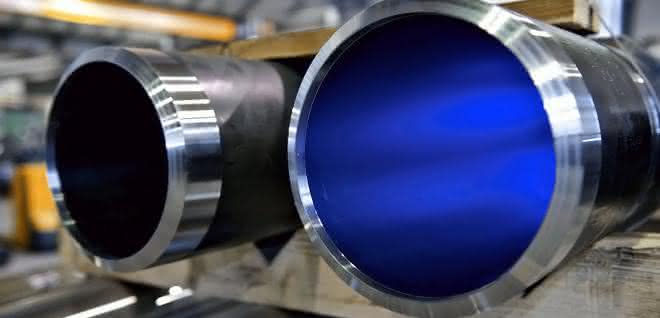
Deep-R technology, a new surface hardening process for the special treatment of weld seams, combines an already familiar technique with state-of-the-art calculation methods. "Deep rolling has long been used as a forming process to positively influence the edge zone properties of hydraulic cylinders. The Deep-R technology supplements this with a calculation algorithm adapted to it," explains Dipl.-Ing. Stephan Wirsing, owner of Industrieforschung Wirsing. The use of modern software products and the ability to calculate according to the latest theorems and algorithms, in close cooperation with Acona, ultimately led to the transfer of an innovative solution approach into a process-safe and future-proof industrial application.
"Deep-R technology can make a significant contribution to optimizing hydraulic cylinders and their surrounding constructions," says Dr Andreas Feuerhack, senior engineer at the Chair of Manufacturing Process Technology at the WZL, which has extensively tested the technology in a series of tests lasting several months and finally verified its effectiveness.
More durable and more powerful
Using this process, manufacturers can make their machines up to 100 percent more durable, up to 25 percent more efficient or save up to 35 percent in volume and weight during construction. "A combination, i.e. an improvement in all three areas, can also be planned and implemented individually," says Philipp Kampel, Managing Director of Acona Hydraulik. Doubling the service life of hydraulic cylinders is particularly lucrative for industry. "Newly produced cylinders achieve up to 100 percent more strokes than comparable products over the course of their application," says Kampel. Repairs and optimizations of existing hydraulic cylinders on the secondary market also ensure that the service life of older machines is extended and mean that they do not have to be replaced unnecessarily with new machines.
Hydraulic cylinders often have to deliver enormous power. "With the same dimensions, our process offers an enormous increase in performance. For example, the operating pressure of hydraulic cylinders can be increased from 350 bar to 430 bar using our technology," reports Kampel and adds what makes the process special: "We have made the technology calculable and were able to introduce it as a decisive factor in the design formula of our products.


You might also be interested in
Plagiarius 2024 negative prize
On January 26, 2024, the Plagiarius campaign awarded its dreaded "Plagiarius" negative prize for the 48th time to manufacturers and retailers of particularly brazen counterfeits and fakes.
 read more...
Ivalua honors winners of the Generative AI...
AI-supported "add-ons" for buyers within 48 hours
Ivalua, provider of cloud-based spend management solutions, announced the winners and innovations of the first Generative AI Innovation Cup. The competition took place in December 2023. It was open to all Ivalua partners and employees - more than...
read more...Efaflex celebrates 50 years of high-speed...
The emphasis is on "fast"
Since day one, Efaflex has wanted to use new technologies as early as possible and drive progress in the industry. This year, the family business is celebrating its 50th anniversary under the motto "Fast Forward".
read more...Security of supply even during power outages
In the winter of 2022, Germany was worried about energy shortages. The drugstore retailer dm did not paint any horror scenarios, but nevertheless saw the possibility of controlled, temporary, regional power cuts (brownouts).
read more...Safety technology in mechanical engineering
Modules with new functions
Euchner's product highlights at EMO 2023 include the communication-capable solenoid interlocks.
read more...Transforming the paper industry towards climate neutrality
Together with partners from industry and research, Voith is developing a project for the optimization of energy and material flows in paper production. The aim of the research project is to develop a digital framework that enables effective process...
read more...Up to 95 percent less flue gas thanks to direct extraction
The requirements for occupational safety measures and safety technology are also constantly increasing in welding technology. The Technical Rules for Hazardous Substances (TRGS) stipulate that welding fumes and harmful substances must be extracted...
read more...Competitive advantages with large machines
Whether 3D-printed components for machines and systems, prototypes or aids for design: additive manufacturing is almost indispensable for modern companies in mechanical and plant engineering and automation if they want to play in the premier league.
read more...Transport technology from the modular system
Many transport tasks can be realized with the help of linear technology. Pre-configured solutions are available to simplify the interaction between the linear unit, motor, gearbox and controller. This minimizes the effort required for research and...
read more...