
SEW industrial gear units move new Zugspitz cable car
Highest performance on the highest mountain
The new Zugspitze cable car is a project of superlatives. It transports up to 580 guests per hour up Germany's highest mountain. The enormous drive power for the cable car, which is extremely steep in places, requires heavy industrial gearboxes: two Series X units from Sew-Eurodrive drive the traction cable, which lifts the cabin to a height of 2,943 meters with the power of a full-size diesel locomotive.
Unique difference in altitude
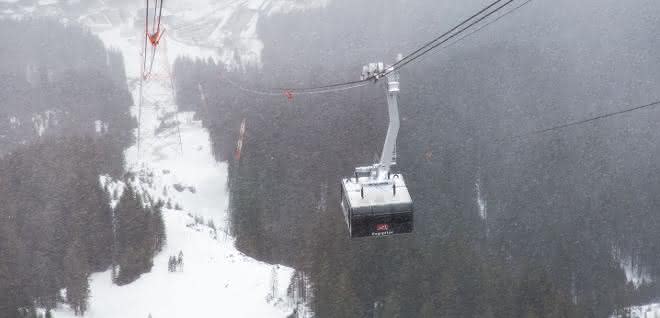
Three years of planning and three years of construction were necessary to future-proof the passenger transportation from the valley station at Eibsee to the Zugspitze. The operating company Bayerische Zugspitzbahn Bergbahn opted for a completely new construction. The contract was awarded to the Swiss ropeway company Garaventa, which merged with the Austrian ropeway manufacturer Doppelmayr in 2002. The Doppelmayr/Garaventa Group has built more than 14,000 ropeway systems in more than 90 countries to date. Nevertheless, the new Zugspitze ropeway is an outstanding prestige project that breaks three world records at the same time: the single support, constructed in steel, is the highest of its kind at 127 meters. Between the support and the mountain station, the ropeway covers an unprecedented 3,213 meters of rope, and the 1,945 meter difference in altitude on this section of rope is equally unique in the world.
Extreme route profile
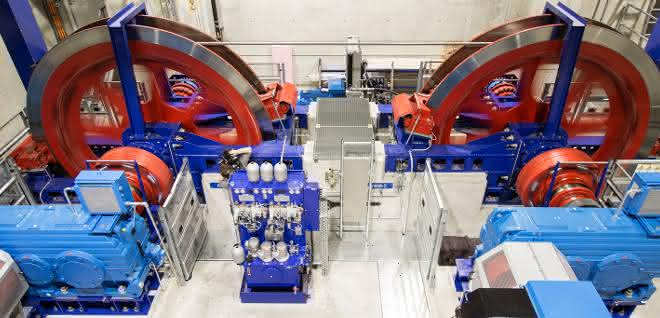
Shortly before the summit, the ascent of the cable car becomes breathtakingly steep: the ascending cabin overcomes a gradient of 104 percent, gaining more than one meter in height for every meter of forward movement. At the same time, the second cabin approaches the bottom station, so the cable car runs in shuttle mode. The two are connected by a cable loop that is driven in the bottom station. Two 900-kilowatt three-phase AC motors are connected to a three-stage X3FS280 spur gearbox from SEW via flexible claw couplings from KTR. "We need the power because we have an extreme track profile here," emphasizes project manager Markus Reichmuth from Garaventa. Behind the clutch is a flywheel with a diameter of almost one meter and a weight of over one ton. The flywheels ensure better control of the drive system. The adjacent industrial gearboxes, each weighing almost six tons, each have a rated torque of 240,000 Newton metres and can transmit a power of 1,024 kilowatts. They are kept within the defined temperature range by an oil-air cooler. On the output side, a switchable pin clutch weighing over three tons ensures the frictional connection with the rope wheels. An emergency drive can engage at the rear via gear couplings.
Remarkable performance
SEW X series gear units are characterized by their low-noise gearing and ease of maintenance. The robust housing of the series is reversible in the universal version and can be used in all spatial positions. The horizontal housings used in the Zugspitze cable car, on the other hand, are specially designed for horizontal applications. Another SEW gear unit is installed in the mountain station on the Zugspitze: The type X3TH210 three-stage helical-bevel gear unit with a rated torque of 90,000 newton meters is located on the drive of the recovery cabin. This could be placed on the suspension cables to rescue passengers if the two cabins of the Zugspitze cable car can no longer be moved. However, this is extremely unlikely - each of the two main motors and the two hydraulically operated emergency drives can also drive the haul rope system on their own if necessary.
Harsh environment
The enormous drive power required is generated by two three-phase motors, each with a rated output of 900 kilowatts. They are connected to a 400-volt medium-voltage grid. In the event of a power failure, diesel generators from the two-megawatt emergency power system can provide the necessary drive power. The emergency power system is installed in an adjacent room in the valley station and was installed and commissioned by Polyma.

In normal operation, the two main motors and the industrial gearboxes of the X series combine to accelerate the gondola system up to 10.6 meters per second - that's almost 40 kilometers per hour. Each cabin holds up to 120 passengers and is supported by two suspension ropes with a diameter of 72 millimetres and a mass of 145 tons. The suspension ropes have a breaking load of over 600 tons and were made from 5,500 kilometers of wire. The cable car is approved for temperatures down to minus 30 degrees Celsius and can operate in winds up to force eight. Passengers can reach the top of the mountain in around ten minutes.
For the manufacturer Garaventa, the new Zugspitze cable car is a flagship project, as it is for the drive specialists at SEW-Eurodrive in Bruchsal, which is represented in Switzerland by the general agency Alfred Imhof. Chr. Rüttling/pb


You might also be interested in
Housing and inserts for plenty of power
Lapp presented the expansion of its Epic Power series at SPS 2023: four new M23 circular connector inserts and three new M23 housings. The special feature: all housings can be combined with any of the four inserts.
 read more...
News and product updates from Smartgas
Portable gas analyzers for outdoor use
Smartgas is starting the second half of the year with a series of updates to existing products and a number of new products. Portable analyzers expand the range of applications, while new accessories such as protective housings and heating modules...
read more...Everything accurate in switch cabinet construction
To ensure smooth work processes, tools for processing enclosures and housings must function flawlessly and reliably. Häwa rounds off its punching range with the Multi-Press 500.
read more...Shafts and conversion parts
The Rodriguez range includes ball bushings including matching housings, shaft brackets, crossbars and supports.
read more...Cooling and temperature control units
Hygienic packaging sells safely
In few industries are the requirements for hygiene in the production process as strict as in the food sector - the health of consumers has top priority. This results in enormous challenges for all machines and components involved, especially in...
read more...Simple tool change in seconds
With the CMS, Schunk is launching a user-friendly, manual change system for quick component replacement. In addition to its simple and convenient operation, the CMS also stands out with its extensive range of optional modules and complementary end...
read more...Motion controller for small drives
Medium power range covered
Faulhaber has another housing-less and compact motion controller in its range, which is particularly suitable for integration in device construction and medical technology applications.
read more...Welding solutions in the name of resource efficiency
At the Welding & Cutting trade fair in Essen (September 11-15), Fronius will be focusing on the major drivers in welding technology. Quality requirements are increasing in all industries, but the required welding specialists are scarce. In...
read more...Safe solutions for cable installations
From thick power cables to thin sensor lines, cables and lines must be routed safely through systems and machines. A challenge that should not be underestimated, explains Jörg Sokat, Head of Product Management at Pflitsch.
read more...