
Mains converter
Grid stabilization and energy recovery
Switched, predominantly converter-fed devices such as electric drives generate harmonics and voltage drops. They also require reactive power. These grid perturbations interfere with other consumers across the entire power range and cause additional costs. Both control and harmonic reactive power contribute nothing to the active power, but are responsible for losses that have to be paid for.
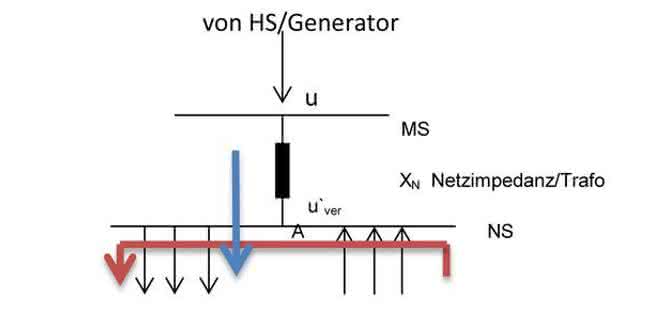
The partial currents of all loads add up at grid connection point A. They cause voltage drops and asymmetries at the grid impedance. As a result, the feed-in voltage drops and is also distorted. Other consumers are disturbed, as drives, for example, generate particular grid perturbations due to their mostly fluctuating load and the associated switching processes.
Pulsed power converters eliminate or drastically reduce such problems. The supply voltage and current retain their sinusoidal shape and nominal amplitude, and their reactive power becomes adjustable. In addition, such four-quadrant converters improve the cost balance of the overall system. The aforementioned controllers complement conventional methods that are only dimensioned for a specific operating point (parallel capacitors, tuned suction circuits). At the same time, they can feed any braking energy released back into the grid (regenerative braking).
Use of electronics
It has been known for more than 40 years that force-commutated, self-commutated converters can compensate for grid perturbations and generate reactive power. However, this approach could only be implemented in a fully electronically controlled, economical and reliable manner with power electronic components (IGBT) and integrated circuits. Grid quality and security of supply increase for all consumers at slightly higher investment costs. Expenditure over the life cycle is reduced as installation, energy and maintenance costs decrease. Even during the investment phase, costs can be offset by lower costs for cables, filters, conventional compensation systems, transformers, buffer equipment and even by designing motors with a lower output.
Grid stabilizer
The active, fully electronic grid stabilizer or reactive power generator couples the supply grid with the load (capacitive as a reactive power converter for generating reactive power, DC consumers, machine/inverter of frequency converters for feeding AC machines). Its design corresponds to the pulsed inverter in a B6 bridge circuit.
The key features of the active, self-commutated forced-commutation mains converter (four-quadrant converter 4QS, Active Front End AFE) are:
- in both directions (four-quadrant operation/controller, mains feedback in braking mode)
- Current on the grid side (minimal grid feedback)
- Inverter tilting in the event of grid failure in regenerative mode
- Operation with a weak grid, compensation of grid voltage fluctuations or dips of up to approx. 60 percent, work as a step-up converter
- Adjustment dynamics of current, voltage and phase shift
- of reactive power (free, regulated power factor adjustment at the input)
- with regard to commissioning, parameterization, operation and communication.
Digital control of the DC link voltage, shape and phase angle of the grid variables (harmonics, reactive power) is available for these tasks. All power converter and EMC standards are thus fulfilled.
Such a feed-in unit shields both the feeding grid and consumers from interference caused by problematic loads (inverters, non-linearities).
Application
The four-quadrant converter was first used in industry as a single-phase mains converter in ICE and Transrapid trains. The use as a pure reactive power converter favors the upper power range.
The application has become established as a mains converter for inverter-fed three-phase drives. It supplies the motor via a DC link and AC/machine converter. Predestined single-phase or three-phase applications for the controller include logistics and transportation equipment, wind turbines, test benches, fans, centrifuges and pumps, LV/MS motion drives, lifts/cranes and motion control.
For example, the ACTIVE FRONT END (AFE, http://www.siemens.de) feed-in/feed-back unit has the above-mentioned properties. Its mains current is practically sinusoidal,
The power factor cosϕ of the load can be set in the range 1 to 0.8 (capacitive or inductive) by direct parameterization or via a field bus as required. Alternatively, the reactive power can be regulated to the required level in order to cover the reactive power requirements of other loads independently of the power, i.e. to replace conventional compensation systems. Inverters often have an input filter that additionally reduces harmonics(http://www.abb.com).
Outlook
With the increase in the use of inverter-fed three-phase drives of all outputs (as well as other devices), grid perturbations are increasing. The necessary stabilization of grid conditions is not economically feasible through grid expansion, partly due to the increased cost pressure resulting from the liberalization of the energy markets. However, non-reactive converters are now even available to compensate for the reactive power of parallel consumers. In addition to savings on operating costs and/or capital expenditure, the drive equipped in this way ensures uninterrupted production and consistent quality even when the grid is weak.


You might also be interested in
Hebotec at the Hannover Messe 2025
Connecting consumers without tools
Additional robots, control cabinets, control panels or other consumers can be easily integrated into the EMC concept of an existing production line using the PAK 25 equipotential bonding terminal from Hebotec.
 read more...
Motion controller for small drives
Medium power range covered
Faulhaber has another housing-less and compact motion controller in its range, which is particularly suitable for integration in device construction and medical technology applications.
read more...Safe solutions for cable installations
From thick power cables to thin sensor lines, cables and lines must be routed safely through systems and machines. A challenge that should not be underestimated, explains Jörg Sokat, Head of Product Management at Pflitsch.
read more...Displacement measuring systems
Economic positioning
The integrated position measuring system IMS from Bosch Rexroth is now also available as IMS-compact for absolute measurement. The non-contact solution with magnetic measuring principle enables robust and economical position detection for linear...
read more...Economic positioning
The integrated position measuring system IMS from Bosch Rexroth is now also available as IMS-compact for absolute measurement. The non-contact solution with magnetic measuring principle enables robust and economical position detection for linear...
read more...Sensors with IO-Link for extruders
The melting pressure always in view
Macchi, a manufacturer of blown film extrusion lines, optimized its extruders for Industry 4.0 by integrating melt pressure transmitters with digital IO-Link output for precise recording of the melt pressure and magnetostrictive displacement...
read more...Vision with good visitor response
6505 visitors and 378 exhibitors attended the machine vision trade fair in Stuttgart.
read more...Würth Elektronik at the embedded world
Würth Elektronik, manufacturer of electronic and electromechanical components, is presenting itself as a partner to developers at embedded world. At stand 110 in hall 2, the company will be presenting its portfolio and the associated services.
read more...Die-cast electronics housing
CTX Thermal Solutions manufactures cost-effective die-cast housings in application-specific geometries.
read more...