

High-precision special ball bearings
Customized and highly precise
Special bearings for high demands on speeds, low vibration and running accuracy as well as bearings and bearing systems for use under extreme environmental conditions often have to be designed and developed specifically for the customer.
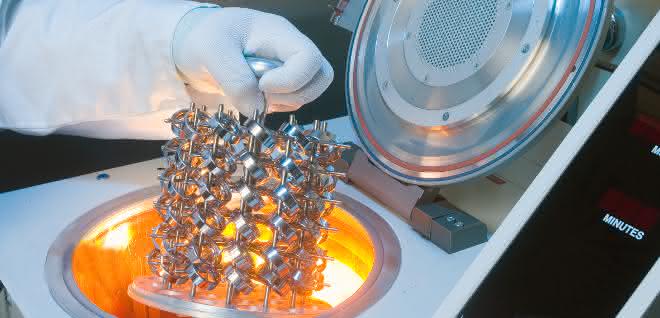
The demand for application-specific high-end products is growing continuously at machine manufacturer GMN Paul Müller Industrie. "Maximum precision is often required. That is our profession. We feel extremely comfortable in the high-precision accuracy classes P4+ and UP+," says Andreas Böhrer, a member of the technical sales team. At GMN, P4+ replaces the previous DIN P4 and ABEC 7 accuracy classes.
Stefan Tritthart, Head of the Bearing Systems and Special Bearings product area, says: "The challenges are as varied as the applications." Among other things, customers place very high demands on special bearings and ready-to-install bearing systems, for example for vacuum technology, in terms of cleanliness. When used in radiological products such as X-ray machines and computer tomographs, the focus is on low vibration and cleanliness. The bearings should also be suitable for extreme ambient temperatures of up to 550 degrees Celsius. When used in measuring and navigation systems, the focus is on system running accuracies of less than a thousandth of a millimeter, while special designs are often required in machine construction.
Ball bearings and complete bearing systems
GMN offers application-specific special solutions for numerous fields of application. The range of services begins with the development and production of individual ball bearings and integrated bearing systems including shafts, conversion parts and housings. It extends to an all-round service for the delivery of series parts, including Kanban processing and article stocking at the end customer. The company focuses on spindle ball bearings, deep groove ball bearings and hybrid models with ceramic balls. During product development, customers often discover that their specific requirements cannot be met with catalog models. "The effort we put into the design and layout of individual bearing systems and individual special ball bearings is considerable," explains Tritthart. "That's why we start a joint development project with the customer for these demanding and extensive projects. This includes, among other things, a separate requirement and functional specification, a concept with the associated design and interface drawings and a calculation of the development costs."
Sometimes a large number of components have to be optimized to meet individual requirements and environmental conditions. Depending on the intended use, specific materials and coatings are also required, and internal processes may also have to be changed and special tools procured. "Once the prototype has been successfully sampled, we start series production of the new product," explains Andreas Böhrer.
Consulting and cooperation in engineering
An application engineer accompanies the customer as a permanent contact throughout the entire development process. Tritthart says: "Our support is very comprehensive and extends far beyond the series production of a special bearing or bearing system. Even after product completion and acceptance, the project partners remain in close contact and continue to develop and optimize the series product."
During configuration, the type of bearing and the area of application are specified first. All ambient conditions are taken into account: Which fluids and aggressive gases are present? Do clean room conditions have to be met? Are special greases or dry lubrication required? Or is special handling necessary to keep the component clean during transportation and subsequent assembly?
"If bearings are to work in a vacuum, as is the case with models that are used in the glass bulbs of X-ray tubes, they also have to be cleaned and packaged in a complex manner, i.e. in a vacuum-compatible manner," says Böhrer.
Numerous configuration options
The next step is to clarify the requirements in terms of precision, rigidity, operating temperature, load capacity, speed, service life and service life. The bearing design must then be determined. Which design is required? Should the cages be made of hard fabric or carbon fiber-reinforced polyetheretherketone (PEEK)? Are balls and rings made of chrome steel sufficient or are ceramics and special steels the better choice? What installation position, fastenings and dimensions are required? What contact angles are required? Should the preload be rigid or spring-loaded?
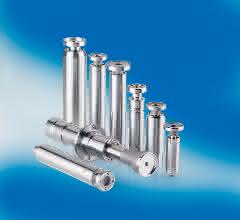
It is also necessary to define which lubrication is required and which bore position is selected for the media supply. The radial and axial loads to which the bearing is exposed must also be taken into account. Finally, other components such as the shaft, housing, conversion parts, springs, washers, circlips, seals and connecting parts as well as the bearing mounting must be determined. In view of the large number of variants, most customers are happy to draw on the experience of the GMN application engineer.
Sample parts aremanufactured under series conditions
As soon as all requirements have been met and the bearing design has been agreed, production of the prototype can begin. "We are already producing the sample parts under series conditions, whereby we have many production steps under our own control thanks to our high level of vertical integration," says Tritthart.
GMN manufactures a large proportion of the required components itself. The company can also draw on its own expertise and supplies from the machine spindles, freewheels and seals divisions. Components for vacuum applications are plasma cleaned on site and, if required, coated with silver, lead, gold or molybdenum disulphide in the company's own PVD system. Bearings can also be assembled under clean room conditions. An in-house measuring equipment and precision measurement department checks all quality-relevant components.
With the concept of experience-based engineering and a highly qualified, partnership-based supply chain, GMN believes the product area is well positioned for the future. Stefan Tritthart is happy to point to the division's more than four-decade-long tradition: "GMN special bearings have been used in navigation systems for forty years. And our custom-made products now store well over 100,000 X-ray tube systems safely and reliably."
F. Stephan Auch, freelance specialist journalist / am


You might also be interested in
Housing and inserts for plenty of power
Lapp presented the expansion of its Epic Power series at SPS 2023: four new M23 circular connector inserts and three new M23 housings. The special feature: all housings can be combined with any of the four inserts.
 read more...
News and product updates from Smartgas
Portable gas analyzers for outdoor use
Smartgas is starting the second half of the year with a series of updates to existing products and a number of new products. Portable analyzers expand the range of applications, while new accessories such as protective housings and heating modules...
read more...Everything accurate in switch cabinet construction
To ensure smooth work processes, tools for processing enclosures and housings must function flawlessly and reliably. Häwa rounds off its punching range with the Multi-Press 500.
read more...Shafts and conversion parts
The Rodriguez range includes ball bushings including matching housings, shaft brackets, crossbars and supports.
read more...Cooling and temperature control units
Hygienic packaging sells safely
In few industries are the requirements for hygiene in the production process as strict as in the food sector - the health of consumers has top priority. This results in enormous challenges for all machines and components involved, especially in...
read more...Simple tool change in seconds
With the CMS, Schunk is launching a user-friendly, manual change system for quick component replacement. In addition to its simple and convenient operation, the CMS also stands out with its extensive range of optional modules and complementary end...
read more...Motion controller for small drives
Medium power range covered
Faulhaber has another housing-less and compact motion controller in its range, which is particularly suitable for integration in device construction and medical technology applications.
read more...Welding solutions in the name of resource efficiency
At the Welding & Cutting trade fair in Essen (September 11-15), Fronius will be focusing on the major drivers in welding technology. Quality requirements are increasing in all industries, but the required welding specialists are scarce. In...
read more...Safe solutions for cable installations
From thick power cables to thin sensor lines, cables and lines must be routed safely through systems and machines. A challenge that should not be underestimated, explains Jörg Sokat, Head of Product Management at Pflitsch.
read more...