

Servo drive system
Galaxie moves swivel axes with precision
Torque density and positioning accuracy were the criteria of the mechanical engineering company Hekuma for the servo drive system of a swivel axis that serves two adjacent injection molding machines. The Galaxie D drive system from Wittenstein was chosen.
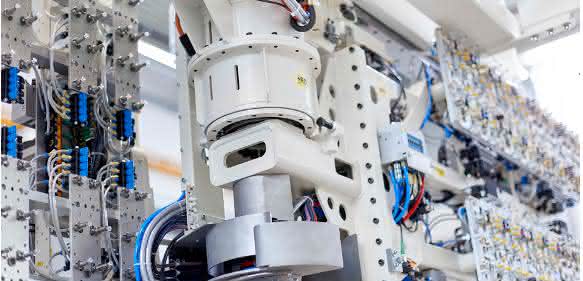
As the compact Galaxie D is completely inaccessible in the swivel axis, Hekuma attached great importance to a permanently service- and maintenance-free solution. With high backlash stability and a motor feedback system whose multi-turn functionality does not require battery buffering, the Galaxie D drive system also meets these important requirements from the end customer's point of view - in contrast to the previously used tension shaft gearbox, which had also proven to be too soft for this precision application, i.e. not sufficiently torsionally rigid and low backlash.
Hekuma - based in Hallbergmoos near Munich - is a leading manufacturer of high-performance automation systems for plastic injection molding machines. The core business of the company, which is part of the Elexis Group, includes high-performance removal systems for injection molding production, the integration of injection molding machines and molds as well as complete turnkey solutions for the removal, processing, assembly, marking, testing and packaging operations. "Our customers are primarily interested in the high-availability automation of upstream and downstream manufacturing steps in injection molding production," says Alexander Kappes, team-leading mechanical designer at Hekuma.
This also applies to the transfer unit, which will combine a two-stage injection molding process with thermoset and thermoplastic substrates at a consumer goods manufacturer. "High sales figures require a high number of cavities in production with a short cycle time," explains Reinhard Steinhoff from Mechanical Design when describing the system. "Each insertion and removal element has 32 cavities. The cycle time is 20 seconds and the machine runs in three-shift operation 340 days a year. The swivel unit with the Galaxie D therefore moves more than 47 million injection molded articles per year."
In addition to the dynamics, however, there was another argument: "The swivel arm of the transfer unit rotates 180 degrees in the y-direction and has a moving mass of around 270 kilograms. In order to position the cavities in front of the injection molding machines with millimeter precision for smooth handling of the molded parts, the drive had to be extremely rigid with minimal torsional backlash," explains Alexander Kappes. However, only limited installation space was available for the servo technology implementation. "The switch to a new motor-gear unit was not allowed to result in any design changes to the swivel unit," confirms Reinhard Steinhoff.
Dynamized single shear teeth, multi-tooth engagement and synchronization
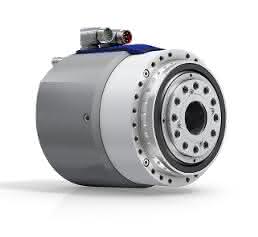
Galaxie is scientifically proven and recognized on the market as an independent and fundamentally superior type of gearbox. The decisive features - dynamized individual thrust teeth instead of rigid gears, full-surface multi-tooth meshing with hydrodynamic contact and mathematically exact synchronization as well as a segmented outer ring as a bearing - mean that the Galaxie gearbox kinematics are superior to known planetary, cycloidal, eccentric and tension shaft gearboxes in all important technical disciplines in relation to the market standard. The gearbox kinematics guarantee top performance in terms of backlash-free operation, synchronization, rigidity, torque density and overload protection without having to "play off" these features against each other.
The decisive requirement for Hekuma from an application perspective was to guarantee outstanding and permanently consistent positioning accuracy. The GalaxieD fulfills this performance feature thanks to its high torsional rigidity and torsional backlash reduced to less than one angular minute. The single thrust tooth kinematics mean that almost all individual teeth are involved in tooth engagement at the same time - and therefore in torque transmission and rigidity formation. In addition, the tooth flanks of the individual teeth and the ring gear are designed as a logarithmic spiral for the first time, which means that contact in multi-tooth meshing is no longer linear as in gearboxes with gearwheels, but instead occurs as surface contact with Galaxie - with a higher contact ratio. This ensures a very high level of rigidity, even with alternating loads in the zero passage.
The second aspect of positioning accuracy, as required by Hekuma, concerns torsional backlash. "In principle, it would have been possible to design the Galaxie D as a zero backlash variant," says Alexander Kappes, looking back. "However, we then opted for a reduced backlash of less than one minute of angle. Together with the torsional rigidity, it optimally reflects our accuracy requirements and at the same time makes it possible to absorb any locking forces that occur during positioning." His colleague Reinhard Steinhoff adds: "As the transfer systems are designed for years of continuous operation, it is particularly important that the torsional backlash remains constant once it has been set."
This is ensured by the Galaxie D's design principle, as a hydrodynamic lubricating film with a large, stable pressure cushion builds up when the polygon and individual teeth mesh even at low speeds. This reduces wear in the gearing to a minimum - as microscope images of loaded contact areas on individual teeth after endurance tests and high practical loads on the gears prove. Furthermore, as the fit between the round tooth bodies and the tooth carrier bores does not wear measurably, once a backlash has been set, it remains absolutely constant over the service life of Galaxie - even with the zero backlash variant.
Designed for maintenance-free use
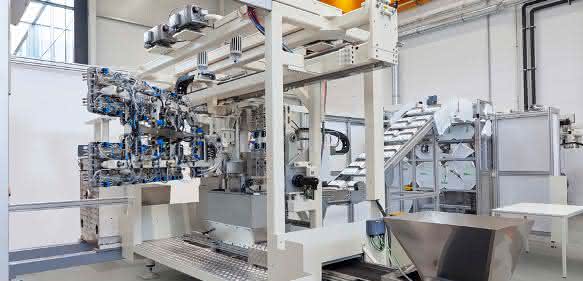
The kinematic principle of the Galaxie D promises long-term service and maintenance-free use. The logarithmic spiral tooth form results in mathematically exact synchronization. In addition, the constant pressure distribution during meshing and the hydrodynamic lubrication mean that there is no risk of abrasion-induced wear particles or contamination of the lubricating substances in the gearbox. In addition, the lubricating oil is selected and filled according to the installation position of the Galaxie D. "This prevents parts of the kinematics from running dry, as is the case with an already installed tension shaft gearbox, as well as the need to refill the servo drive with lubricant during machine operation," says Alexander Kappes.
In order to convert the mechanical precision advantages into maximum positioning accuracy in terms of control technology, the SEM90 rotary motor feedback system from Sick Stegmann is being used for the first time in the Galaxie D used at Hekuma. The holistic scanning multiturn system enables high-resolution position control of the servo drive. The multiturn functionality with 4,096 revolutions is realized mechanically. "The encoder does not require a buffer battery, which would have to be replaced at great expense after a corresponding running time," explains Reinhard Steinhoff. In terms of control technology, the system is connected to a Movidrive inverter from SEW Eurodrive via Hiperface. N. Hehn / S. Höhne / as


You might also be interested in
Plagiarius 2024 negative prize
On January 26, 2024, the Plagiarius campaign awarded its dreaded "Plagiarius" negative prize for the 48th time to manufacturers and retailers of particularly brazen counterfeits and fakes.
 read more...
Ivalua honors winners of the Generative AI...
AI-supported "add-ons" for buyers within 48 hours
Ivalua, provider of cloud-based spend management solutions, announced the winners and innovations of the first Generative AI Innovation Cup. The competition took place in December 2023. It was open to all Ivalua partners and employees - more than...
read more...Efaflex celebrates 50 years of high-speed...
The emphasis is on "fast"
Since day one, Efaflex has wanted to use new technologies as early as possible and drive progress in the industry. This year, the family business is celebrating its 50th anniversary under the motto "Fast Forward".
read more...Security of supply even during power outages
In the winter of 2022, Germany was worried about energy shortages. The drugstore retailer dm did not paint any horror scenarios, but nevertheless saw the possibility of controlled, temporary, regional power cuts (brownouts).
read more...Safety technology in mechanical engineering
Modules with new functions
Euchner's product highlights at EMO 2023 include the communication-capable solenoid interlocks.
read more...Transforming the paper industry towards climate neutrality
Together with partners from industry and research, Voith is developing a project for the optimization of energy and material flows in paper production. The aim of the research project is to develop a digital framework that enables effective process...
read more...Up to 95 percent less flue gas thanks to direct extraction
The requirements for occupational safety measures and safety technology are also constantly increasing in welding technology. The Technical Rules for Hazardous Substances (TRGS) stipulate that welding fumes and harmful substances must be extracted...
read more...Competitive advantages with large machines
Whether 3D-printed components for machines and systems, prototypes or aids for design: additive manufacturing is almost indispensable for modern companies in mechanical and plant engineering and automation if they want to play in the premier league.
read more...Transport technology from the modular system
Many transport tasks can be realized with the help of linear technology. Pre-configured solutions are available to simplify the interaction between the linear unit, motor, gearbox and controller. This minimizes the effort required for research and...
read more...